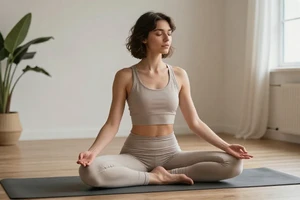
Walking into your first yoga class can feel like entering a foreign land. The quiet room, the unfamiliar poses, the instructor’s gentle reminders to “just breathe”—it’s a recipe for subtle panic, not peace. If your mind races while everyone else seems effortlessly zen, you’re not doing it wrong. You’re simply human. The secret to finding calm on the mat often lies not in forcing your body into a pretzel, but in relearning the most basic thing you do: breathe.
Anxiety in a new yoga setting is a common, physiological response. Your nervous system is on alert, which can make the instructed breathing patterns feel confusing or even restrictive. The good news is that breath is your built-in anchor. With a few expert-backed adjustments, you can transform your breath from a source of stress into your most reliable tool for calm.
Why Does Yoga Breathing Make Me Anxious?
Before we adjust the technique, it helps to understand the reaction. In a state of anxiety, your sympathetic nervous system (the “fight-or-flight” response) is activated. Your breath becomes shallow and quick, centered high in the chest. Many beginner yoga instructions, however, ask you to take deep, slow, controlled breaths—an action governed by the parasympathetic nervous system (the “rest-and-digest” response).
When your system is in fight-or-flight, being told to “deeply relax” can create internal conflict, heightening the sense of struggle.
You might feel like you’re not getting enough air, become hyper-aware of your heartbeat, or feel lightheaded. This isn’t failure; it’s feedback. It means the current approach needs a gentler on-ramp.
Foundational Principle: Let Go of “Perfect” Breath
The first and most important adjustment is mental. Release the idea that there is a “right” breath you must perform. The goal is not to achieve a textbook diaphragmatic breath immediately, but to use your awareness to gently guide your nervous system toward safety.
Think of your breath as a companion, not a taskmaster. If instructed to breathe in for a count of four and out for six, but that feels impossible today, shorten the count. Breathe in for two, out for three. The ratio is what matters—a slightly longer exhale—not the specific numbers. Your version is the correct one.
Four Practical Breathing Adjustments to Try
1. Start with Observing, Not Changing
Instead of launching straight into a controlled pattern, spend your first minute on the mat simply noticing. Place one hand on your chest and one on your belly. Feel the natural rhythm. Is it jagged or smooth? Deep or shallow? There’s no judgment here, only curiosity. This act of neutral observation begins to engage the prefrontal cortex, the part of your brain that can regulate emotion, and starts to dial down the alarm signals.
2. Prioritize the Exhale
When anxiety is present, the exhale is your best friend. A long, slow exhale is the most direct signal to your nervous system that it’s safe to relax. It stimulates the vagus nerve, triggering a calming reflex.
- In your next practice, don’t worry about the inhale. Just let it come in naturally.
- Focus all your attention on gently lengthening the exhale. Imagine sighing out through a straw, or letting the air leave like a slow leak from a balloon.
- Even a few breaths with this focus can shift your physiological state.
3. Introduce a Tactile Anchor
Anxious minds tend to wander to past regrets or future worries. A physical anchor brings your attention back to the present, safe moment. This is where simple breath cues work wonders.
Try this: As you inhale, silently think “in.” As you exhale, think “out.” Or use “rise” and “fall” with your belly. The words are mundane, and that’s the point. They give your thinking brain a simple, repetitive job, preventing it from spinning into anxiety narratives.
Your anchor word is a lifeline back to the present. Use it without pressure, as often as you need.
4. Match Breath to Movement (Very Gently)
Vinyasa cues like “inhale to upward dog” can feel overwhelming. Simplify. In a basic cat-cow stretch, let the movement follow a comfortable breath, not the other way around. Move into cow pose on whatever feels like an easy inhale. Round into cat on a natural exhale. Let the breath lead the pace. This builds the mind-body connection without the strain of synchronization.
What to Do When Overwhelm Strikes Mid-Class
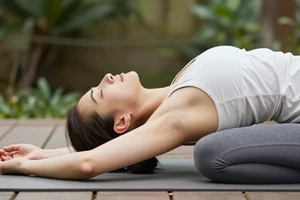
Even with preparation, a wave of anxiety can surface. Have a plan. Your number one option is always to come into a resting pose like Child’s Pose or simply lie on your back. This is not quitting; it’s skilled self-regulation.
Once there, return to observation. Feel the weight of your body on the floor or mat. Listen to the ambient sounds. Then, employ the “exhale priority” adjustment. Five breaths here, focusing only on letting the air out slowly, can reset your entire practice. The room will continue without you, and you can rejoin when you feel ready.
Building a Sustainable Relationship with Your Breath
The aim is to cultivate a friendly, responsive relationship with your breath, both on and off the mat. This takes the pressure off any single practice. Some days your breath will feel full and easy. Other days it may feel tight. Both are okay. The practice is in showing up and meeting your breath where it is, not where you think it should be.
Over time, these small adjustments rewire the association. The cue to “breathe” becomes an invitation to check in, not a demand to perform. Your mat becomes a space where you practice responding to internal signals with kindness—a skill that extends far beyond the yoga studio walls.