You’ve found your flow, you’re breathing deeply, and you’re moving with intention. Yet, a subtle ache persists in your knee after Warrior II, or your downward dog never feels quite right. Before you question your form or flexibility, consider an often-overlooked factor: the surface beneath your feet. Your yoga mat is more than just padding; it’s the foundation of your practice. When it’s not supporting you properly, it can quietly undermine your alignment, turning a practice meant to heal into one that strains.
Alignment in yoga isn’t about achieving a perfect picture. It’s about stacking your bones efficiently to create stable, safe, and sustainable poses. This protects your joints, allows muscles to work optimally, and deepens the mind-body connection. A mat that’s too slick, too soft, or simply worn out can disrupt this delicate balance, forcing your body to compensate in ways that lead to discomfort or injury over time.
1. Your Feet or Hands Slip During Weight-Bearing Poses
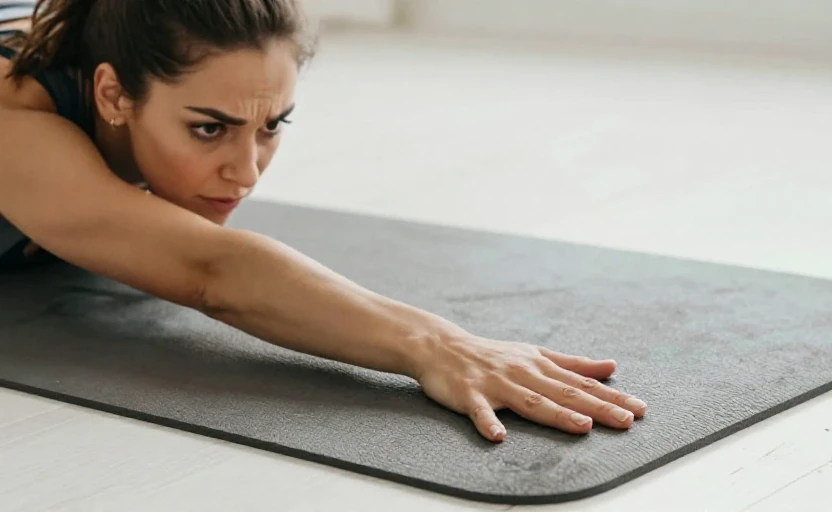
This is the most obvious and potentially dangerous sign. If you’re constantly micro-adjusting your hands in plank or feeling your front foot creep forward in a lunge, your mat lacks the necessary grip. Slipping isn’t just frustrating; it forces your body into a reactive state. To prevent a slide, you’ll unconsciously tense muscles you should be engaging smoothly, particularly in the shoulders, wrists, and core.
A mat that forces you to grip with your toes or fingers is teaching your body tension, not stability.
This compromised stability can pull joints out of their natural track. In a pose like downward-facing dog, slipping hands can dump weight into the shoulders and wrists. A sliding foot in Warrior I can torque the knee. The result isn’t strength—it’s strain. If you’re wiping your mat and your hands frequently, or if you find yourself avoiding poses where you feel unstable, your mat’s surface is likely the culprit.
2. Your Joints Feel Uncomfortable Pressure on Hard Floors
While a little firmness can help you feel grounded, a mat that provides insufficient cushion is a direct threat to alignment. When knees, hips, or the tailbone press into an unforgiving surface, the body’s natural response is to avoid the pain. You’ll subtly shift your weight, misaligning your posture to find relief.
For instance, in low lunge or pigeon pose, a hard mat can make it nearly impossible to settle your hip toward the floor without sharp discomfort. Instead of allowing the hip to open, you’ll likely hike it up or twist the torso, throwing the entire pose out of balance. In seated poses, discomfort in the sit bones can cause you to round the spine, collapsing the chest and compromising spinal integrity. A good mat should offer enough cushion to allow your joints to relax into proper position, not fight against it.
3. The Mat Deforms or Wobbles Under Your Weight
This sign is subtler but equally problematic. If your mat compresses unevenly, wrinkles under your feet, or has permanent indentations from being stored rolled, it creates an unstable, uneven foundation. Imagine building a house on shifting sand; your body faces a similar challenge. To stay upright, your ankles, knees, and hips must engage in constant, tiny corrections.
This instability is particularly telling in balancing poses like Tree Pose or Warrior III. If the mat feels wobbly or soft, you’ll over-grip with your standing foot and tense your entire leg, defeating the pose’s purpose of finding steady, relaxed focus. An uneven surface can also cause subtle pelvic tilting, which radiates up the spine. A mat should provide a consistent, supportive plane. If it feels like you’re practicing on a soft mattress or a lumpy blanket, it’s actively working against your alignment.
Choosing a Mat That Supports Your Practice
Recognizing the signs is the first step. The next is selecting a mat that acts as a true partner in your practice. Focus on these three core characteristics, not just color or brand.
Grip is Paramount: Look for a textured surface or a material known for its traction, especially when damp. Your mat should hold you securely in a sweaty palm or a firm foot placement.
Cushion with Stability: Seek a balance. The mat should cushion joints without feeling mushy. A common recommendation is a thickness around 4-5mm, which offers protection while still allowing you to feel a solid connection to the floor for balance.
Lay Flat and Stay Flat: A quality mat should unroll and lie completely flat without curling at the edges. It should recover its shape and not retain deep creases from storage, ensuring a uniform surface.
Remember, the "best" mat is highly personal. A heavier, sticky PVC mat might be ideal for a hot yoga practitioner needing maximum grip, while a natural rubber mat offers great traction and cushion for most styles. A travel mat might be thin and light, but if it causes joint pressure on your home hardwood floor, it’s not serving your alignment. Listen to what your body tells you during practice—it’s the most reliable reviewer.
Caring for Your Foundation
A good mat is an investment in your practice. Protect it with regular, gentle cleaning using mat-specific sprays or a mild soap-and-water solution. This removes the oily residue from skin that destroys grip over time. Always let it air dry fully before rolling it up. Store it flat or rolled with the top surface facing out to help maintain its shape and flatness.
Your yoga practice is a conversation between your mind, body, and breath. Don’t let a poor foundation distort that dialogue. By ensuring your mat provides a stable, supportive, and grippy surface, you free your body to find its true alignment—building strength, flexibility, and peace from the ground up.