You’ve found your mat, learned the poses, and settled into the rhythm of your practice. The physical alignment feels good, but something in the flow still feels slightly off. Often, that subtle disconnect isn’t in the muscles or bones, but in the breath. Pranayama, the yogic art of breath control, is the silent conductor of our practice, yet its cues can be easy to miss.
Unlike a wobbly balance pose or a tight hamstring, signs that your breathing technique needs a tune-up are frequently internal and nuanced. Learning to recognize these quiet signals can transform your practice from a series of shapes into a truly integrated, mindful experience.
Are You Holding Your Breath Without Realizing It?
This is perhaps the most common, and most overlooked, sign. It doesn’t look like a dramatic gasp for air. Instead, it manifests as a brief, unconscious pause—a micromoment of suspension—usually during a challenging transition or while holding a pose.
You might be flowing through a vinyasa and, as you lift into Chaturanga, your breath simply stops for a second. Or, in a long hold like Warrior II, you’ll inhale, but then the exhale doesn’t come smoothly; it’s stalled by effort. This breath-holding is often a stress response, a subtle bracing against difficulty.
Your breath should move like ocean waves—constant, rhythmic, and without abrupt halts.
To check in, pause mid-practice and ask yourself: Is my breath continuous? Can I feel a clear, unbroken cycle of inhalation and exhalation, even in the tough parts? The goal isn’t forced, heavy breathing, but a steady, conscious stream that lubricates the movement of both body and mind.
Does Your Breath Feel Shallow or Stuck High in the Chest?
Another subtle indicator is the location and quality of the breath. In efficient yoga breathing, you should feel a three-dimensional expansion: the belly softens and expands on the inhale, the rib cage widens to the sides and back, and finally, the upper chest lifts slightly.
If your technique is off, you might notice the breath is “clavicular”—stuck high in the collarbones. The shoulders might hike up toward the ears with each inhale, and the breath feels quick and shallow. This pattern is associated with anxiety and doesn’t provide the full oxygen exchange or calming nervous system effect that deep diaphragmatic breathing offers.
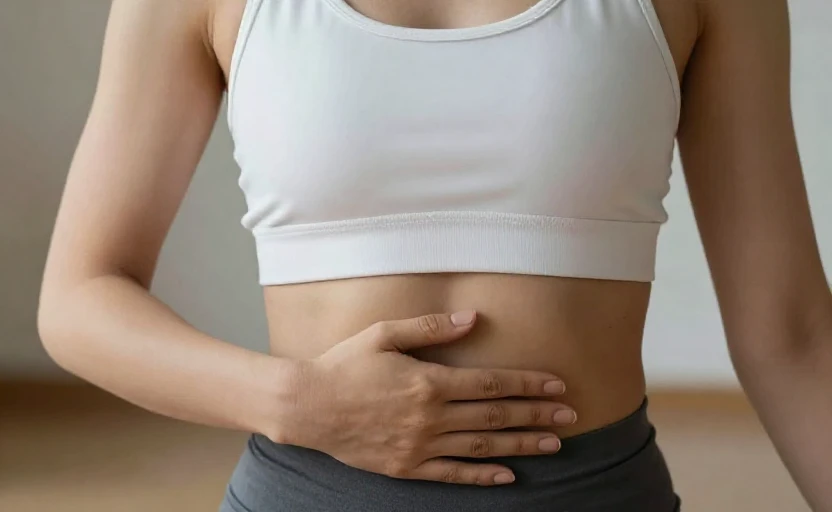
Place one hand on your belly and the other on your chest. As you inhale naturally, which hand moves first? In a balanced breath, the lower hand should move outward first, followed by the upper hand. If only the top hand is moving, your breath isn’t tapping into the diaphragm’s full capacity. This doesn’t mean forcing the belly out, but rather allowing it to relax and receive the breath.
How to Gently Reset Your Breath
Noticing these signs is the first and most important step. The adjustment is rarely about adding more force or complexity. It’s about simplification and awareness.
Return to a Foundational Ratio
When breath becomes erratic, simplify. A 1:1 breathing ratio—making your inhale and exhale the same length—is a profoundly stabilizing tool. You don’t need to count long seconds. Just use your internal sense of rhythm. Inhale for a comfortable count, then match that length exactly on the exhale. This equal pacing can immediately smooth out pauses and create a predictable, calming rhythm.
Practice Breath Awareness Off the Mat
The breath patterns we use on the mat are often the ones we carry through the day. Building awareness during quiet moments can retrain the system. Try this for five minutes:
- Sit or lie comfortably.
- Simply observe the natural breath. Don’t try to change it.
- Notice its path: Can you feel air at the nostrils? Does the chest or belly move?
- Gently guide your awareness to any areas that feel tight or still.
This non-judgmental observation, without the added challenge of a physical pose, builds the neural pathways for better breath awareness during your practice.
Let Movement Follow Breath, Not the Other Way Around
In a sun salutation, we often learn “inhale to upward dog, exhale to downward dog.” If you’re struggling, flip the script. Let the breath lead. Begin the inhale a half-second before you initiate the movement into upward dog. Let the movement be an expression of the breath already in motion. This subtle shift prioritizes the breath as the driver, which naturally eliminates holding and creates a more fluid, graceful practice.
The Mind-Body Connection of Refined Breath
Adjusting your breathing technique does more than improve physical performance. The breath is the direct dial to the autonomic nervous system. Shallow, held breath signals stress (activating the sympathetic “fight-or-flight” response). A smooth, diaphragmatic breath signals safety (engaging the parasympathetic “rest-and-digest” state).
When you correct those subtle signs, you’re not just doing yoga more correctly; you’re teaching your nervous system resilience. The steadiness you cultivate on the mat—that unbroken wave of breath—becomes an internal resource you can access during any of life’s challenging holds and transitions.
So the next time you unroll your mat, before you move into your first pose, take a few moments to listen. Tune into the quiet rhythm of your own breathing. Is it continuous? Is it full? Let that inquiry, not perfection, guide your practice. The most profound adjustments are often the quietest ones.