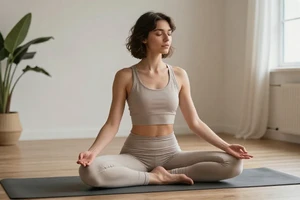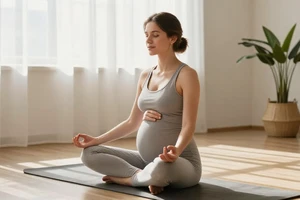
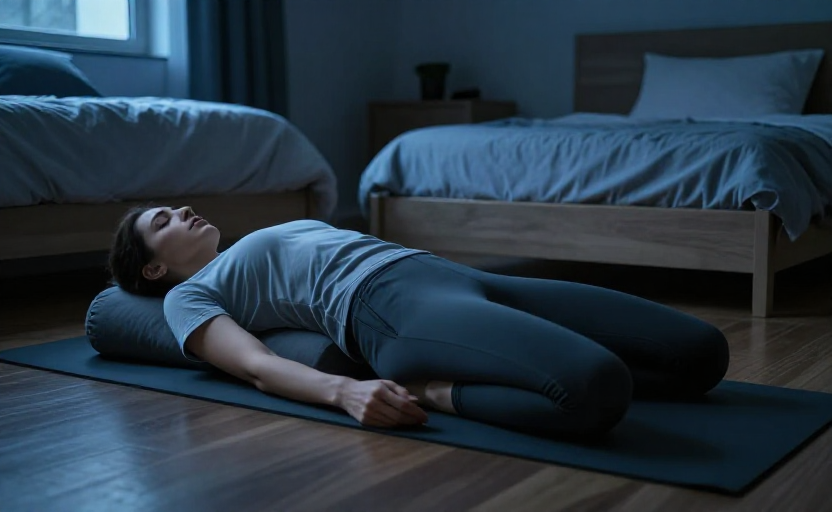
You roll out your mat at night to unwind. The candles are lit, the playlist is mellow, and the intention is clear: you want to wash off the day’s stress and drift into a deep, restorative sleep. For many, evening yoga is a perfect prelude to rest. But for others, a quiet problem emerges. You feel tired, yet you lie awake, your mind humming or your body strangely alert.
The disconnect between a relaxing routine and actual relaxation can be confusing. If you’ve recently added a nighttime practice and your sleep quality has dipped, the culprit might not be the yoga itself, but two very specific, subtle details within your sequence. These are not loud red flags; they are quiet saboteurs that live in the pacing and the temperature of your practice. Here’s what to look for.
1. Your Practice Has a “Highway Exit” Problem: The Pace Shift Is Too Abrupt
This is the most common and most overlooked sign. You finish a vigorous flow—maybe some sun salutations, a few warrior poses, or a core-strengthening sequence—and then you collapse into Savasana (Corpse Pose). Your heart is still pumping, your nervous system is in a sympathetic (fight-or-flight) state, and your body has just been told to go from 60 miles an hour to zero. That jolting transition is a problem.
Our nervous systems need a gradual off-ramp. When you drop straight into stillness after a moderately stimulating practice, your body struggles to engage the parasympathetic nervous system (the “rest and digest” mode). Instead of calming down, you might experience:
- A racing heart that won’t settle for 20 minutes.
- A buzzing sensation in your legs or feet.
- An inability to shut off mental chatter (the body is still sending “alert” signals to the brain).
The subtle sign to watch for
You feel physically exhausted but mentally wired when you get into bed. This is a classic hallmark of a nervous system that never received a proper deceleration sequence. The practice itself might be beautiful, but the final act—the cool-down—is the most critical piece of the puzzle.
What to do about it
Think of your cool-down as a gentle, descending staircase, not an elevator drop. After your main sequence, dedicate at least 5 to 7 minutes to floor-based, restorative poses that signal safety and surrender. Try:
- Legs-Up-the-Wall (Viparita Karani): This inversion calms the nervous system and lowers heart rate without requiring effort.
- Reclined Butterfly (Supta Baddha Konasana): Supported on bolsters or pillows, this pose opens the hips while keeping the spine neutral and still.
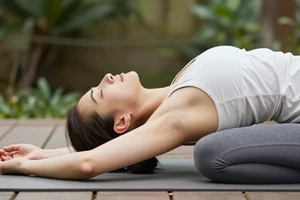
- Supported Child’s Pose (Balasana): Place a cushion under your torso and turn your head to one side. Stay for 10 slow breaths.
These poses should feel like sinking, not stretching. The goal is not to deepen a muscle stretch, but to signal to your brain that it is safe to shut down.
2. Your Room Is Too Warm (Or Your Sequence Is Too Heating)
Even a gentle practice can be surprisingly thermogenic. If you practice in a room that’s already warm from heating, or if your sequence involves several standing poses that build internal heat, your core temperature can rise. This is a classic sleep disruptor.
Your body needs a drop in core temperature to initiate and maintain sleep. The natural process of falling asleep involves a slight cooling of the body. If your yoga session—even a “gentle” vinyasa—cranks your internal thermostat up, you may feel drowsy at first (the post-exercise crash) but then experience a secondary wakefulness as your body struggles to cool down.
The subtle sign to watch for
You wake up suddenly between 2:00 and 3:00 AM, or you feel hot and restless during the first hour of sleep. You might also notice you’re sweating slightly or that your pillow feels warm. This is not a sign of poor bedding; it’s a sign your body’s cooldown cycle was interrupted.
What to do about it
Adjust both the environment and the sequence:
- Lower the room temperature: Aim for 65–68°F (18–20°C) during your practice and for sleep. If your room is already warm, open a window or use a fan during Savasana.
- Avoid “power” styles: Skip Hot Yoga, Bikram, or vigorous Power Vinyasa within 90 minutes of bedtime. Even a “Flow” class can be too heating if you push yourself.
- Swap for cooling poses: Favor supine (lying down) poses over standing ones. Consider a short, seated sequence with a focus on exhale-based breathing (longer exhales trigger the relaxation response). Poses like Seated Forward Fold (Paschimottanasana) or Half Fish (Ardha Matsyendrasana) are gentle and cooling.
A quick check: Take your pulse after your cool-down. If it’s more than 10 beats above your resting rate, your practice is still too stimulating. Add more floor time.
Putting It All Together: A Simple Nighttime Check
Your evening yoga should feel like a soft landing, not a warm-up for an active day. If you suspect your routine is backfiring, make one small change at a time. Try adding a 10-minute cool-down with legs-up-the-wall and a slightly cooler room. Observe your sleep for three nights.
Often, the most effective evening yoga is the shortest, quietest, and least intense. You don’t need to sweat to make progress. You need to settle. When you prioritize that transition—the off-ramp—your sleep will thank you.
Pay attention to those two subtle signs: an abrupt pace shift and a body that’s too warm. They are small details, but they have an outsized impact on whether your mat becomes a gateway to rest, or a barrier to it.