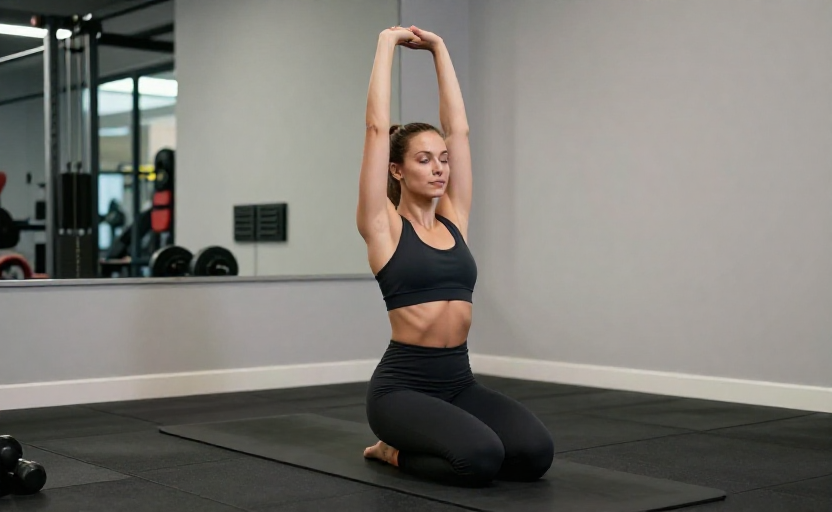
You walk into the gym, scan the room, and suddenly your warm-up feels rushed. The stretches you planned in the parking lot get cut short because someone is waiting for the mat. Later, after your last set, you slip out the door before you’ve even thought about a cool-down. This is gym anxiety at work—and it has a direct, often overlooked effect on your pre- and post-workout routine.
When your nervous system is already buzzing from social unease, your body’s natural inclination is to shorten the transition phases. You skip the slow, deliberate movements that prepare your joints and the gentle stretches that help your muscles recover. The result? You increase your risk of injury and miss the recovery benefits that make your workouts sustainable. Let’s break down why this happens and how to take back control.
Why Gym Anxiety Hijacks Your Warm-Up and Cool-Down
Anxiety activates your sympathetic nervous system—the “fight or flight” response. In the gym, that might show up as a racing heart, sweaty palms, or a feeling that you’re being watched. Your brain prioritizes getting through the workout quickly over moving with intention. The warm-up, which should take 5–10 minutes, gets compressed into 90 seconds of half-hearted arm circles. The cool-down becomes an afterthought or disappears entirely because you’re eager to leave the environment that feels uncomfortable.
This isn’t about a lack of discipline. It’s a protective reflex that needs to be gently overridden by habit and strategy.
Fix #1: Build a Non-Negotiable Warm-Up Script
Design a warm-up sequence so simple you could do it without thinking. Write it down. Rehearse it at home. The goal is to remove decision-making once you’re in the gym. For example:
- 30 seconds of deep breathing while standing still (to settle the nervous system)
- 10 cat-cow stretches (mobility for spine and shoulders)
- 10 bodyweight squats (hip and knee prep)
- 20 seconds each arm and leg: leg swings, arm circles
When your warm-up is scripted, anxiety has less room to rush you. You know exactly what comes next. Repeat it every session until it feels automatic.
Fix #2: Use the “Finish Line” as Your Cool-Down Anchor
Instead of treating the cool-down as an optional extra, attach it to a clear moment: the second you rack your last weight. Have a timer ready on your phone. Set it for 3 minutes. During those 3 minutes, you are not allowed to leave the floor. Stretch the muscles you just worked—quads, hamstrings, chest, back—holding each for at least 30 seconds. This anchors the cool-down to a visible, timed commitment, not a vague intention.
“The cool-down is not bonus time. It is part of the workout. Treat it as mandatory as the last rep.”
Fix #3: Choose a Corner, Not the Center
Gym anxiety often spikes when you feel exposed. If you stretch in the middle of an open space, you might feel watched. Pick a corner, a wall, or a spot behind a pillar where you have less foot traffic. Set up your mat there. Keep your water bottle and phone nearby. This physical anchor reduces the “onstage” feeling and makes it easier to hold your space for the full warm-up and cool-down. Over time, you can gradually move closer to busier areas—but start where you feel safe.
Fix #4: Reframe the Purpose of the First 10 Minutes
Instead of seeing the warm-up as something you have to get through before the “real” workout, see it as a transition from the outside world into your body. The first 5 minutes of deep breathing, gentle movement, and joint circles are a chance to check in mentally. If you feel anxious, that’s fine—you are already doing something about it by moving slowly. Reframing the warm-up as a grounding ritual shifts your focus from “I need to finish this fast” to “I need to arrive fully.”
The warm-up and cool-down are the bookends of every safe, effective workout. When gym anxiety cuts them short, it undermines your progress and comfort. Start with one fix. Try the scripted warm-up for a week. Notice how your body feels. Then add the 3-minute cool-down anchor. You don’t have to overhaul everything overnight—just take back those first and last 5 minutes.