You finally found a routine you can stick with. No gym membership, no commute, no awkward waiting for equipment. Bodyweight workouts feel honest and accessible. So why, after a few solid weeks, are your legs telling a different story? It is not in your head. There is a specific reason bodyweight training can leave you more sore when you do it too often — and, more importantly, there are three simple drinks that genuinely help your muscles recover.
The Real Reason Frequent Bodyweight Workouts Increase Soreness
Most people assume that if you are not lifting heavy dumbbells, the soreness should stay mild. That assumption misses an important point about how your muscles work. When you repeat bodyweight exercises like squats, push-ups, or lunges at high frequency — five or six days a week without enough rest — you are not giving your muscle fibers time to repair the microtears that happen during exercise. Those microtears are the actual cause of delayed onset muscle soreness, or DOMS.
Here is the catch: many bodyweight movements rely on eccentric contractions. That is the part of the motion where your muscle lengthens under tension. Think of lowering into a push-up or descending into a squat. Eccentric contractions create more muscle damage than concentric (shortening) contractions. And because bodyweight exercises do not need external weight, people tend to do more repetitions and more sets than they would with a barbell. That means more eccentric loading, more microtears, and more cumulative soreness over consecutive days.
Training a muscle group every day without a break — common in bodyweight circuits — prevents the inflammation cycle from resolving. Soreness stacks on top of existing soreness. Your muscles become chronically tight, performance dips, and you may feel like you are moving through mud. The fix is not to stop training altogether. It is to manage frequency and give your body the nutrients it needs to repair.
How to Keep Training Without Overdoing It
You do not need to abandon your bodyweight workouts. You just need to respect recovery. Here are a few practical adjustments:
- Alternate intensity. Have hard days and easy days. A hard day could include maximal push-ups or deep squats. An easy day might feature slow mobility work, light stretching, or half the usual reps.
- Include rest days. At least two full days each week where you do no structured bodyweight work. Your muscles repair and strengthen during rest, not during the workout itself.
- Listen to joint pain. Soreness in muscle bellies is normal. Sharp or persistent joint pain is not. Back off and assess your form.
- Stay hydrated. Your muscle cells need water to flush out metabolic waste products that accumulate during exercise.
These strategies help, but they pair best with targeted nutrition. That is where the three drinks come in.
3 Drinks That Support Muscle Recovery After Bodyweight Training
These drinks are not magic potions. They are whole-food based drinks that provide specific compounds your muscles need to reduce soreness and speed repair. Drink them after your workouts or during rest days.
Tart Cherry Juice
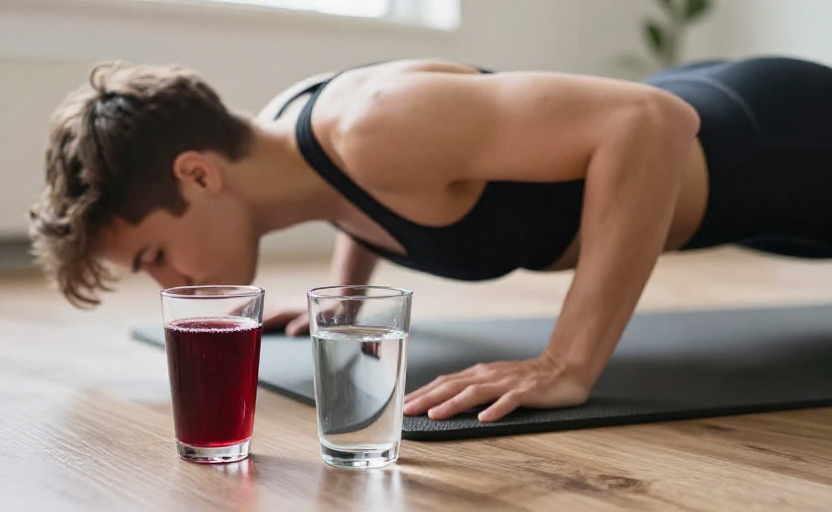
Tart cherry juice is one of the most researched recovery drinks available. It contains high levels of anthocyanins, which are antioxidants that reduce inflammation and oxidative stress caused by exercise. A 2016 study in the Journal of the International Society of Sports Nutrition found that tart cherry juice significantly reduced markers of muscle damage and soreness after intense exercise. It also helped participants regain strength faster.
Drink about eight to twelve ounces after your workout. Look for unsweetened varieties. The tartness is part of the benefit, so do not dilute it with sugar.
Watermelon Juice (with Rind)
Watermelon contains L-citrulline, an amino acid that improves blood flow and reduces muscle soreness. The rind actually has a higher concentration of citrulline than the flesh. You can buy watermelon juice that includes rind extract, or make your own by blending chunks of watermelon with a piece of the rind (washed well) and strain it.
Research published in the Journal of Agricultural and Food Chemistry showed that citrulline supplementation reduced muscle soreness and heart rate recovery time. Watermelon juice is a refreshing, hydrating way to get that benefit without taking a supplement.
Chocolate Milk
This one may surprise you, but chocolate milk has earned a reputation among endurance and strength athletes for good reason. It provides a natural ratio of carbohydrates to protein — roughly four to one — which is ideal for replenishing glycogen stores and providing amino acids for muscle repair. The protein in milk contains leucine, the key amino acid that triggers muscle protein synthesis.
A 2019 review in Nutrients concluded that chocolate milk is a practical, affordable recovery drink that performs comparably to commercial recovery beverages. Stick to low-sugar chocolate milk or make your own with cocoa powder and a touch of honey.
Tip: Drink these within 30 to 60 minutes after your workout for the best recovery window. That timing aligns with when your muscles are most receptive to nutrients.
Putting It Together: Frequency, Recovery, and the Right Drinks
Bodyweight workouts are excellent for building functional strength, endurance, and mobility — but they are surprisingly easy to overtrain because you lack the weight plate cues that tell you when intensity should drop. Pay attention to how your body feels each day. If you are consistently sore beyond the first two days after a workout, dial the frequency back.
Use the three drinks as tools, not crutches. They complement a sensible training schedule. If you find yourself reaching for tart cherry juice every day but still training sore, the drink is not the problem — the training frequency is. Fix the frequency first, then support it with nutrition.