You’ve been consistent with your workouts. You’re showing up, putting in the effort, and feeling that post-sweat satisfaction. But lately, your lower back has been talking back—and not in a good way. Instead of feeling stronger, you’re noticing a dull ache that lingers after exercise, or a sharp twinge when you bend over to tie your shoes.
If this sounds familiar, you might be dealing with a common but often overlooked training habit: working out your back muscles without properly engaging your core. It’s a subtle shift, but it can turn even the best fitness routine into a source of chronic lower back pain.
What’s Really Happening When Your Lower Back Hurts After Workouts
Your spine is designed to move with a team of muscles. When you perform exercises like rows, lat pulldowns, deadlifts, or even push-ups, your back muscles—especially the erector spinae and latissimus dorsi—can take on more load than they’re meant to handle alone. That’s where your core comes in.
The core isn’t just your six-pack; it’s a cylinder of muscles that wraps around your torso, including the transverse abdominis, obliques, and multifidus. When you don’t intentionally brace these muscles during a workout, your lower back ends up acting as the primary stabilizer. Over time, this leads to overuse, muscle spasms, and joint irritation.
A core that goes quiet under load is a lower back that shouts for help.
The Hidden Habit: Losing Intra-Abdominal Pressure
One of the most effective ways to protect your spine during exercise is by maintaining intra-abdominal pressure. This is the internal pressure created when you take a deep breath into your belly, tighten your core muscles, and hold that brace while you lift, push, or pull. It stabilizes your spine from the inside out.
Here’s where the bad habit sneaks in: as you get tired, or when you rush through a workout, you forget to reset that brace between reps. Your breathing becomes shallow, your core goes slack, and your lower back stiffens as it tries to compensate. This is the exact moment when pain can begin.
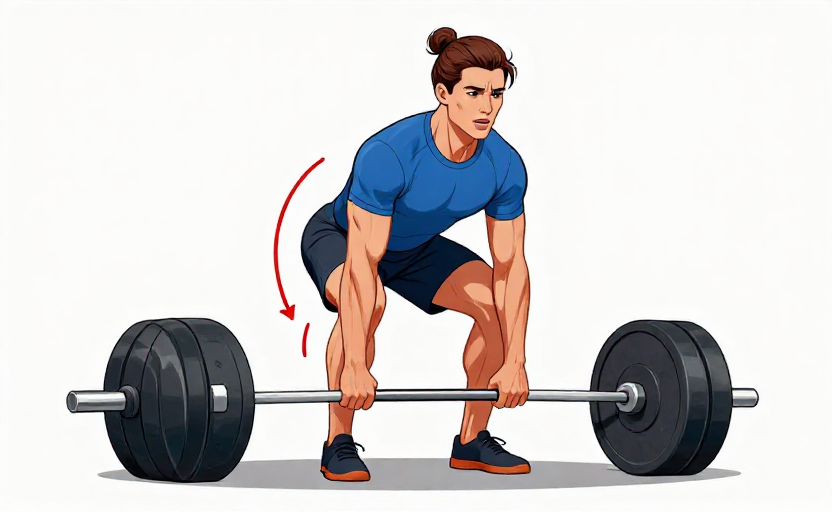
- You lose tension at the top of a deadlift — your lower back rounds, and the load shifts to your spine.
- You rush through rows without bracing — your pelvis tilts forward, and the lumbar spine hyperextends.
- You let your abs go soft during a squat — your lower back takes the brunt of the weight on the way up.
How to Fix It Without Stopping Your Workouts
You don’t need to quit training or switch to “gentle” exercises. You just need to retrain one skill: bracing your core intentionally before every demanding movement. This is a mechanical fix, not a passive “stretch more” recommendation.
1. Master the Deep Belly Breath
Before you lift a weight, take a slow, full breath that expands your rib cage sideways and your belly forward. Don’t let your shoulders rise. Then, tighten your entire torso like someone is about to punch you in the stomach. Hold that tension as you move.
2. Use Braced Breathing in Every Set
Exhale at the hardest part of the movement (for example, as you push the weight up during a squat), but keep your core tight even as you exhale. Practice this with light weight first. It feels unnatural at first, but it becomes automatic within a few sessions.
3. Incorporate Core Stability Moves Between Sets
Use your rest periods to activate the muscles that help you brace. Do a 10-second plank hold, a dead bug, or a farmer’s carry with a light kettlebell. These moves wake up the deep stabilizers without adding fatigue.
4. Lower the Load Until You Own the Brace
If your lower back is already sore, drop the weight on your main lifts by 20% for a week. Focus entirely on maintaining a steady core brace through every rep. Pain often disappears once the stabilizers are working correctly—the load isn’t the problem; the lack of support is.
Signs You Are Overusing Your Lower Back Right Now
- Your lower back feels tight or “locked up” immediately after finishing a set of rows or deadlifts, even if other muscles feel fresh.
- You notice a forward-leaning posture in the hours after a workout, with your hips pushed forward and your lower back arched.
- You have to arch your back to complete a push-up or a press because your core doesn’t hold you in a straight line.
- You feel pain when you sneeze or cough—a classic sign of a lower back that has been over-stabilizing without core backup.
When Lower Back Pain Needs More Than Bracing
While poor core engagement is one of the most common workout-related causes, it isn’t the only one. If you already have a disc issue, spinal stenosis, or a stress fracture, simply bracing harder might not be enough. In those cases, working with a physical therapist or a knowledgeable coach is critical. But for the majority of active people, learning to turn on your core at the right moment can resolve a stubborn backache that has resisted stretching and foam rolling.
Your workouts are not the enemy. The habit of letting your core go quiet is. With a few focused breaths and a mindset shift, you can keep training hard and let your lower back recover its natural, pain-free role.