Bodyweight training often gets a reputation as “easier” than lifting weights, but anyone who has held a proper plank or grinded through a set of deep squats knows the truth: it is a precise and demanding way to build strength. When the goal is joint health, bodyweight exercises offer an incredible advantage—they allow you to load your joints in a controlled range of motion without the risk of heavy external weights. The question that comes up most often in my coaching sessions is, “How often should I do this to keep my shoulders, hips, and knees healthy, not worn out?”
The short answer is three to four times per week, but the real skill lies in knowing how to structure those sessions so you build resilience without tipping into overuse. Let’s walk through the reasoning behind that frequency and, more importantly, how to apply it to your own routine.
Why Bodyweight Work Is a Win for Your Joints
Joints don’t have their own blood supply—they rely on movement to circulate synovial fluid, which nourishes cartilage and keeps things gliding smoothly. Bodyweight exercises provide a perfect stimulus for this process. When you move a joint through its full range of motion under a moderate load (your own body), you essentially pump nutrients into the cartilage and encourage the production of joint-lubricating fluid.
This is why the frequency of bodyweight training matters more than the intensity. A single hard session once a week can’t create the steady, low-impact circulation your knees and hips need. Regular, moderate exposure is the magic variable. As a general rule, think in terms of “movement snacks” rather than punishment.
The 48-Hour Rule: Allow at least 48 hours between challenging sessions that target the same major muscle groups. This gives your connective tissue time to adapt and repair without becoming irritated.
How to Structure Your Week
For healthy joints, I recommend four core sessions per week, each lasting about 25–35 minutes. Here is a sustainable pattern that respects recovery while building strength:
- Monday: Lower-body focus (squats, walking lunges, glute bridges, calf raises)
- Tuesday: Upper-body push and core (push-ups, planks, side planks, pike push-ups)
- Thursday: Pull and hinge (inverted rows under a table, glute bridges, superman holds, bird-dog)
- Saturday: Full-body flow (a combined circuit of squats, push-ups, rows, and planks at a conversational pace)
This schedule gives you two rest days (Wednesday and Friday) that still allow gentle walking or stretching, plus a day between heavy lower and upper sessions. It hits each joint complex twice per week, which decades of sports-medicine research suggest is ideal for both strength gains and connective-tissue health.
Listen to the Signals, Not the Schedule
No template works for every body. The most important skill you can develop is distinguishing between the burn of muscular fatigue and the ache of joint irritation. Muscular burn fades quickly after you stop an exercise. Joint pain, on the other hand, often feels sharper, more localized (think “inside the knee” rather than “in the thigh muscle”), and may persist for hours or even a day later.
If you feel the latter, dial back. Drop the number of reps, reduce your range of motion slightly, or switch to an easier variation. On bodyweight exercises, regression is not a sign of weakness—it is a sign of wisdom. For example:
- If full push-ups bother your wrists, do them on your fists or use push-up handles.
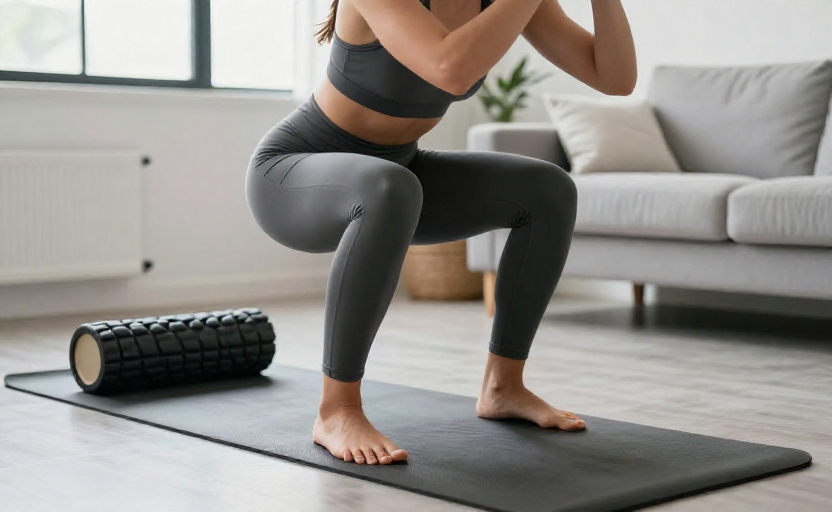
- If deep squats aggravate your knees, start with box squats (sit to a chair and stand) or narrow the stance slightly.
- If planks hurt your lower back, try them from your knees while keeping your glutes squeezed.
Reps, Sets, and the “Two-Rep Rule”
One of the most common coaching corrections I make is telling people to stop sooner. Doing bodyweight exercises to absolute failure—grinding out that last rep where your form crumbles—is a fast track to joint strain. Instead, use the two-rep rule: stop every set two reps short of failure. If you can do twelve good squats, stop at ten. If your push-ups break form at eight, stop at six.
This keeps fatigue away from your joint capsules and emphasizes quality movement patterns. Over a month, that discipline yields far more progress than pushing to failure twice a week and then needing three days to recover.
Warm Up with Purpose
Cold connective tissue is brittle. A five-minute warm-up that moves your joints through their full available range can cut your risk of joint irritation significantly. Before each session, spend one minute each on:
- Cat-cow stretches (spine and shoulders)
- Leg swings (front-to-back and side-to-side for hips)
- Deep bodyweight squats (hold the bottom for a few breaths)
- Arm circles and chest openers
- Ankle rolls and knee circles
This primes the synovial fluid and increases blood flow to the tendons and ligaments. Do not skip it, especially if you are over thirty.
When to Back Off Completely
There are times when the best prescription for joint health is not more bodyweight work—it is deliberate rest. If you notice any of the following for more than a few days, take a week of gentle walking and stretching only, then reassess:
- Persistent clicking or popping that is accompanied by pain (popcorn sounds without pain are normally fine)
- Swelling around a joint after a workout
- A feeling of instability, like a knee or shoulder might “give out”
- Pain that wakes you up at night
In those cases, bodyweight exercises are not the problem—but continuing them unchanged can be. Scale way back and consider working with a physical therapist to identify the root cause.
Putting It All Together
You do not need elaborate equipment or a gym membership to keep your joints healthy. Bodyweight training, done three to four times per week with intelligent volume and careful attention to form, is one of the most effective tools we have. The key is consistency without aggression. Treat your joints like a fine hinge: they need oil (movement), not force.
Start with the weekly template above, apply the two-rep rule, and listen honestly to what your body tells you. Over a few months, you will likely find that your knees feel more stable when you walk stairs, your shoulders move more freely, and your lower back complains less during daily life. That is the quiet, powerful payoff of training smart with your own body weight.