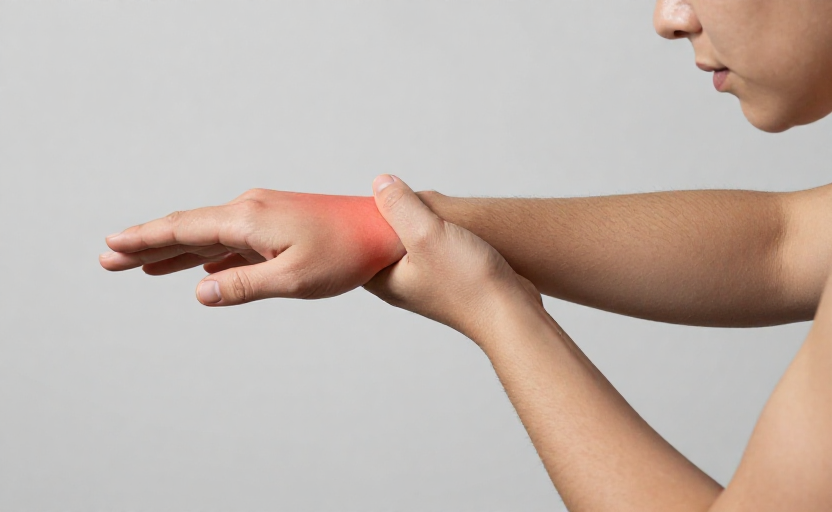
You pushed through the burn in your forearms during that last set of heavy deadlifts or plank holds. A few hours later, a dull ache settled into your wrist. Maybe you ignored it, iced it briefly, and went back for another session the next day. That ache has now turned into a sharp pinch every time you put weight on your palm. This is the classic trajectory of wrist overuse in the gym, and it is your body asking for a serious recalibration of your workout frequency.
Wrist pain is often dismissed as a minor nuisance, but it is one of the most reliable signals that your training volume exceeds what your connective tissue can adapt to. Your wrists are complex joints made of eight small carpal bones, ligaments, and a tight tunnel of tendons. Unlike larger joints such as the hips or knees, the wrist has less soft-tissue padding and a smaller margin for recovery. When you do high-volume push-ups, handstands, kettlebell swings, or barbell work day after day, the load accumulates faster than the tendons and ligaments can repair. The result is a cascade of symptoms that you should never push past.
1. Dull Ache That Lingers After Your Workout Ends
If your wrist feels vaguely sore or throbbing hours after you have finished lifting, that is not a normal pump. A dull ache that persists into the evening or the next morning indicates that the inflammatory response has not settled. Acute soreness during a set is one thing—chronic low-grade pain after the session means the joint environment is irritated. This is the earliest and most subtle signal. Many people misinterpret it as weakness or stiffness that needs to be stretched out, but persistent ache is a volume warning, not a mobility issue.
2. Sharp Pain When Bearing Weight Through the Palm
When you get into a push-up position, a down-dog, or plant your hand for a yoga bind, does a sharp, specific pain shoot through the center of your wrist? That sensation is a red flag for the structures that stabilize the carpal bones under load. Bearing weight through an extended wrist (the wrist bent back at 90 degrees) places enormous compression across the scaphoid and lunate bones and strains the scapholunate ligament. If the pain is reproducible every time you load that position, you are looking at a high likelihood of ligament or bone stress. Rest is not optional here—continuing to push through sharp pain can lead to a ligament tear that requires surgery.
3. Clicking, Popping, or Grinding Without a Recent Fall
Your wrist should move silently. If you feel or hear a click, pop, or grinding sensation every time you rotate your wrist or put pressure through it, and you have not recently fallen on an outstretched hand, this is a sign of crepitus related to overuse. Tendons sliding over inflamed sheaths (tenosynovitis) or a small tear in the triangular fibrocartilage complex (TFCC) on the pinky side of the wrist often produce these audible cues. A little painless clicking is common in some people. The key distinction is whether the noise is paired with discomfort or swelling. If it clicks and hurts, dial back immediately.
4. Pain That Radiates Up the Forearm or Down Into the Thumb
Wrist overuse almost never stays isolated to the joint itself. If you feel a burning or pulling sensation that travels up toward your elbow or down into the base of your thumb, you are most likely dealing with tendinopathy. The muscles that control your fingers and wrist originate in the forearm, and their tendons pass through the wrist in tight sheaths. Repeated gripping, curling, and extending inflames the tendons at their insertion points. This radiating pattern is a classic presentation of De Quervain's tenosynovitis or extensor tendinopathy. The longer you ignore it, the more the tendon degenerates, leading to weakness and potential rupture.
5. Numbness, Tingling, or a Sensation of Swelling
When your wrist feels puffy, tingly, or numb—even if it looks normal—you should be concerned about the median nerve inside the carpal tunnel. Aggressive flexor tendon irritation from overuse can compress the nerve, causing that pins-and-needles feeling, especially in the thumb, index, and middle fingers. This is not necessarily carpal tunnel syndrome, but it is pre-symptomatic compression. Nighttime numbness that wakes you up or tingling during long bike rides or holding a steering wheel indicates that the inflammation is crowding the nerve. Workout frequency must drop until that sensation resolves completely, or it can turn into a chronic neuropathy.
When your wrist hurts, your workout program is wrong for your tissues—you do not push through joint pain like you push through muscle soreness.
What to Do Instead of Just Resting
Rest alone can clear the inflammation in a few days, but it will not fix the root cause: you were training through an environment that did not allow the wrist to recover between sessions. To prevent recurrence, reduce your wrist-loading frequency to no more than two sessions per week that involve any weight-bearing on the hands. Replace high-volume pressing and overhead work with alternative exercises that bypass the wrists, such as push-ups on parallettes or dumbbell presses performed with neutral grip (palms facing each other). If you do yoga or gymnastics, substitute forearm plank holds and use blocks in downward dog until the wrist feels silent again. Ice the aching area for 15 minutes after any aggravating activity, and consider wearing a supportive brace during sleep to prevent sleeping with your wrist flexed, a common cause of compression.
The wrist is a dense, busy joint with modest recovery capacity. The five symptoms above are not signs of a weak mind—they are signs of a worn-out structure. The smartest move is to change your program before the pain changes your anatomy.