If you're in the gym four, five, or six days a week, your shoulders take the brunt of it. Presses, pull-ups, rows, and even your warm-up arm circles all add up. Over time, that constant demand can tighten the capsule around the joint, limit your range of motion, and set you up for impingement issues—long before any real pain sets in.
The good news is that fixing it doesn't require a major routine overhaul. You just need three targeted post-workout stretches that hit the spots where tightness builds first: the rear delt, the rotator cuff, and the pec minor. Done after your session when the tissue is warm, these moves take under five minutes total and can make a tangible difference in how your shoulders feel during the next press or overhead movement.
Why Frequent Training Tightens the Shoulder
Every time you bench press or do a push-up, your pectorals shorten and your anterior deltoid works hard. Meanwhile, the external rotators and the muscles around your shoulder blades—the ones that keep the humeral head centered in the socket—tend to get neglected or simply fatigued. Over a week of consistent training, that imbalance pulls the shoulder joint into a slightly forward, internally rotated position.
This isn't a disaster, but it is a slow leak on mobility. Without a counter-stretch after training, the soft tissues adapt to that shortened state. The result: you can't reach overhead without your lower back arching, or you feel a pinch when you try to grab something behind you.
The Three Stretches That Actually Matter
These three moves aren't random. Each one targets a specific area that gets tight from frequent training. They are meant to be held at a low intensity—no bouncing, no pain—for longer durations than a typical warm-up stretch.
1. Doorway Pec Stretch (for the Front of the Shoulder)
Stand in an open doorway. Place your right forearm against the doorframe at roughly shoulder height, elbow bent to ninety degrees. Keeping your chest tall, gently turn your torso away from that arm until you feel a stretch across the front of your right chest and shoulder. Hold for 45 seconds, then switch sides.
Keep your shoulders down away from your ears. If you feel a sharp pinch in the front of the joint, lower your arm a few inches on the frame. You should feel the stretch in the muscle belly, not the joint itself.
2. Lying T-Spine Rotation (for the Mid-Back and Shoulder Blade Mobility)
Lie on your left side with both knees bent at ninety degrees. Extend your arms straight out in front of you, palms together. Keeping your knees and hips stacked, reach your right arm up and over to the right, opening your chest toward the ceiling. Let your head follow your hand. Stay for three slow breaths—roughly 15 seconds—then return. Do 6 reps per side. The twist happens between your shoulder blades, not just in your lower back.
3. Banded Shoulder Dislocate (for Overall Range of Motion)
You will need a long resistance band or a dowel. Hold the band with a wide, comfortable grip—start wider than shoulder-width. Keeping your arms straight, slowly raise the band up and over your head, then behind your body, and back. Move at a controlled pace. Pause where you feel a stretch, breathe, and continue. Do 8 controlled reps. This stretch dynamically opens the chest and stretches the lats and rotator cuff simultaneously.
If you cannot get the band behind you without arching your back, widen your grip. Over time, gradually bring your hands closer together as your mobility improves.
When and How to Use These
The timing matters. Perform these stretches after your workout, not before. Cold muscles do not like being held in deep stretches, and you risk straining a tissue that hasn't been warmed up. Do them in the cool-down phase, right after your last set, maybe while you are re-racking weights or before you head to the locker room.
Aim for two to three sessions per week if you train frequently. You do not need to do them every single day—consistency over several weeks is more important than a single long session. If a particular movement feels especially tight, you can hold the corresponding stretch longer, up to 90 seconds.
Common Mistakes to Avoid
- Overstretching: You should feel a mild pull, not a tearing sensation. Back off if the stretch sharpens.
- Holding your breath: Exhale slowly as you settle into each position. Breath-holding increases muscle tension.
- Rushing the reps: The T-spine rotation and banded dislocate work best at a slow, deliberate tempo. Fast reps rely on momentum and skip the actual stretch.
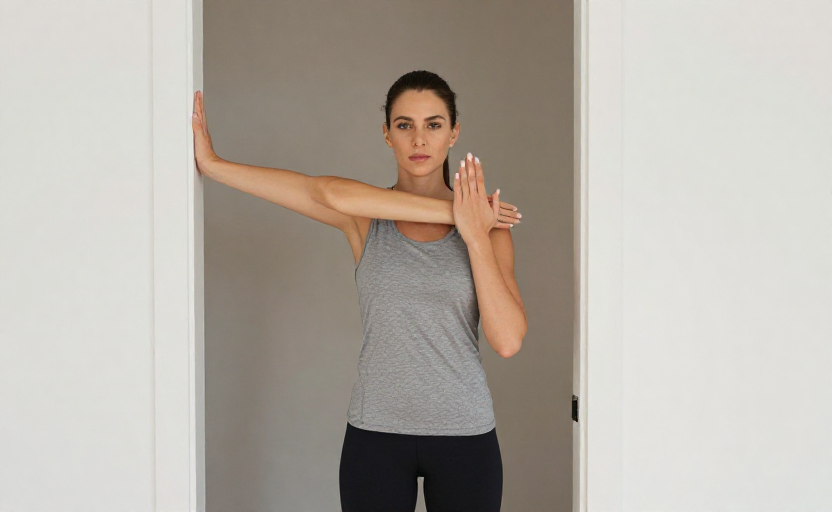
- Skipping the rear delt: Many people only stretch the chest. The cross-body shoulder stretch (pulling one arm across your chest) is a simple addition if you feel tightness in the back of the shoulder. Hold it for 30 seconds per side after your main three.
Putting It All Together
Here is a sample sequence you can run through in about four minutes:
- Doorway pec stretch — 45 seconds per side
- Lying T-spine rotation — 6 reps per side (about 1 minute total)
- Banded shoulder dislocate — 8 slow reps (about 45 seconds)
- Cross-body shoulder stretch (optional) — 30 seconds per side
That's it. No foam rolling, no elaborate warm-up. Just a short, targeted routine that pays off in the long run for anyone who trains hard and often.