You show up. You change into your gear. You even step onto the gym floor. But something feels off. Your muscles never quite get that full pump, your heart rate stays tepid, and you finish your sets wondering if you actually worked out at all. For many people, the culprit isn’t laziness or a lack of knowledge—it’s gym anxiety quietly dialing down your effort.
Anxiety in the gym doesn't always look like a panic attack or a sprint for the exit. More often, it manifests as subtle, almost invisible habits that protect you from feeling judged, awkward, or out of place. The problem is that these coping mechanisms directly sabotage your workout intensity. Recognizing them is the first step toward reclaiming your effort.
Habit #1: The Long, Aimless Pause Between Sets
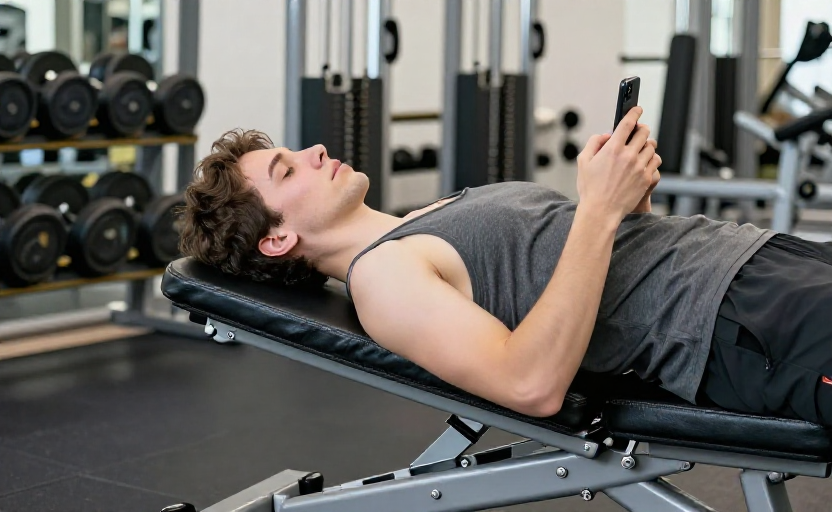
You finish a set of squats. You catch your breath. Then you grab your phone. You scroll. You re-rack a plate that was already straight. You check your phone again. Five minutes pass. Maybe eight.
This is one of the most common expressions of gym anxiety. It feels like rest, but it’s actually avoidance. You’re delaying the next set because the next set means performing again—and performing means potential scrutiny. The longer you wait, the more your muscles cool down, and the lower your overall session intensity drops. Your volume (total reps and sets) shrinks, and that’s the very thing that drives muscle growth and endurance gains.
What to do instead: Use a timer. Before you start your next set, set a rest interval based on your goal (60 to 90 seconds for hypertrophy, two to three minutes for strength). Tell yourself you only need to do one more rep than feels comfortable. That single rep is where the real stimulus lives—and it’s the part your anxiety is trying to avoid.
Habit #2: Sticking to the “Safe” Weight—Every Time
You’ve used the same dumbbell weight for chest presses for the last six weeks. You could probably go up by five pounds, but you don’t. You tell yourself you’re “perfecting form” or “not trying to get bulky.”
Underneath that logic is often a fear of failure—specifically, the fear of failing in front of others. Picking a heavier weight carries the risk of struggling, grunting, or needing to drop the bar. For someone with gym anxiety, that public struggle feels unbearable. So you stay at a weight that feels easy, which means your muscles never receive the progressive overload they need to grow or get stronger. Your workout becomes a maintenance session, not a building session.
A good rule of thumb: if you can complete all your target reps with perfect form and still have energy left for two extra reps, it’s time to increase the weight.
Start small. Add one plate to the leg press or one step up on the cable stack. The social spotlight is almost never as bright as you think it is, and nobody is tracking your weights as closely as you imagine.
Why These Habits Are Sneaky Saboteurs
Both habits share a common thread: they keep you in a comfort zone that feels psychologically safe but physically underwhelming. When you stretch out your rest or undershoot your load, you never approach the edge of your capacity. That’s fine for a recovery day, but if it happens every session, your progress flatlines.
The physiological impact is real. Your body adapts to stress. Without sufficient mechanical tension and metabolic stress—both of which come from lifting at the right intensity—muscle protein synthesis doesn’t fire up as strongly. You might feel like you “went to the gym,” but your tissue never got the signal to rebuild stronger.
Signs It’s Anxiety, Not Laziness
It helps to know whether you’re dealing with anxiety or just a low-effort day. Here are a few markers:
- Mental friction before hard sets: You physically brace yourself, sigh heavily, or negotiate with yourself before pushing.
- Heart rate spikes unrelated to exertion: You feel a rush of adrenaline when someone walks near your station.
- Routine rigidity: You never deviate from your path—no equipment swaps, no new exercises—because the unknown feels threatening.
If these sound familiar, your intensity problem is likely an anxiety problem. The fix isn’t to try harder; it’s to lower the social stakes.
How to Build Intensity Without Amplifying Anxiety
You don’t need to become a fearless gym-goer overnight. The goal is to create small windows of genuine effort while keeping your nervous system relatively calm. Here are three practical methods:
Anchor to a number. Pick a rep range (say, 6 to 10) and commit to hitting the top end. If you stop at 6 when you could do 9, your anxiety just cost you three reps. Treat that number as non-negotiable, like a contract with yourself.
Use the “one last” technique. Once you think your set is done, take a deep breath and do one more controlled rep. That rep is often the only one that truly stimulates adaptation, and it’s the one your anxiety wants you to skip.
Shift your focus to output. Instead of thinking, “What do people think of my form?” think, “How does this weight feel? Can I move it faster?” Redirecting attention to your own internal cues (body awareness) reduces the volume of the social noise. Over time, the external environment fades.
A Final Reminder
Gym anxiety is not a character flaw. It’s a normal response to a vulnerable situation—being watched while you push your physical limits. The habits it creates feel protective, but they’re actually holding you back from the stimulus you came for. When you spot yourself lingering at the dumbbell rack or surfing Instagram between sets, ask yourself one question: Am I resting, or am I hiding?
Your workout will thank you for an honest answer.