You show up, you sweat, you push through the last rep. That part you have down. But what happens in the hours and days after your workout is just as important as the session itself. Many dedicated athletes and weekend warriors alike hit a plateau not because they are working too lightly, but because they are making two specific mistakes with their workout frequency that directly sabotage their post-exercise recovery. Ignoring these can mean the difference between getting stronger and simply getting more worn down.
Recovery is not passive rest; it is an active physiological process where your muscles repair, your nervous system resets, and your energy stores replenish. If your training schedule fights against that process, you will feel stuck, achy, and progress will stall. Let's look at the two errors that are most responsible for delaying this crucial phase.
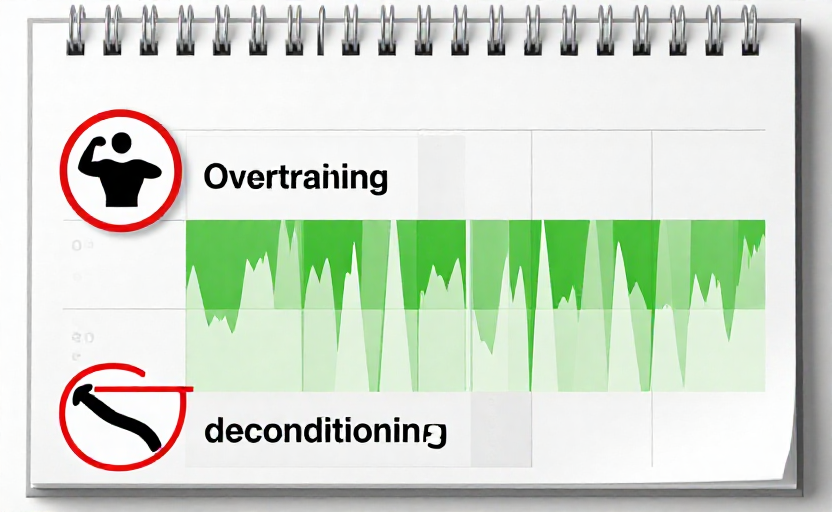
Mistake #1: Training a Muscle Group Too Often Without Enough Recovery Time
This is the classic pitfall: the belief that more is always better. We are told to grind, to be consistent, to hit every workout on the calendar. But your muscles do not grow during the workout itself—they grow in the recovery window afterward. When you lift, run, or perform high-intensity intervals, you create micro-tears in muscle fibers and deplete your body's energy systems. This is a good thing. It is the stimulus for adaptation. The problem arises when you repeat that stimulus before the repair process is complete.
For most people doing resistance training, a specific muscle group needs at least 48 hours—and often 72 hours for larger groups like legs or back—to rebuild and strengthen. Squatting heavy on Monday and then doing heavy leg presses on Wednesday might feel productive. In reality, you are simply breaking down tissue that is still trying to mend. This keeps you in a constant state of inflammation and fatigue rather than progressing to a stronger, recovered state.
The fix is straightforward, if unintuitive: do less, strategically. If you are training full-body, space your sessions out by at least two days. If you use a split routine (like push/pull/legs), make sure you are not hitting the same prime movers with heavy loads on consecutive days. Listen for the signals of incomplete recovery—persistent soreness beyond 72 hours, a feeling of heaviness in the limbs, or a lack of 'pop' in your movements. These are your body telling you that your frequency is too high for your current recovery capacity.
Mistake #2: Taking Too Many Days Off and Letting Deconditioning Set In
The other side of the coin is equally damaging. While working out too often can delay recovery, taking too much time off between sessions creates a different problem called deconditioning. This happens when the physiological adaptations you gained from your last workout begin to reverse. For cardiovascular fitness, measurable declines can start within a few days. For strength, the neuromuscular adaptations and glycogen storage efficiency begin to fade after about a week of no training.
The recovery paradox here is that many people, after an intense session, will take three or four days off 'to recover,' only to find that they are sore all over again when they return. That return soreness is often not from the new workout—it is from the body having to re-adapt because it partially lost its conditioning during the long layoff. You are essentially starting over each time, which keeps your recovery system in a constant state of shock.
Consistency beats intensity when it comes to sustainable recovery. A moderate workout every 48 hours is far easier for your body to adapt to than a crushing workout followed by a mini-vacation.
The solution is to tighten your training window. Aim to work each major movement pattern or muscle group with sufficient frequency to maintain a training effect. For most people, that means hitting a muscle group at least twice per week. This keeps the 'recovery baseline' elevated. Your body learns that it needs to repair efficiently because another stimulus is coming soon, and it adapts by improving its repair mechanisms and energy storage capacity.
How to Find Your True Recovery Rhythm
Your personal ideal frequency depends on several variables: your training intensity, your sleep quality, your nutrition, your stress levels, and your age. A 20-year-old sprinter recovers differently than a 45-year-old recreational lifter. The key is not to follow a rigid calendar but to use a sliding scale. For example, after a very high-intensity leg day, you might need 72 hours before you can train legs again effectively. After a moderate upper-body session, you might be ready in 48 hours. After a light 'active recovery' session (purely movement based, low intensity), you could train the same muscles again the next day.
One practical way to dial this in is to keep a simple recovery journal. For two weeks, note the date and type of each workout. Then note how you felt in the 24- to 48-hour window afterward. Rate your recovery on a simple scale of one to five. After a few cycles, patterns will emerge. You will see that heavier sessions reliably need a longer gap, while lighter, more skill-focused work can be done almost daily. This systems-based approach prevents you from falling into either of the two common mistakes.
Remember, recovery is not a sign of weakness—it's the signal that your body is building something. By avoiding the trap of training too often or too rarely, you give that process the steady, rhythmic foundation it needs to keep you moving forward without the constant cycle of breakdown and deconditioning.