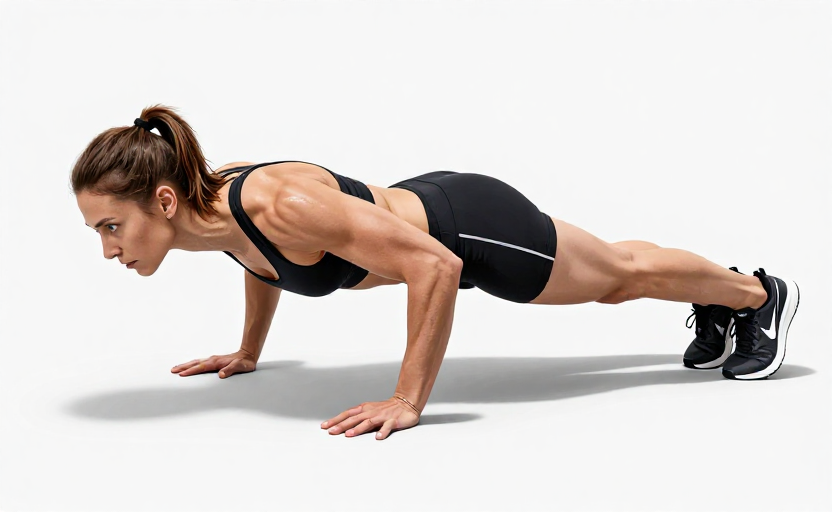
You pride yourself on discipline. Five hundred reps. Barely any rest. Sweat pooling on the mat. Yet your knees or wrists or shoulders are starting to mutter—then grumble, then flare. High-frequency bodyweight training can be transformative, but there’s one mechanical mistake that almost guarantees you’ll trade gains for grief. And it has almost nothing to do with how many reps you log.
Let's be clear: joint pain in bodyweight work is rarely a sign you’re getting weaker. More often, it’s a sign you’ve turned your own skeleton into a lever, and you’re leveraging it wrong. Here’s the mistake—and more importantly, how to undo it.
The Mistake: Dominating Every Rep with Full Tension
High-frequency workouts invite a mindset of aggressive engagement: squeeze everything, lock out every joint, drive through every transition with muscular grit. You hear coaches yell “engage your core” so often that you start bracing your entire torso as if waiting for a punch. The problem is, when you hold that kind of full-body tension for hundreds of reps, day after day, your joints absorb the wrong kind of stress.
Think of your joints as suspension bushings. They need some slack to distribute load smoothly. When you lock every rep with maximal muscular tension—especially in the terminal ranges of a push-up, squat, or plank—you transfer shearing forces directly into the articular surfaces. Over days and weeks, the result isn’t stronger joints; it’s irritated synovium, strained ligaments, and a persistent ache that doesn’t go away with a warm-up.
Why Speed Amplifies the Problem
Frequent bodyweight athletes often combine high tension with speed. Burpees, squat jumps, fast push-ups. When you add velocity to an already tense movement, momentum becomes the driver, not your muscles. Your joints become the brakes. The patella grinds. The scapula impinges. The wrist extensors complain. The solution isn’t to train slower forever—it’s to understand that tension should be dynamic, not static.
The Fix: Cyclical Tension Instead of Constant Bracing
Instead of holding a braced plank from rep one through rep fifty, practice what movement coaches call “tension cycling.” That means you engage your core and supporting muscles at the moment you need them—during the eccentric (lowering) phase of a push-up, for example—and you allow a brief, controlled softness at the bottom before you press. This isn’t collapsing. It’s a micro-yield that lets your joints align naturally before force application.
Think of it as three beats: set, load, drive. Set your alignment. Load through controlled range. Drive with intent. The “set” is not the entire rep.
Here’s how that looks in common moves:
- Push-ups: Keep shoulders packed and core light. Lower your chest. At the bottom, allow your shoulder blades to retract naturally. Pause. Then press, feeling the lats and chest engage. Do not squeeze your glutes through the entire rep—your hips don’t need to be granite for a push-up.
- Squats: Sit back rather than dropping straight down. At the bottom, let your pelvis tilt slightly forward (a natural “butt wink” within reason) to unload the lumbar spine. Drive through your heels, using glutes and quads, not your lower back.
- Planks: Brace your core only enough to keep your spine neutral. Do not crush your abs. If your lower back sags, pause and reset. If your shoulders hunch toward your ears, drop to your knees and reposition. A perfect 20-second plank beats a wobbling 60-second plank every time.
How to Adjust Your Frequency for Recovery
High-frequency means you’re inviting stress daily. That only works if you also invite daily recalibration. Consider splitting your sessions into “hard” and “soft” days, even within the same movement patterns. On hard days, you work toward full range of motion and moderate tension. On soft days, you do the same moves but deliberately soften the tension by 20–30%, focusing purely on placement and flow.
You might also consider this: high frequency doesn’t have to mean high volume. If you’re doing push-ups or squats every day, cap your daily working sets at 3–4 and keep reps moderate. A 50-rep test once a week is very different from 300 reps spread across seven days. The joint stress of daily volume accumulates faster than muscle adaptation.
Wrist and Knee Specifics
If your wrists ache after push-up variations, it’s almost certainly because you’re placing your hands too far forward and driving through the heel of your palm while gripping the floor with your fingers. Instead, distribute pressure across the entire hand—fingertips included. Use push-up bars or dumbbells to keep the wrist neutral. If your knees hurt during lunges or squats, check your foot angle. Your femur rotates internally when your foot flares out too far. Align your kneecap with your second toe, and don’t let your knee cave inward on the way up.
When Pain Is a Signal, Not a Failure
Joint pain in bodyweight training is common, but it’s not normal. It’s a signal that your structure—joint position, rhythm, and tension management—needs editing. You don’t need to stop training. You just need to stop fighting your own joints. The most durable athletes don’t lock down every rep. They learn when to hold, when to release, and when to simply reset.
Tension is a tool, not a straightjacket. Use it with precision, not force, and your joints will return the favor by letting you train tomorrow, and the day after that.