You sit down with a full plate, and before you know it, it’s empty. You barely tasted the last few bites, and now you feel uncomfortably full. Sound familiar? In a world of oversized restaurant servings and distracted dining, our natural sense of portion size has become blurred. Mindful eating offers a gentle, sustainable way to reclaim that sense, not through rigid rules, but through awareness.
At its heart, mindful eating for portion control isn’t about deprivation. It’s about reconnecting with your body’s signals—the subtle cues of hunger and fullness that get drowned out by screens, stress, and speed. It’s learning to distinguish between eating because you’re truly hungry and eating because the food is there. By cultivating a few key habits, you can create a more balanced, intuitive approach to food that naturally guides you toward satisfying, not stuffing.
What is mindful eating, really?
Think of mindful eating as the opposite of automatic eating. It’s the practice of bringing your full attention to the experience of eating and drinking, both inside and outside your body. You notice the colors, smells, textures, flavors, and even the sounds of your food. You pay attention to the physical sensations of hunger and satiety. You observe the thoughts and emotions that arise around food without judgment.
When applied to portion control, this awareness is transformative. Instead of relying on external cues—like finishing everything on your plate or eating until the bag is empty—you begin to rely on the internal cue of comfortable fullness. You give your brain and gut time to communicate, which can naturally lead to choosing and consuming smaller, more appropriate portions without feeling like you’re on a diet.
Four foundational habits to start today
You don’t need to overhaul your life overnight. Start with one of these practices. Master it, then layer in another. The goal is progress, not perfection.
1. Pause and plate everything
This habit breaks the cycle of mindless grazing. The rule is simple: no eating straight from the bag, box, or takeout container. Always transfer your food to a plate or bowl, even for a snack.
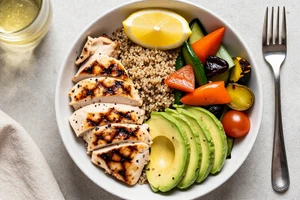
This single act creates a crucial moment of choice. It forces you to see the quantity you’re about to consume. That handful of chips becomes a visible mound on a plate. That pint of ice cream becomes a single serving in a bowl. This visual reality check allows your conscious mind to engage before you start eating. It’s a simple boundary that builds awareness and interrupts autopilot.
Seeing your food portioned out provides a visual reality check, allowing your conscious mind to engage before you start eating.
2. Engage your senses before your fork
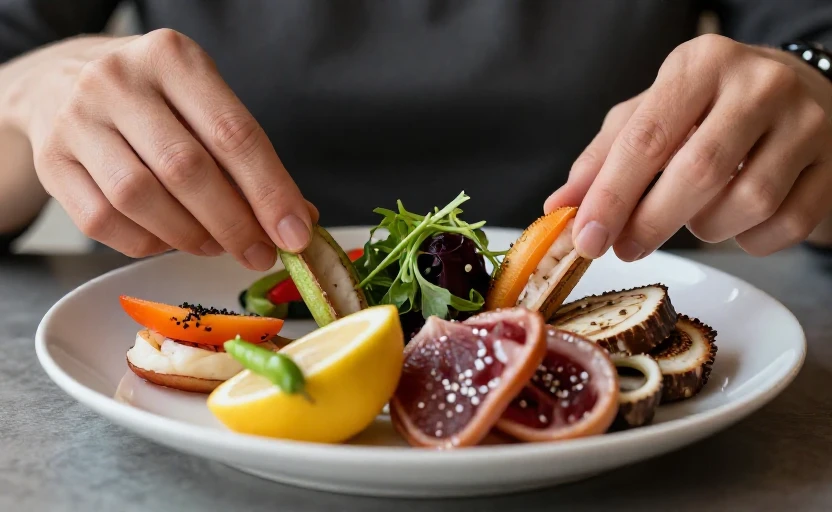
Before you take the first bite, pause for ten seconds. Look at your food. Notice its colors and arrangement. Smell the aromas. Acknowledge the work that went into preparing it. This brief pre-meal ritual does two important things.
First, it signals to your brain that eating is beginning, which starts the process of digestive enzyme secretion. Second, it shifts you out of “grab and go” mode and into “experience and enjoy” mode. When you begin a meal from a place of presence, you’re more likely to eat at a slower pace and notice your body’s signals sooner.
3. Master the halfway check-in
This is perhaps the most powerful tool for portion control. When you’re about halfway through the food on your plate, put your utensil down. Take a full breath. Ask yourself a gentle, curious question: “How does my stomach feel?”
Rate your fullness on a scale from 1 (ravenous) to 10 (painfully stuffed). Aim to stop around a 6 or 7—pleasantly satisfied, but not full. This mid-meal pause gives your body the necessary time—often 15-20 minutes—for satiety signals from your gut to reach your brain. You may find that the food you thought you needed to feel satisfied is now more than enough. The rest can be saved for later.
4. Redefine what “done” looks like
We’re often taught that a clean plate means the meal is done. Mindful eating invites you to change the finish line from an external cue (an empty plate) to an internal cue (a comfortably full body).
Give yourself unconditional permission to leave food on your plate. It’s okay. You can save it. This habit dismantles the “clean plate club” mentality that drives overeating. It reinforces that you are in charge, not the portion served to you. Start small—leave just two bites. Notice how it feels. It’s a practice in trusting yourself more than the plate.
Making it work in real life
These habits shine in a calm home environment, but real life is messy. Here’s how to adapt the principles when you’re out or in a rush.
At a restaurant, ask for a to-go box when your meal arrives and immediately portion out what looks like a reasonable amount to eat now, boxing the rest. It removes the temptation to eat the entire oversized serving. For snacks on the go, buy single-serving packages or take a moment to portion a larger bag into a small container before you leave home. The core idea remains: create a boundary between you and an unlimited food supply.
Be patient with yourself. Some days you’ll be fully present; other days you’ll finish a meal and realize you were on another planet. That’s normal. The practice is in gently bringing your attention back, without criticism, each time you eat.
The deeper benefit beyond the plate
While portion control is a tangible outcome, the greater gift of mindful eating is a changed relationship with food. It moves you from a mindset of restriction (“I can’t have that”) to one of connection (“I’m choosing this, and I’m fully enjoying it”). Food becomes a source of nourishment and pleasure again, not a source of anxiety or guilt.
By listening to your body, you honor its needs. You may find yourself naturally gravitating toward more nutritious foods because they make you feel better. You learn that a truly satisfying portion is the one that leaves you feeling energized and well, not sluggish and stuffed. That is a sustainable foundation for well-being that no strict diet can ever provide.