
You crushed your leg day. Your form was solid, you pushed through the last rep, and you left the gym feeling that satisfying pump. But the next morning? Your quads feel like concrete. Stairs are a negotiation. Even rolling over in bed makes you wince.
We often assume that profound soreness is simply the price of progress—a direct signal of a good workout. But in the reality of strength training, not all soreness is created equal. A sharp ache from a new movement pattern can be part of the adaptation process. However, the kind of debilitating stiffness that actually derails your next workout is frequently avoidable. It often comes down to two very specific, commonly skipped habits. If you’ve ever woken up wondering why you feel more broken than built, you might be missing these critical recovery levers.
Habit #1: Skipping the “Cool-Down” Eccentric Focus
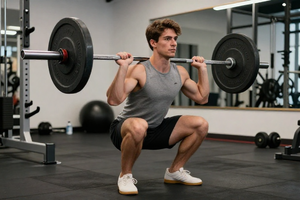
When the bar is back on the rack, your instinct is probably to get your heart rate down with some light walking or static stretching. That isn't what we are talking about here. The first habit that fuels excessive soreness is skipping a deliberate set of lengthened-state holds or eccentric-focused repetitions at the very end of your main lifts.
Strength training damages muscle fibers mechanically, especially during the eccentric (lengthening) phase—think lowering the bar in a bench press or descending into a squat. If you grind through your last heavy set and then immediately stop, those fibers are left in a state of high tension and micro-tearing without a signal to begin the repair cascade smoothly.
The quick fix: After your last working set of the primary exercise (like squats or rows), immediately drop the weight to about 50-60% of your working load. Perform 5 very slow, controlled reps with a 4- to 5-second eccentric (lowering) phase. Resist on the way down, and do not explode back up. This signals your nervous system to modulate the inflammatory response before it peaks 24-48 hours later.
Habit #2: Post-Workout Carbohydrate Timing (Not Just Protein)
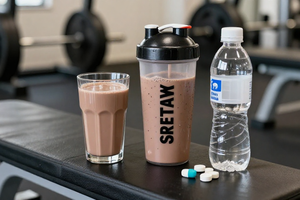
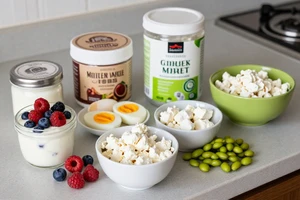
You likely already drink a protein shake or eat some chicken post-lift. You have heard a thousand times that protein builds muscle. The second soreness-increasing habit is neglecting fast-digesting carbohydrates in that same post-workout window.
Intense resistance training depletes your muscle glycogen stores significantly. Low glycogen creates a metabolic environment where muscle tissue breakdown outpaces repair. Carbohydrates do not just give you energy—they potentiate protein absorption and shuttle water and nutrients into the muscle cells. If your post-workout meal is strictly fat and protein (e.g., a steak salad with avocado), you are missing the insulin spike that actually kickstarts recovery. Without it, your muscles remain slightly dehydrated and nutrient-starved, leading to significantly more pain the following morning.
Most lifters fail to ingest at least 30-50 grams of simple carbs within 60 minutes after training. Skipping this window is one of the fastest ways to turn a moderate session into a two-day recovery saga.
Why These Two Habits Are Often Overlooked
Both of these habits fall into a category of “invisible work.” You cannot feel the effect of 5 slow eccentrics in the moment—it just feels like extra time under tension. And a banana or some white rice post-workout does not feel as “hardcore” as a scoop of casein or a steak. But these are the low-hanging fruit of soreness management. They are not about reducing the quality of your training; they are about optimizing the signal your body receives after the stress has been applied.
One more layer: Hydration status directly impacts how these two habits work. Chronic low-water intake will amplify both the eccentric damage and the carbohydrate utilization issue. Make sure you hydrated well during your workout, not just after.
How to Implement Without Overthinking It
You do not need a perfect protocol. Here is a simple way to integrate both habits into your strength routine starting tomorrow:
- At the end of each main compound lift (squat, deadlift, bench, row, overhead press): Strip the bar to ~50%, and perform 5 slow negatives (4 seconds down, no pause, controlled up).
- Within 60 minutes of finishing your last rep: Eat a meal or shake that contains a roughly 2:1 carbohydrate-to-protein ratio—think a banana with your protein shake or a cup of white rice with your chicken.
- Do not confuse this with stretching. The eccentric reps are a neuromuscular reset, not a flexibility drill. Save static stretching for a separate session or at bedtime.
The goal is not to eliminate soreness entirely—some is healthy and indicates adaptation. The goal is to eliminate the debilitating soreness that makes you skip your next workout. These two habits are easy to skip, incredibly cheap, and surprisingly effective when you actually do them.
Residual muscle tenderness is a sign that you are pushing your limits. Inability to walk normally for 72 hours is a sign that your recovery inputs are missing. Pay attention to which one you are experiencing. If it is the latter, look first at these two gaps before you start questioning your program.