
You know the drill: you crush a workout, feel the burn, and then spend the next two days wincing every time you sit down or reach for a coffee cup. Muscle soreness is a natural signal of adaptation, but persistent fatigue, stalled progress, or nagging tightness often points to a bigger issue—your workout structure might be working against your recovery, not with it.
Most lifters focus on what happens inside the gym: sets, reps, and progressive overload. But the real gains happen after you rack the weights. If your training plan doesn’t actively support how your muscles repair, you’re essentially trying to build a house on a shaky foundation. Here is a practical, no-nonsense guide to reshaping your weekly structure so recovery becomes a feature, not an afterthought.
Why recovery needs its own strategy
Recovery isn’t passive. It’s an active process where your body clears metabolic waste, repairs micro-tears in muscle fibers, and replenishes energy stores. If you train the same muscle groups too frequently, or with too much volume, your body never gets a full cycle of repair before the next breakdown begins. Signs you need to adjust your structure include plateaued strength gains, lingering soreness beyond 72 hours, poor sleep quality despite hard training, and that general “heavy-legged” feeling that never quite lifts.
Key levers you can adjust in your training week
You don’t need to overhaul everything. The most effective structural changes involve three variables: frequency, volume distribution, and intensity management. Here is how to walk through each one.
1. Training frequency per muscle group
Conventional wisdom says hit each muscle once a week. But research over the last decade suggests that splitting volume across two or three sessions per muscle group often leads to better recovery outcomes because no single session is brutally taxing. For example, instead of one massive leg day with 20 sets for quads and glutes, you might do two moderate leg days with 10 sets each. The total volume stays the same, but the recovery load is spread out. If you’re currently doing a bro split (chest Monday, back Tuesday, etc.), consider moving to an upper/lower or push/pull/legs split. Your central nervous system will thank you.
2. Volume and intensity management
Volume (total sets per muscle per week) and intensity (how close you train to failure) are the two most common culprits of recovery breakdown. A practical guideline: most intermediate lifters recover well with 10–20 working sets per muscle group per week. If you’re consistently sore beyond 48 hours, drop the higher end of that range temporarily. Similarly, if you are taking every set to absolute failure, reserve that for the last set of the last exercise. Capping proximity to failure (leaving one or two reps in the tank) on earlier sets dramatically reduces systemic fatigue without sacrificing strength gains. Recovery-friendly structure means not every session needs to be a fight to the finish.
Quick self-check: If you can’t remember the last time you finished a workout feeling like you could have done one more set, you’re probably overreaching. Back off by 10–15% volume for two weeks and see how your body responds.
3. Strategic deload weeks
Deloading isn’t a sign of weakness; it’s a planned reduction in training stress that allows full recovery. Most structured programs include a deload every four to six weeks. In practice, this means reducing your volume by about 40–60% while keeping intensity moderate. You can also use a “light week” where you still show up but use 50% of your normal weights. For many people, this is the single most impactful structural adjustment they can make. If you never deload, you are likely accumulating fatigue that messes with your sleep, hunger, and mood—all things that slow recovery further.
How to structure your week with recovery in mind
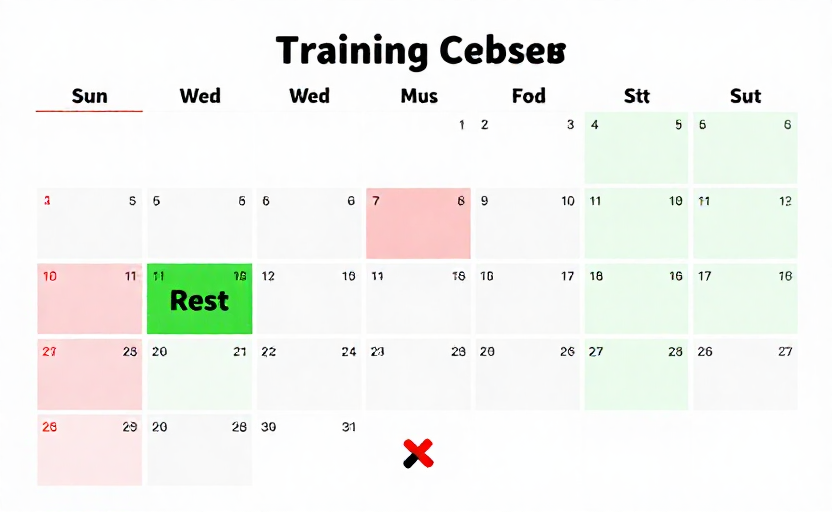
Here is a sample template that distributes stress across the week, giving each system time to bounce back. This is not a prescription, just a visualization of what recovery-centered scheduling can look like.
- Monday: Lower body (quad-focused) — moderate volume, 2 RIR (reps in reserve) on main lifts
- Tuesday: Upper body (push) — moderate volume, leave 1–2 RIR
- Wednesday: Active recovery — 20–30 minute walk, light mobility work, foam rolling
- Thursday: Lower body (posterior chain) — moderate volume, slightly higher intensity on deadlift variations
- Friday: Upper body (pull) — moderate volume, focus on rowing and pull-ups
- Saturday: Full body “pump” — lighter loads, higher reps, low fatigue
- Sunday: Full rest — no structured movement
Notice that no muscle group is hit twice in a row, and the lower days are split by focus area to avoid overlapping fatigue. The midweek active recovery day is not “lazy”—it promotes blood flow without additional muscle damage.
Sleep, nutrition, and stress: the supporting cast
You can structure your workouts perfectly, but if you’re sleeping five hours a night, eating too little protein, or chronically stressed, your recovery capacity will be capped. Sleep is the single most potent recovery tool. Aim for seven to nine hours consistently. Protein intake spread across the day (roughly 1.6–2.2 grams per kilogram of body weight for active individuals) provides the raw materials for repair. Carbohydrates replenish glycogen, especially if you train in the afternoon or evening. Hydration matters more than people think—even mild dehydration can slow muscle protein synthesis.
Stress management also plays a role you can’t ignore. High cortisol levels interfere with sleep quality and tissue repair. If your life outside the gym is chaotic, your training structure needs to be even more conservative. Consider adding a short meditation session, deep breathing, or a brisk walk to bring down baseline stress.
When to dial back and when to push through
One of the hardest skills in training is distinguishing between normal post-workout fatigue and overreaching that requires a cutback. General soreness that peaks 24–48 hours post-exercise and fades is a good sign. Fatigue that persists for four or more days, along with irritability, poor sleep, or loss of appetite, suggests you need to back off. If you’re unsure, take a lighter week—even a small reduction in volume often restores clarity and energy. Pushing through chronic fatigue is a recipe for injury or burnout.
Adjusting your workout structure for better muscle recovery doesn’t require a complete rewrite of your routine. Small, intentional changes—spreading volume across more sessions, managing how close you go to failure, and respecting deload weeks—can transform how you feel between workouts. When your recovery improves, your performance follows. Listen to your body, test one change at a time, and give yourself permission to rest without guilt.