
If you’ve been trying to lose weight, you’ve probably heard that calories matter—but not all calories are created equal. The balance of protein, fat, and carbohydrates—your macronutrients, or “macros”—plays a major role in how your body responds to a calorie deficit. While the idea of calculating macros might sound like something only bodybuilders or dietitians do, the basic math is straightforward. This guide walks you through a practical, no-gimmick method for estimating your own macronutrient needs for weight loss, so you can tailor your eating plan to support fat loss while preserving energy and strength.
Why Macros Matter for Weight Loss
When you eat in a calorie deficit—consuming fewer calories than your body burns—you lose weight. But without attention to macronutrients, you risk losing muscle along with fat. Muscle tissue is metabolically active, meaning it burns calories even at rest. Prioritizing protein helps protect muscle mass, while dietary fat supports hormone function and carbohydrate intake fuels your workouts and daily activity. Getting the right balance helps you lose more fat and less lean tissue, which keeps your metabolism humming and makes it easier to maintain weight loss long term.
Step 1: Find Your Calorie Target for Weight Loss
Your macronutrient numbers start with a calorie goal. A safe, sustainable rate of weight loss is about 1 to 2 pounds per week, which generally requires a daily deficit of 500 to 1000 calories from your maintenance level. To estimate your maintenance calories, multiply your current body weight in pounds by a factor that reflects your activity level:
- Sedentary (little exercise): 12 calories per pound
- Lightly active (light exercise 1–3 days/week): 13–14 calories per pound
- Moderately active (moderate exercise 3–5 days/week): 15–16 calories per pound
- Very active (hard exercise 6–7 days/week): 17–18 calories per pound
For example, a 180-pound woman who is moderately active would need roughly 2700–2880 calories for maintenance. To lose about a pound per week, she would subtract 500 calories, giving a target of around 2200–2380 calories per day.
These numbers are estimates. Your actual needs depend on age, sex, muscle mass, and genetics. It’s always wise to track for a couple of weeks and adjust if you’re not seeing the expected rate of loss.
Step 2: Set Your Protein First
Protein is the most important macronutrient to prioritize during weight loss. Adequate protein helps suppress appetite, supports muscle repair, and increases the thermic effect of food—meaning your body burns more calories digesting protein than it does carbs or fat. A solid starting point for weight loss is 0.7 to 1.0 grams of protein per pound of body weight. If you’re very overweight, use your goal body weight or your lean body mass instead of current weight to avoid overestimating.
At 0.8 grams per pound, a 180-pound person would aim for about 144 grams of protein per day. Spread that across three to four meals, and you’re looking at roughly 35–40 grams per meal. Real-food sources like chicken breast, Greek yogurt, eggs, tofu, lentils, and fish all count.
Step 3: Allocate Your Fat
Dietary fat is essential for hormone production, vitamin absorption, and cell health. It also adds flavor and helps you feel full. Aim for 20 to 35 percent of your total calories from fat. If you’re eating 2200 calories per day, that works out to about 440–770 calories from fat, which equals 49–86 grams (since fat provides 9 calories per gram).
If you prefer a more prescriptive approach, a common middle-ground target is 0.3 to 0.4 grams of fat per pound of body weight. For the 180-pound example, that’s 54–72 grams daily. Choose unsaturated fats from sources like olive oil, avocados, nuts, seeds, and fatty fish, and limit processed trans fats.
Step 4: Fill the Rest with Carbohydrates
After you’ve set protein and fat, the remainder of your calorie budget goes to carbohydrates. Carbs are not the enemy—they provide the energy your brain and muscles need, especially if you exercise. To find your carb target, calculate calories already allocated to protein and fat, then subtract from your total calorie goal.
Sticking with our 2200-calorie example: 144 grams of protein provides 576 calories (4 calories per gram of protein). If we pick 60 grams of fat, that’s 540 calories. Together, that’s 1116 calories, leaving 1084 remaining. Divide by 4 (calories per gram of carbohydrate) and you get 271 grams of carbs per day. For most active people, that’s plenty to support workouts and daily function.
For those who do intense endurance training or heavy lifting, you may prefer to keep carbs on the higher end and fat a bit lower. If you find you feel sluggish, try shifting some fat calories into carbs. The numbers are flexible—the goal is to find a ratio you can stick with consistently.
You don’t need to hit your macro targets perfectly every day. A range of plus or minus 5–10 grams for protein and fat, and a bit more for carbs, is perfectly fine. Consistency over time matters more than daily precision.
A Sample Day at a Glance
To make this less abstract, here’s what a 2200-calorie day with 145g protein, 60g fat, and 270g carbs might look like:
- Breakfast: 2 scrambled eggs (12g protein, 10g fat), 1 cup oatmeal with 1 cup berries (10g protein, 5g fat, 60g carbs)
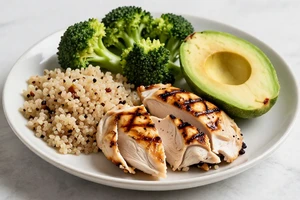
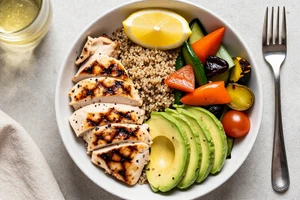
- Lunch: 6 ounces grilled chicken (42g protein, 3g fat), 1 large sweet potato (4g protein, 0g fat, 45g carbs), 1 cup steamed broccoli (3g protein, 0g fat, 11g carbs)
- Snack: Greek yogurt—plain, nonfat (20g protein, 0g fat, 8g carbs) with 1 apple (0g protein, 0g fat, 25g carbs)
- Dinner: 6 ounces salmon (34g protein, 18g fat, 0g carbs), 1 cup quinoa (8g protein, 4g fat, 40g carbs), side salad with 2 tbsp vinaigrette (0g protein, 14g fat, 10g carbs)
Pro tip: Add a tablespoon of olive oil or a handful of almonds anywhere you need an extra calorie or a bit more healthy fat to round out your day.
How to Track Without Going Crazy
You don’t have to weigh and log every morsel forever. Many people use a tracking app for the first few weeks to learn portion sizes and see which foods fit their macro targets. After that, you may find you can estimate intuitively. If you’d rather not track at all, a simpler approach is to build each meal around a palm-sized portion of protein, a fist-sized portion of vegetables, a cupped handful of starchy carbs, and a thumb-sized portion of fats. That template alone will get you surprisingly close to a balanced macro distribution.
When to Adjust Your Macros
Your macronutrient needs aren’t static. As you lose weight, your calorie target will need to decrease slightly because a smaller body burns fewer calories. If your weight loss stalls for more than two weeks after you’ve been consistent, recalculate using your new weight. Also, if you’re losing weight but feel unusually fatigued, irritable, or are losing strength, it may be a sign you need more carbs or an overall smaller deficit. Listen to your body—it gives useful feedback.
The Bottom Line
Calculating your macros for weight loss doesn’t have to be complicated. Start with a realistic calorie deficit, set protein to protect muscle, add enough fat for health and satiety, and let carbs fill the gap. Adjust as needed based on your results and how you feel. There’s no single perfect ratio for everyone, but this practical method gives you a solid starting point to take control of your nutrition without extreme restriction.