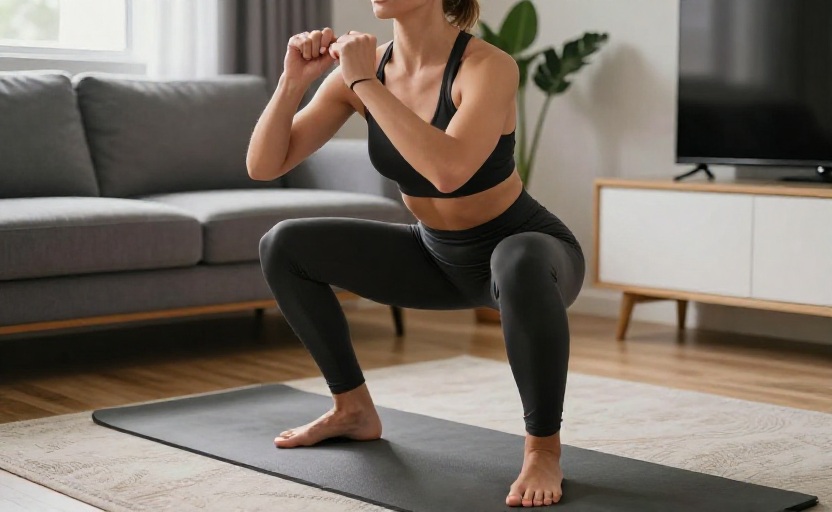
You don't need a squat rack, a barbell, or a gym membership to build real lower-body strength. Bodyweight training, when done with intention, can challenge your quads, hamstrings, glutes, and calves effectively. The key is to focus on movement quality, range of motion, and progressive overload through variations and tempo changes.
These six exercises form a complete, no-equipment leg workout you can do anywhere. They are sequenced to build from foundational patterns to more demanding movements. Perform them as a circuit, or take short rests between sets. Aim for 10–15 reps per side on unilateral moves, and 15–20 reps on bilateral moves, adjusting based on your current fitness level. Always prioritize controlled form over speed.
1. Bodyweight Squat
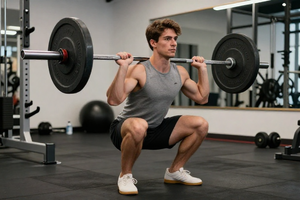
The squat is the foundation. Stand with feet hip-width apart, toes slightly turned out. Initiate the movement by sitting your hips back and down, keeping your chest up and your weight in your heels. Lower until your thighs are at least parallel to the floor, or as deep as your mobility allows without your lower back rounding. Drive through your heels to return to standing, squeezing your glutes at the top.
Progress it: Slow down the eccentric (lowering) phase to a 3- or 4-second count. This increases time under tension without adding weight.
2. Reverse Lunge
Lunges are excellent for single-leg strength and balance. Step one foot back about two feet, landing on the ball of your foot. Bend both knees to lower your hips until your front thigh is parallel to the floor and your back knee hovers just above the ground. Your front shin should be vertical. Push through the heel of your front foot to return to the starting position. Complete all reps on one side before switching.
The reverse lunge is often more knee-friendly than the forward version because the fixed front foot creates a more stable, controlled descent.
3. Bulgarian Split Squat
This exercise elevates the rear foot, placing more load on the front working leg. Stand about two feet in front of a chair, bench, or sturdy step. Place the top of your rear foot on the surface behind you. Your stance should be long enough that your front shin remains vertical at the bottom of the movement. Lower your back knee toward the floor until your front thigh is parallel or slightly below. Keep your torso upright. Press through your front heel to stand.
If you feel too much quad dominance, lean your torso forward slightly to engage the glutes more on the working leg.
4. Glute Bridge
Lie on your back with your knees bent, feet flat on the floor hip-width apart, and arms at your sides. Press your lower back into the floor, then squeeze your glutes to lift your hips up until your body forms a straight line from shoulders to knees. Hold the top position for one second, squeezing glutes hard, then lower slowly without fully relaxing at the bottom.
For a greater challenge, perform single-leg glute bridges: extend one leg straight in the air, keeping both hips level, and bridge using only the grounded leg.
5. Calf Raise
Stand with feet hip-width apart. Hold onto a wall or sturdy surface for balance if needed. Slowly rise up onto the balls of your feet as high as possible, squeezing your calves at the top. Lower your heels back down with control, letting them drop slightly below the level of the toes for a full stretch at the bottom.
Tip: Pause for two seconds at the top of each rep. This eliminates momentum and forces your calves to work harder.
6. Lateral Lunge
Stand with feet together. Take a wide step to the right, landing with your right foot flat. Shift your weight onto that leg as you sit your hips back and bend your right knee, keeping your left leg straight. Keep your chest up and your right knee tracking in line with your toes. Push off your right foot to return to the starting position. Alternate sides or complete all reps on one side before switching.
The lateral lunge targets the inner thighs (adductors) and glute medius—muscles often neglected in sagittal-plane exercises like squats and lunges.
A Note on Progression
Bodyweight training is effective only if you continue to challenge your muscles. To build strength without external weight, manipulate these variables: increase reps, slow down the tempo (especially the eccentric phase), reduce rest time between sets, and use deeper ranges of motion. If bodyweight squats become easy, try the Bulgarian split squat; if glute bridges feel too simple, switch to single-leg work.
Consistency matters more than intensity in a single session. Perform this circuit two to three times per week, allowing at least one day of rest between sessions for muscle recovery. Pair it with a balanced diet that includes adequate protein to support muscle repair and growth.