You’ve been hitting the gym hard, following the program, and eating what you think is the “right” stuff. But lately, you feel run down—achy, irritable, and stuck in a fatigue that sleep won’t fix. For new lifters, this can feel confusing. You’re working for progress, yet your body is sending signals of strain.
The usual advice for overtraining focuses on rest and sleep, but what you eat plays a surprisingly direct role. While no single food causes overtraining, certain choices can amplify the inflammation, hormonal disruption, and poor recovery that define the condition. Here are four foods that may make overtraining symptoms worse, especially if you’re newer to structured strength training.
1. Highly processed protein bars and powders
Protein is critical for muscle repair, but not all protein sources are equal. Many mass-market protein bars and some powders are packed with artificial sweeteners, sugar alcohols, and additives. For a lifter whose nervous system is already under stress from volume or intensity, these additives can be problematic.
Artificial sweeteners like sorbitol and maltitol can cause gastrointestinal distress—bloating, gas, or diarrhea—which disturbs sleep and increases systemic inflammation. When you’re overtrained, your digestion is often more sensitive. A heavy reliance on these processed protein sources means you might not be getting the micronutrients your body needs for recovery. Instead, think of whole-food protein sources as your foundation: eggs, Greek yogurt, chicken, or fish. Use bars and powders as true supplements, not meal replacements.
2. High-sugar sports drinks that aren’t needed
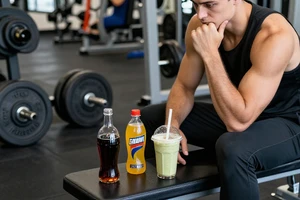
It’s become a habit to sip a neon-colored sports drink during every workout, even during a standard one-hour strength session. Unless you’re doing high-volume, high-intensity work for more than 90 minutes, you likely don’t need that load of simple sugar.
Excess sugar intake spikes insulin and can amplify cortisol, the main stress hormone. For a lifter already dealing with elevated cortisol from overtraining, adding a constant drip of sugar can push your system further out of balance. This can worsen irritability, disrupt sleep, and make it harder to lose body fat even if you’re trying to “earn” the calories. Water, plain or with a pinch of salt, is almost always better for moderate sessions. If you need a pick-me-up, a black coffee before training works without the sugar roller coaster.
3. Fried foods and industrial seed oils
Overtraining is, at its core, an inflammatory condition. You’re breaking down muscle tissue faster than you can repair it, and the nervous system is inflamed due to accumulated stress. Fried foods—from fast food to restaurant fries cooked in reused oil—are rich in advanced glycation end products (AGEs) and oxidized fats that promote inflammation.
Most cheap frying oils (soybean, corn, canola) are high in omega-6 fatty acids. While some omega-6 is necessary, the average Western diet already contains far too much. When your training load is high, a diet heavy in these oils can tip the scales toward chronic inflammation. This lingering inflammation may manifest as persistent joint pain, poor sleep, or a feeling that you just can’t get warm and recover after a session. Swapping fried sides for roasted vegetables drizzled with olive oil is a small but meaningful shift.
Think of it this way: you have a finite recovery capacity. Every inflammatory food you eat eats into that budget, leaving less for muscle repair and adaptation.
4. Caffeine overload and energy drinks
Caffeine is a staple in most lifters’ routines, and moderate amounts can genuinely enhance performance. But when overtraining sets in, the line between helpful and harmful becomes thin. Many new lifters respond to fatigue by drinking more coffee, pre-workout, or energy drinks—which creates a cycle of borrowed energy.
Too much caffeine further elevates cortisol and can interfere with deep sleep stages. Poor sleep is the single biggest enemy of recovery. If you’re drinking caffeine after 2 p.m., you may be sabotaging your body’s ability to repair overnight. Energy drinks also add the sugar problem mentioned above, plus stimulants like taurine and guarana that amplify the adrenal stress. A sensible guideline: cap your total caffeine around 200 to 300 milligrams (roughly two to three cups of coffee) and stop all intake by early afternoon.
Signs you might be pushing past the line
If you’re a new lifter, it’s useful to know when your eating habits might be colliding with training stress. Some telltale signs include: waking up unrested even after eight hours in bed, getting sick more often, feeling irritable or depressed without a clear reason, and noticing that your strength has stalled or dropped for several sessions. If any of these sound familiar, take a close look at what you’re eating around your workouts and throughout the day.
A practical approach
No single food will cause or cure overtraining, but diet is one lever you can control immediately. Try a two-week experiment. Cut back on the four categories above while focusing on whole foods: lean protein, vegetables, whole grains like rice or oats, and healthy fats from avocado, nuts, and olive oil. Drink water as your main fluid. Track how you feel during and after training.
The goal isn’t perfection; it’s awareness. Many new lifters find that when they clean up these specific areas, their recovery improves noticeably within a week or two. Your body wants to adapt and get stronger—it just needs the right fuel and enough rest to finish the job.
Listen to your body’s signals. A persistent feeling of being beat up isn’t normal and shouldn't be ignored. Adjusting what’s on your plate can be as powerful as adjusting what’s in your training log.