You have your workout plan ready. You walk into the gym, drop your bag, and run through a few bodyweight squats and leg swings before grabbing the barbell. It feels like checking a box. But if those warm-up moves are sloppy or misaligned with what you are about to lift, you might be doing more harm than good.
A proper warm-up for a strength session is not about breaking a sweat. It is about signaling your nervous system, lubricating your joints, and waking up the exact muscles you will load under heavy weight. When you rush or rely on stale movement patterns, you lose those benefits and raise your odds of straining something. Here are four bodyweight warm-up mistakes that quietly increase injury risk on lifting days — and how to fix them before your next deadlift or press.
Mistake 1: Staying in the Sagittal Plane Only
Most lifters warm up with the same forward-and-back motions they are about to do in their working sets. Forward lunges, bodyweight squats, walking knee hugs. All useful, but none of them ask your hips or spine to move sideways or rotate. The problem is that real-world forces — and heavy barbells — rarely travel in only one direction. A sudden shift of weight or an off-balance rep demands stability in the frontal and transverse planes. If you have not rehearsed those movements, your joints are less prepared to handle them.
Add one side-to-side movement, such as a lateral lunge or a cossack squat, and one rotational movement, such as a half-kneeling thoracic rotation or a standing torso twist with a controlled reach. Two minutes of varied-plane movement before your first working set can reduce the surprise on your hips and lower back.
Mistake 2: Skipping the Active Joint Mobilization
Passive stretching — holding a hamstring stretch or pulling your heel to your glute — does little to prepare your joints for loaded movement. It can temporarily decrease muscle stiffness, which actually reduces force output. What you need instead is active mobilization: moving a joint through its full range of motion under muscle control.
For the shoulders, controlled arm circles, scapular push-ups, or thread-the-needle drills. For the hips, deep bodyweight squats held at the bottom for a few seconds, or 90/90 hip shifts. For the ankles, kneeling dorsiflexion rocks. The goal is not to feel a stretch; it is to tell your brain that this joint is allowed to move freely under load. That kind of signaling takes intentional, slow repetition, not a quick bounce.
Mistake 3: Rushing the Reps
Warm-up sets done at the same pace as working sets miss the point entirely. When you fling your arms or legs through a warm-up movement, you rely on momentum and elastic recoil rather than muscle activation. Your nervous system needs time to register the movement, recruit motor units, and coordinate stabilizers. Speed defeats that process.
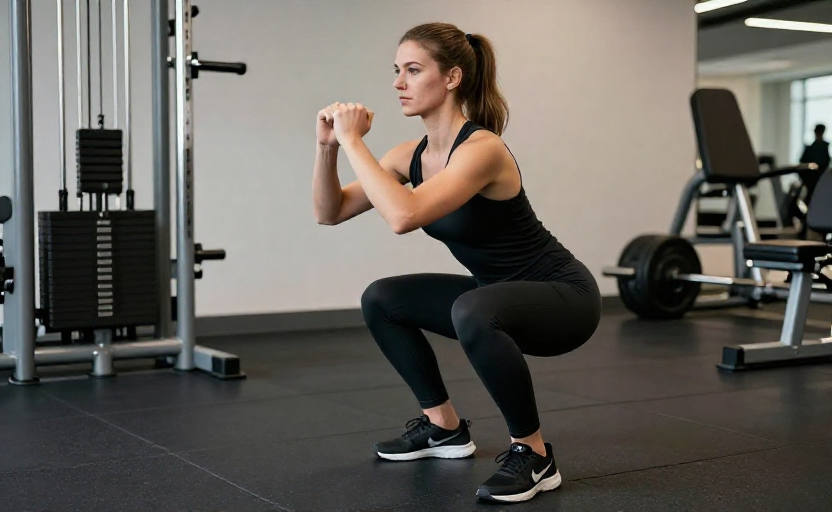
Slow down each bodyweight warm-up rep. Take two seconds to lower into a squat, pause at the bottom, and stand up with control. For an inchworm or a walking lunge, think about the path your foot takes and where your weight sits. Slower reps during warm-up also let you feel asymmetries — a tight hip, a hesitant shoulder — so you can address them before they become a problem under a barbell. Five slow, controlled bodyweight lunges tell your body far more than fifteen rushed ones.
The warm-up is not a formality; it is a rehearsal. Treat it with the same focus you give your heavy sets.
Mistake 4: Ignoring the Coordination Between Upper and Lower Body
Many warm-up routines isolate the lower body (leg swings, squats) and then the upper body (arm circles, band pull-aparts) as if they are unrelated. But a squat, deadlift, or overhead press requires your entire kinetic chain to work as one unit. Tension must transmit from your grip through your core into your legs. If you have not rehearsed that connection, you are asking your body to coordinate under load without a practice run.
Include at least one movement that links the upper and lower body. Dead bugs with controlled arm and leg extension. A bear crawl hold or a slow bear crawl forward. A walking lunge with an overhead reach. These drills force your core to stabilize your torso while your limbs move in opposite directions. That is a skill you need on every heavy set, and it only takes a minute to prime it during warm-up.
Fix these four mistakes and your warm-up transforms from a box you check into a genuine layer of protection. Your joints move through their intended ranges, your nervous system is awake, and your whole body is ready to work together. On lifting days, that is the difference between a strong session and a sidelined one.