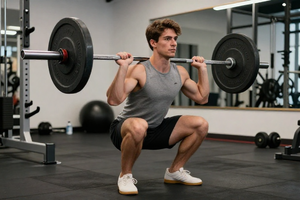

When you first start strength training, your body sends signals you are not used to. That deep ache in your quads the morning after leg day, the tightness in your chest from push-ups, the soreness that makes sitting on the toilet feel like a challenge — it is all part of the process. But for beginners, it is often hard to tell the difference between normal muscle soreness and something more serious like an injury.
Here are three specific symptoms of muscle soreness that beginners commonly mistake for injury, and how to recognize the difference so you can train smart and avoid unnecessary worry.
The pain is symmetrical — both sides feel it
One of the most reliable signs of muscle soreness is that it shows up equally on both sides of your body. If you did squats, both legs ache. If you did rows, both sides of your upper back feel stiff. This symmetrical pattern is a strong indicator of normal soreness from exercise-induced muscle damage (the good kind that builds strength).
In contrast, an injury is almost always one-sided. A pulled hamstring or strained rotator cuff hurts only on the affected side. So when you feel the same discomfort in your left and right limbs, you can usually relax — it is soreness, not injury.
But pay close attention if the pain is only on one side, especially if it came on suddenly during a movement. That asymmetry can be an early warning sign that needs rest or professional evaluation.
The pain is a dull ache, not a sharp or stabbing sensation
The quality of the pain tells you a lot. Normal muscle soreness, often called delayed onset muscle soreness (DOMS), feels like a deep, diffuse ache. It might make your muscles feel heavy, tired, and tender to the touch. It is uncomfortable but not alarming — more like a full-body fatigue than a specific hurt.
An injury, on the other hand, tends to produce sharp, stabbing, or grabbing sensations. You might feel it when you move your arm a certain way, or when you press on a specific spot. If you can pinpoint the pain to a single, small area and it feels like a knife or a needle, that is not just soreness.
Another clue: soreness usually peaks 24–72 hours after your workout and then fades gradually. Injury pain often lingers longer and may actually get worse when you repeat the movement that triggered it.
Your range of motion is reduced but not blocked
When your muscles are sore, you will feel tight and stiff. Reaching overhead or bending down to tie your shoes may feel difficult, but you can still complete the motion — it just hurts a bit. This is because soreness is caused by microscopic tears in muscle fibers and inflammation, which create a feeling of resistance but do not physically stop you.
An injury often restricts your range of motion in a more dramatic way. If your shoulder will not let you lift your arm past a certain point, or if your knee locks up when you try to straighten it, that is a mechanical block — not simple soreness. The difference is subtle but real: with soreness you are reluctant to move; with injury you cannot move.
Try gently moving the sore body part through its full range of motion (without pushing into pain). If you hit a hard stop that will not budge, treat it as a potential injury. If you can move through the full range with achy discomfort, it is likely soreness.
How to manage soreness without risk
Understanding these three differences can give you the confidence to keep training even when you feel beat up. But it is also smart to have a plan for managing soreness so it does not interfere too much with your next workout.
- Light movement, such as walking or gentle stretching, can help. Complete rest is not always better — moving the sore muscles without loading them heavily promotes blood flow and recovery.
- Hydration and protein intake support tissue repair. Drink water consistently throughout the day and eat a meal with protein within two hours after training.
- Apply heat to increase blood flow, or cold if swelling is present. Heat works well for general soreness; cold can help if you suspect inflammation from a minor strain.
- Sleep is when most recovery happens. Aim for at least seven to eight hours per night, especially after challenging workouts.
When to see a professional
Even with good judgment, sometimes it is hard to tell the difference. If the pain does not start to fade after 72 hours, if it keeps you from sleeping at night, if you see significant swelling or bruising, or if the discomfort is severe enough that you cannot walk normally or lift light objects, that is a sign to check in with a physical therapist, athletic trainer, or sports medicine provider.
Trust your body, but also trust the patterns. Most beginner aches are just your muscles saying, “We worked hard, and now we are growing stronger.” Learning to interpret them correctly is one of the most valuable skills you can develop as you build your fitness journey.