Bodyweight training is often sold as the "safe" option. No heavy barbell on your back, no loaded plates to drop — just you and gravity. The logic seems sound, but it misses a critical truth: you can absolutely injure yourself with nothing but your own mass if your mechanics are off. Joint pain is the most common signal that something is wrong, yet many people chalk it up to "getting older" or "just being sore."
After editing hundreds of movement assessments and talking with physical therapists, I've noticed two form errors that come up again and again. They fly under the radar because they don't hurt in the moment. The damage is cumulative. Here’s what to watch for if your wrists, knees, or lower back are complaining about your bodyweight routine.
1. Your wrists ache during planks and push-ups — the hand position giveaway
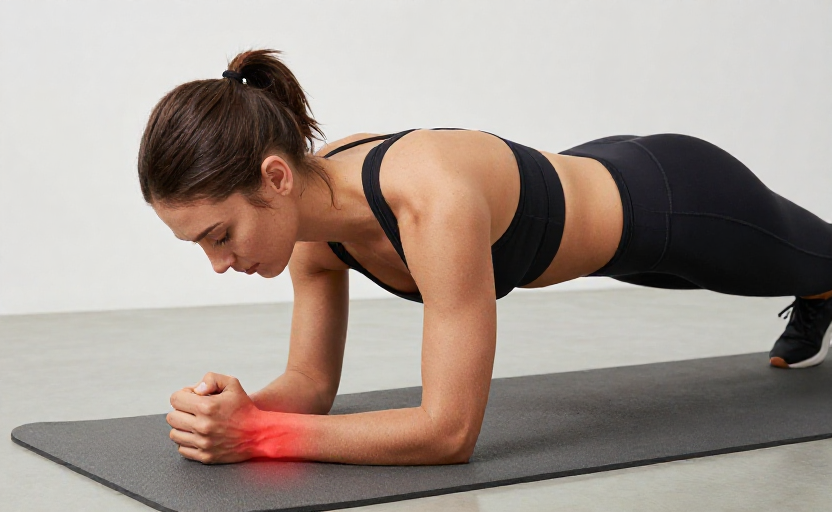
Wrist pain is the number one complaint I hear from people doing bodyweight work. The fix isn't always about strengthening your wrists (though that helps). The real problem is often where your weight lands relative to your hand bones.
Watch yourself from the side during a plank or the bottom of a push-up. If your hands are turned outward (fingers splayed wide) or your palms are lifting slightly off the mat, you're likely dumping your body weight into the heel of your hand — specifically the pisiform bone. That's a small, pea-shaped bone that isn't designed to take your full load. Over time, that pressure irritates the wrist joint and the surrounding ligaments.
Try this: place your hands so your middle fingers point straight ahead (or slightly turned inward, about 10 degrees). Now actively grip the floor with your fingertips, like you're trying to claw into the mat. You want to feel a slight arch in the palm — it shouldn't be flat. That arch distributes the weight across the entire hand skeleton, not just the heel. If you still feel a pinching sensation, try push-ups on your fists (neutral wrist) or use push-up handles until your wrist mobility improves.
A quick check: during a plank, your elbows should be directly over your wrists. If your elbows drift forward past the wrist joint, your shoulders are taking extra shear, and your wrists pay the price.
2. Your knees click or ache at the bottom of a squat — the shin angle trap
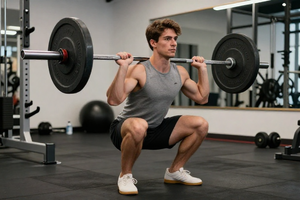
Bodyweight squats seem simple. Sit back, stand up. But the moment your knees start talking back at the bottom of the movement, pay attention. The issue usually isn't depth — it's what your lower legs are doing to get there.
Stand sideways to a mirror and squat slowly. At the bottom, look at your shins. If they're nearly vertical (straight up and down), you're likely compensating by rounding your lower back and shifting your weight onto your toes. That forces your knee joint to become the primary stabilizer, rather than your glutes and core. The result is a grinding sensation or a sharp click in the kneecap (patellofemoral joint).
Now try this: as you descend, allow your knees to track forward slightly — just enough so your shin angle matches the angle of your torso. Your knees should go in the same direction as your toes (usually 10–15 degrees forward from vertical). This alignment keeps your weight in the mid-foot and lets your hamstrings and glutes share the load. A good cue is to think about sitting your hips down between your heels, not back behind them.
The deeper problem: compensation patterns
Both of these form issues share a common root. When one joint can't move properly, another joint takes over — and that borrowed movement creates friction. Stiff ankles lead to wrist pain in planks. Weak glutes lead to knee clicking in squats. Tight lats lead to shoulder impingement in push-ups. Your body is an interconnected system, not a series of isolated machines.
The best fix is to slow down. Really slow down. Take 4 seconds to lower into a squat, pause for a second at the bottom, and brace your core before coming up. In planks, hold for 20 seconds with perfect form rather than 60 seconds with broken wrist alignment. Quality beats quantity every time when joint health is on the line.
If you're feeling consistent discomfort in the same joint for more than two weeks, that's a sign to step back. Rest the movement, work on accessory mobility (ankle dorsiflexion for squats, wrist extension for planks), and rebuild with perfect mechanics. Your joints don't have a reset button — treat them like the irreplaceable parts they are.