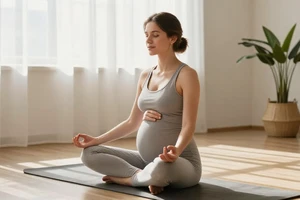

When you step onto your mat during pregnancy, every breath matters. The way you inhale and exhale not only affects your relaxation — it directly impacts your pelvic floor, your baby’s oxygen supply, and your blood pressure. In prenatal yoga, two breathing patterns come up most often: diaphragmatic (belly) breathing and chest (thoracic) breathing. Understanding the difference between them, especially from a safety standpoint, can make or break your practice.
Let’s walk through the key comparison points so you know when to use each technique and why one is almost always the safer default during pregnancy.
What is diaphragmatic breathing?
Diaphragmatic breathing, often called belly breathing or abdominal breathing, engages the dome-shaped diaphragm muscle that sits just below your lungs. As you inhale, the diaphragm contracts and flattens downward, creating space for the lungs to expand. This pushes the abdominal contents forward — your belly rises naturally. On the exhale, the diaphragm relaxes and returns to its dome shape, and the belly falls.
This is the body’s natural, restful breathing pattern. In prenatal yoga, it’s the foundation for grounding, calming the nervous system, and maintaining steady oxygen exchange for both you and the baby.
Safety note: Diaphragmatic breathing is the gold standard in prenatal yoga because it supports pelvic floor relaxation, avoids unnecessary pressure on the abdominal wall, and keeps maternal heart rate stable.
What is chest breathing?
Chest breathing, or thoracic breathing, relies primarily on the intercostal muscles between your ribs. You inhale by lifting and expanding the rib cage upward and outward, while the belly stays relatively still. This pattern is shallow and fast. It’s the type of breathing that kicks in during stress, anxiety, or physical exertion — and it engages the accessory neck and shoulder muscles.
In a non-pregnant context, chest breathing is not dangerous. But during pregnancy, especially in the second and third trimesters, it can introduce risks that deserve attention.
2 critical comparison points for safety
1. Pelvic floor load and intra-abdominal pressure
The most significant safety difference between these two breathing patterns lies in how they affect intra-abdominal pressure (IAP). During pregnancy, the growing uterus already increases baseline IAP. Diaphragmatic breathing helps distribute this pressure evenly through the pelvic floor and abdomen, encouraging the pelvic floor muscles to lengthen and relax naturally on the exhale.
Chest breathing, by contrast, often causes the diaphragm to remain tight and high. This creates a pressure imbalance: the rib cage lifts, but the lower abdomen and pelvic floor do not expand properly. Over time, this can contribute to pelvic floor tension, poor coordination of the pelvic floor muscles, and even exacerbate issues like pelvic girdle pain or diastasis recti. Prenatal yoga emphasizes diaphragmatic breathing precisely to avoid this upward pressure gradient.
2. Oxygen exchange and maternal heart rate
A second major comparison point involves how each breathing pattern affects oxygen delivery and cardiovascular efficiency. Diaphragmatic breathing uses the full capacity of the lower lungs, where blood flow is richest. This maximizes oxygen uptake for both mother and baby without raising the maternal heart rate unnecessarily.
Shallow chest breathing, however, uses only the upper lung fields, which are less vascular. To get the same amount of oxygen, the heart has to beat faster — increasing maternal heart rate and, in some cases, blood pressure. For a pregnant person already managing increased blood volume and cardiac output, this added strain is not ideal. In prenatal yoga, keeping the heart rate moderate is a standard safety guideline, and diaphragmatic breathing naturally supports that goal.
When chest breathing might be useful in prenatal yoga
That said, chest breathing is not universally dangerous. In very specific, short-duration contexts, a prenatal yoga teacher might introduce gentle thoracic expansion — for example, during a side-lying opening pose or to help a student who feels claustrophobic breathing only into the belly. The key is that it should be used sparingly, only in supported positions (like lying on the side or sitting upright with good posture), and never combined with forceful exhales or core engagement.
If you ever feel lightheaded, dizzy, or notice a rapid pulse while practicing chest breathing in class, stop and return to slow belly breathing. Those are signals that the pattern is not serving you.
Practical cues for your prenatal practice
To build a safe prenatal yoga practice around breathing, try these simple checks:
- Hand placement: Place one hand on your belly and one on your chest. On the inhale, feel the belly hand rise first. The chest hand should move only slightly, if at all.
- Exhale length: Make the exhale slightly longer than the inhale. This activates the parasympathetic nervous system and helps the pelvic floor release.
- Avoid breath holding: Holding the breath (kumbhaka) is common in some yoga traditions, but during pregnancy it can spike blood pressure and reduce oxygen to the baby. Stick to smooth, continuous breathing.
The bottom line for prenatal yoga safety
When you compare diaphragmatic breathing to chest breathing in the context of prenatal yoga safety, the evidence is clear: diaphragmatic breathing is the safer, more effective default for nearly all positions and trimesters. It protects your pelvic floor, keeps your heart rate steady, and optimizes oxygen exchange without strain. Chest breathing has a narrow, supervised role — but left unchecked, it becomes a hidden source of tension and cardiovascular load.
Listen to your body, breathe into your belly, and let your practice feel as supported as the baby growing inside you.