You’ve laid out your mat, queued the playlist, and settled into child’s pose. But just before you transition into your first sun salutation, you might hit a familiar wall: the deep core just won’t fire. Your abs feel sluggish, your low back is bracing, and the connection you’re chasing stays stubbornly out of reach. Sometimes the missing piece is not a different cue or a longer warm-up—it’s what you choose to drink beforehand.
What you sip before practice can either sharpen the mind-muscle connection or leave you feeling heavy, jittery, or dehydrated. For practitioners who want to activate the transverse abdominis and pelvic floor—those hard-to-reach stabilizers—the right pre-yoga beverage offers subtle but real advantages. This is not about chugging energy drinks or pre-workout powders. It’s about strategic, gentle hydration and the minerals that support the nervous system and muscle contraction itself.
Why hydration matters for core engagement
The deep core is a network of slow-twitch endurance muscles designed to hold you steady through long holds and transitions. When you’re even slightly underhydrated, your blood volume drops, your nervous system becomes less efficient, and the muscles that need sustained activation—like the transversus abdominis—tend to shut down first. You feel this as a vague instability, a tendency to rely on the rectus abdominis (the “six-pack” muscles) instead.
Water alone is almost always the best base, but the addition of certain nutrients can help the signal from your brain reach those deep fibers more effectively. Think of it as tuning the radio: you have the station, but now you want clearer reception.
Top drinks that support deep core recruitment
Still water with a pinch of unrefined salt
Sodium is absolutely essential for nerve transmission and muscle contraction. A tiny pinch of high-quality sea salt or pink Himalayan salt in a glass of warm or room-temperature water can improve electrolyte balance and neuromuscular signaling. The key is quantity—we are talking about a pinch, not a teaspoon. Overly salty water can cause the opposite effect. Many teachers and sports dietitians recommend this simple hack for anyone who feels “flat” or disconnected during the first half of practice.
Salt amplifies the electrical charge that tells your muscles to engage. Without enough, you’re whispering to your core when you should be giving it a clear command.
Green tea (low-caffeine)
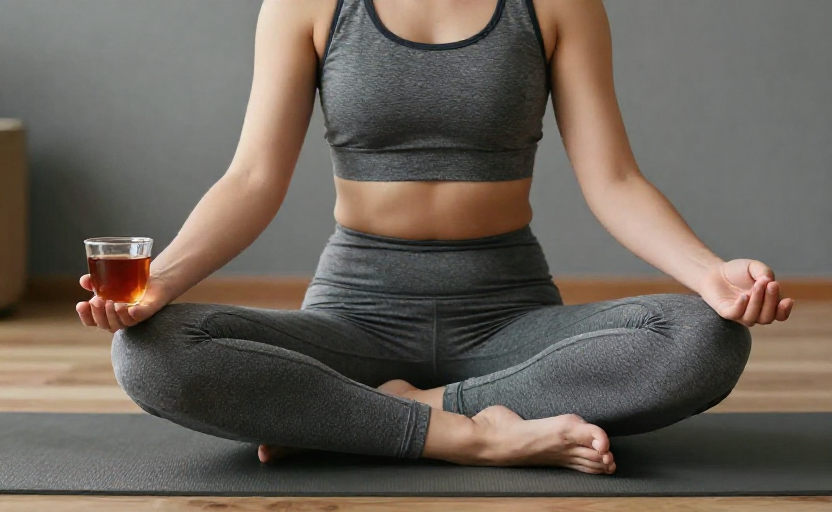
A cup of green tea, steeped for about two minutes (not the long brew that makes it too bitter), provides L-theanine along with a mild dose of caffeine. L-theanine is an amino acid that promotes a state of calm alertness—exactly the mental state you want for core-heavy poses like boat pose, plank variations, and arm balances. The gentle caffeine lift is enough to heighten focus and reaction time without the jitters or crash that can accompany coffee. If you are caffeine-sensitive, choose a decaffeinated green tea or a pure herbal alternative; the ritual of sipping something warm itself signals the nervous system to shift out of fight-or-flight.
Coconut water (unsweetened, no pulp)
For longer or hotter practices, unsweetened coconut water offers naturally occurring potassium and magnesium, plus a small amount of sugar for immediate energy. Potassium is a partner to sodium—without enough, the muscles can cramp or feel “stiff” rather than engaged. The low sugar load is not enough to spike insulin, but it does spare muscle glycogen during a demanding vinyasa or power flow. Avoid the flavored, sweetened versions; they tend to contain added sugar or artificial sweeteners that can cause bloating, which directly interferes with deep core engagement (a belly full of gas or water retention makes it much harder to draw the navel in).
Small amounts of beetroot juice or tart cherry juice (diluted)
Beetroot juice is rich in nitrates, which convert to nitric oxide in the body. Nitric oxide improves blood flow and oxygen delivery to active muscles, especially under sustained isometric conditions like the holds in core work. Tart cherry juice provides antioxidants and has been shown to reduce muscle soreness—which matters if you want to come back to your core practice day after day. The catch: both are strong and can cause stomach upset if consumed full-strength before movement. Dilute one part juice with three parts water, and drink it 45–60 minutes before you start.
What to avoid before a core-focused session
- Dairy-heavy drinks (milk, heavy smoothies, whey protein shakes) are slow to digest and sit in the stomach, making hollowing and compression poses uncomfortable.
- Carbonated beverages (including sparkling water) create trapped gas that distends the abdomen; your brain cannot differentiate between gas pressure and core activation, so the feedback loop gets garbled.
- High-caffeine coffee or energy drinks can fire up the sympathetic nervous system (fight-or-flight), which overrides the parasympathetic state needed for controlled core work. The resulting muscle tension often engages the upper back and neck rather than the deep core.
- Large volumes of anything—even plain water—sipped immediately before practice. A full stomach forces the pelvis into a slight anterior tilt and reduces your ability to find neutral spine.
When to drink, and how much
Timing is as important as the drink itself. Aim to hydrate moderately throughout the day, then take your pre-yoga beverage about forty-five minutes to one hour before the first pose. A good volume is roughly 6 to 10 ounces (180 to 300 milliliters) for most adults. Drinking too close to practice can cause sloshing, while drinking too far out misses the window for optimal hydration. If you have a very early morning practice, a small cup of warm salt water or green tea before you leave the door works well; you can sip more during the first few minutes of class if needed.
Listen to your own body
Everyone’s digestive sensitivity varies. Some practitioners find that any caffeine before an evening class disrupts sleep, while others rely on the focus boost. Some people feel amazing with a splash of lemon in their water; others find acidic drinks cause heartburn during forward folds. The best approach is to test different options during low-stakes home practice and notice how your deep core feels during boat pose, plank, or reclined abdominal work. Keep a simple journal—date, drink, how deep core felt—for a week. Patterns will emerge quickly.
The goal is not to find a magic elixir. It is to remove the obstacles between your intention and your muscles. When your hydration is dialed, your electrolytes are balanced, and your nervous system is calm and alert, the deep core stops being a mystery. You feel the lift from the inside, and every pose becomes a little more connected.