You roll out your mat with the best intentions. The sun is rising, the house is quiet, and you’re ready to greet the day with a few gentle stretches. Yet, by mid-morning, you feel tighter than when you started—a subtle, lingering stiffness that seems to cling to your shoulders, back, or hips all day long. If this sounds familiar, a common, well-meaning error in your morning routine might be the culprit.
This mistake isn’t about doing the wrong pose. It’s about approaching your entire practice with a mindset better suited for noon than for dawn. Morning bodies are unique. After hours of stillness, our muscles are cooler, our joints have less synovial fluid, and our fascia—the connective tissue web that surrounds everything—is less pliable. Treating this body the same as your afternoon body is a recipe for that stubborn stiffness.
Why Your Morning Body Is Different
Think of your body after sleep like a garden hose that’s been coiled in a cool shed overnight. If you try to stretch it out quickly or force it into a sharp bend, it’s resistant, maybe even prone to kinking. Once it’s been in the sun and water has flowed through it, it becomes far more supple. Overnight, your body undergoes a similar process. Core temperature drops, circulation slows, and the fluid that lubricates your joints settles. This isn’t a flaw; it’s a natural, protective state.
Jumping straight into a dynamic flow or deep static holds ignores this physiological reality. You’re essentially asking cold, dormant tissues to perform at capacity immediately. The result is often a protective tensing—a micro-guarding—that can set a tone of rigidity for hours as your nervous system remains on alert.
The Core Mistake: Skipping the Awakening Phase
The routine mistake is this: neglecting to dedicate the first several minutes solely to awakening the nervous system and inviting circulation, not stretching. We confuse movement with mobilization. The goal of the first five to ten minutes should not be to increase flexibility, but to increase internal awareness and fluid movement.
Start by waking up the system, not by stretching it.
This means prioritizing gentle, rhythmic motions that connect breath to small movements. It’s the difference between forcing a forward fold and slowly, with an inhale, lifting your arms overhead, then with an exhale, softly rounding forward vertebra by vertebra, letting gravity do the work.
Signs You’re Making This Mistake
- You move quickly into sun salutations or other familiar flows.
- You hold early stretches to the point of strong sensation.
- Your breath is short or you’re holding it during initial poses.
- The stiffness you feel later is a general tightness, not a specific muscle soreness.
Building a Softer Morning Sequence
Re-framing your morning practice as a transition from rest to activity changes everything. The following principles can help you construct a practice that leaves you feeling open and fluid, not stiff.
Begin Supine or Seated. Don’t even stand up for the first few minutes. Lying on your back or sitting comfortably allows your body to feel supported as it comes online. Simple knee-to-chest rocks, cat-cow stretches on your back, or gentle neck rolls are perfect here.
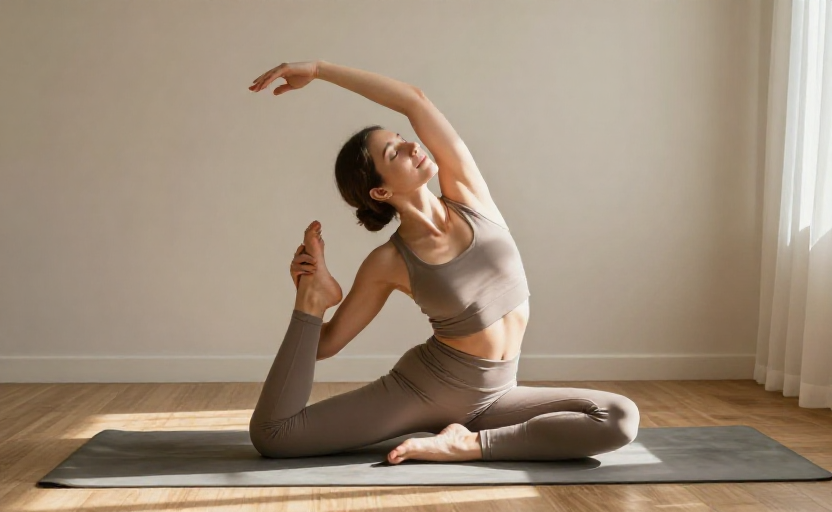
Connect Breath to Micro-Movements. Inhale to create a tiny bit of space; exhale to release, not to deepen. For example, in a seated twist, inhale to lengthen your spine, and only on the exhale do you rotate a degree more. The movement should be almost imperceptible to an observer.
Prioritize Joint Circles. Ankles, wrists, shoulders, and hips benefit greatly from slow, mindful circles. You’re not stretching the muscles here; you’re distributing lubricating fluid and reminding the joint of its full range of motion.
Focus on Fluidity Over Form. Let go of how a pose “should” look. In the morning, a flowing, gentle movement in and out of a shape is more valuable than holding a perfect, static alignment. Think of it as stirring your body’s internal waters.
Two Practices to Replace the Stiffness Cycle
1. The 5-Minute Rehydration Sequence
Do this right after getting out of bed, even before your full practice.
- Sit on the edge of your bed. Circle your ankles 10 times each direction.
- Interlace your fingers and slowly press your palms forward, then overhead, rounding side to side.
- Place hands on knees and do a slow, breath-led cat-cow spine round.
- Stand up. Slowly roll down through your spine to hang for 3 breaths, then roll up just as slowly.
2. The Morning Floor Flow
Stay on your mat on the floor for this entire sequence.
- Start lying down. Hug knees to chest and rock gently side-to-side for 1 minute.
- Extend legs up and gently circle ankles and wrists.
- Come to hands and knees for a very slow cat-cow, moving with each breath for 10 cycles.
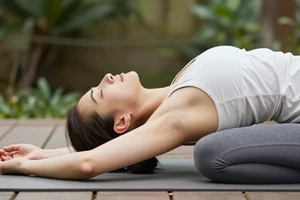
- From there, flow gently between child’s pose and a sphinx pose (never pushing into full cobra), linking each movement to an inhale or exhale.
Only after this kind of awakening should you consider moving into sun salutations or more active poses, and even then, perform them at half your usual pace and depth for the first few rounds.
Listening to Your Body’s Daily Signals
Some mornings you will feel naturally more supple than others. Stress, sleep quality, and hydration from the day before all play a role. Your practice should adapt. The true marker of a successful morning practice isn’t how deep you went, but how freely you move through the rest of your morning. If you finish and feel a need to “crack” your back or stretch again immediately, it’s a sign you moved too quickly or too deeply.
By honoring the unique state of your morning body, you shift from forcing flexibility to cultivating resilience. You’re not just avoiding stiffness; you’re training your nervous system to begin the day in a state of calm readiness, which can influence your posture, stress levels, and movement patterns long after you’ve rolled up your mat.