You finish a tough yoga session or a deep core workout and expect to feel the burn for a day or two. That sensation of gentle fatigue in your abdominals is often a sign that you challenged your muscles. But there is a specific, daily physical signal that many people mistake for normal soreness when it actually points to something else: inadequate recovery of the deep core system.
This signal isn't a sharp pain or a pulled muscle. It is a persistent, low-level tightness that never seems to fade—the kind that makes you feel as though you cannot take a full, satisfying breath. It shows up when you wake up, it lingers during forward folds, and it often makes sitting upright feel like effort. If this sounds familiar, your core is not recovering between workouts. Understanding the difference between productive adaptation and chronic tension is the first step toward building a resilient midsection.
The sensation that feels like a workout but isn't
The primary signal to watch for is a constant, unrelenting feeling of being "braced" in your abdomen, even when you are relaxed. After a challenging core workout, it is normal to feel some muscle fatigue—a sense of warmth or mild tenderness when you press on your obliques or rectus abdominis. That response usually peaks 24 to 48 hours after exercise and gradually subsides.
The non-recovery signal is different. It feels less like fatigue and more like a knot that never loosens. You might notice that your lower ribs flare slightly when you lie on your back, or that your stomach feels hard to the touch even when you try to soften it. In yoga, this often means that poses like Child's Pose or a gentle supine twist do not bring relief the way they used to. Your core is stuck in a low-grade protective state, and it cannot properly rebuild.
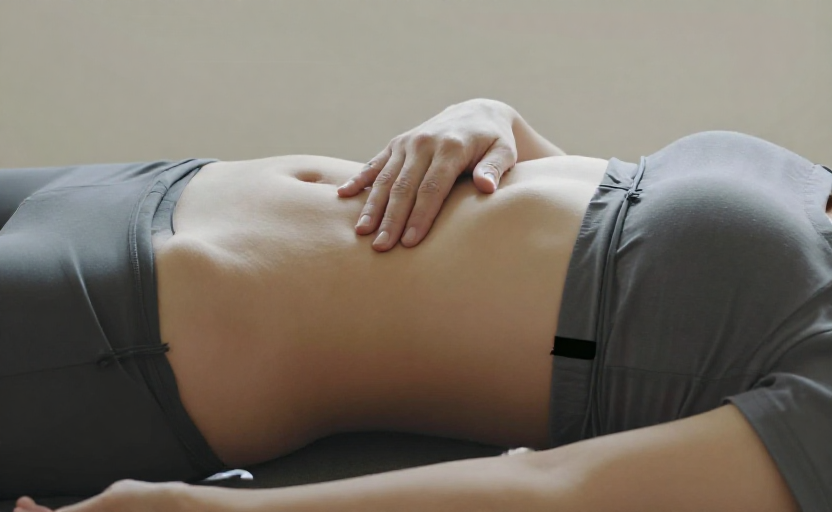
A simple check: Lie on your back with your knees bent. Place your fingertips just inside your hip bones. If your belly feels rigid or your fingers cannot sink inward by even a centimeter, your core may be in a state of chronic activation rather than healthy recovery.
Why chronic tension undermines core recovery
The deep core—particularly the transverse abdominis and the pelvic floor—is designed to turn on and off. It activates to protect your spine during movement and should fully relax when you are at rest. When you push your core muscles too frequently without adequate downtime, the nervous system can fail to disengage that protective tone. The muscles remain in a low-level contraction.
This state prevents the muscle fibers from repairing micro-tears, restricts blood flow to the tissues, and keeps the fascial network tight. Over time, you lose the ability to generate power during your actual workout because the muscles are never fully fresh. You also increase the risk of developing compensations—your lower back or hip flexors start to take over, leading to stiffness that masquerades as flexibility.
Three common mistakes that prevent core recovery
Most people who experience the "never-relaxing" core are not overtraining in the classic sense (hours of crunches daily). Instead, they are making quieter mistakes that keep the core in a perpetual state of activation:
- Practicing abdominal engagement cues all day long. If you have been taught to "zip up" your belly or pull your navel to your spine during every standing posture, it can become a background habit. Carrying that cue into walking, sitting, and even sleeping keeps the core turned on constantly.
- Skipping parasympathetic rest poses. After a strong vinyasa or Pilates session, moving directly into Savasana is not enough if you still feel your abs holding. A bridge with a block under the sacrum or a supported reclined twist specifically targets the nervous system to signal that it is safe to release the core.
- Treating tightness with more flexion. When you feel tight in the abs, the instinct is often to curl forward or do more abdominal work to "loosen" the area. In reality, gentle extension work—like a supported backbend over a bolster—can be more effective because it lengthens the shortened tissues.
How to reset a core that won't recover
If you recognize the signal of persistent tightness, the solution is not to stop moving entirely but to change how you move. For the next few days, prioritize the following actions:
- Breathe into the back body. In a comfortable seated position or lying on your side, send your inhales toward the back of your rib cage and your lower back. Place your hands on your lower ribs and feel them expand posteriorly. This type of breathing directly counters the forward-pulling tension of a tight core.
- Replace active core work with eccentric lengthening. Instead of planks or crunches, try slow, controlled dead bugs where you focus on the exhale phase and fully soften the belly on the inhale. The goal is to rebuild the connection between tension and release.
- Use myofascial release on the diaphragm. The diaphragm is the top of your core cylinder. Lying on a lacrosse ball placed just below the sternum (or on the right side of the rib cage) can help release the fascial tension that keeps the entire core engaged.
- Take one full rest day from all core-intensive activity. No crunches, planks, yoga flows that include Boat Pose, or Pilates hundreds. Walking, gentle hip stretches, and neck rolls are fine—but avoid any movement that makes you consciously brace your stomach.
When the signal changes, recovery is happening
You know your core is recovering when you feel softness in your belly during rest. You might notice that your exhales feel longer or that you can take a deeper inhale without your shoulders rising. During your next yoga practice, a simple Downward Dog will feel more spacious in your abdomen, and you will be able to move into a forward fold without the sensation of a wall in your midsection.
This does not mean you lose strength. In fact, a fully recovered core allows your deep stabilizers to work with greater speed and precision. You will feel stronger in arm balances and inversions because your center can actually react, rather than just hold a rigid brace. Let that persistent tightness be your cue to soften—not to push harder.