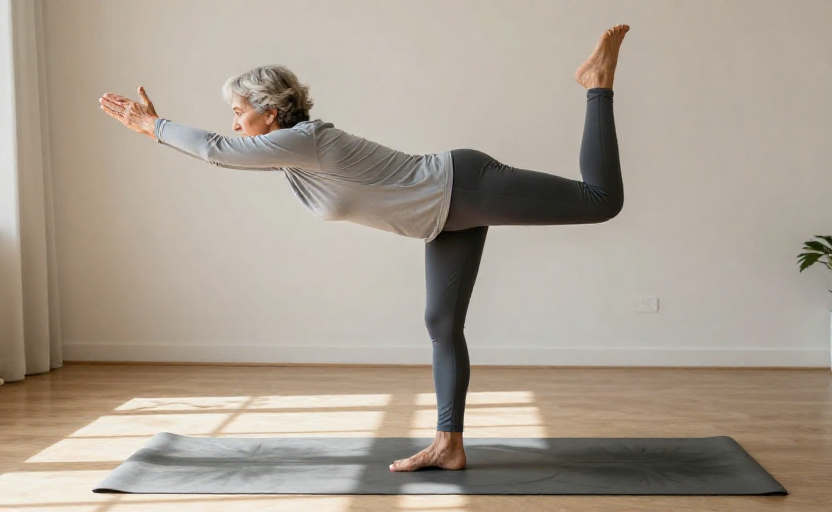
For many seniors, the path to a consistent yoga practice isn't blocked by a lack of desire, but by a quiet fear of losing balance. That unsteadiness when shifting weight, the slight wobble in a tree pose, the hesitation before moving from standing to the floor—these moments can make the mat feel like uncertain ground. Yet, stability is not a fixed trait you either have or lack; it's a skill, built layer by layer, often by something you do long before you unroll your mat.
The most effective tool for improving stability in yoga isn't a fancy prop or an advanced pose. It's a deceptively simple daily habit: mindful walking. This isn't about power-walking for cardio or counting steps for distance. It's about transforming a routine activity into a deliberate, sensory-rich practice of balance and body awareness. This daily rehearsal of stability directly translates to a more confident, grounded experience on the yoga mat.
Why Walking is the Perfect Foundation for Yoga Stability
Walking is our most fundamental movement pattern. It's a continuous, controlled fall—a constant negotiation with gravity where we catch ourselves with one foot, then the other. For seniors, this daily act is a full-body exercise in proprioception, the body's ability to sense its position in space. When you walk mindfully, you're actively training the very systems yoga relies on: your feet communicating with your brain, your core engaging to keep you upright, and your joints learning to move with smooth, controlled coordination.
This practice strengthens the often-overlooked stabilizer muscles in your feet, ankles, and hips—the same muscles that fire to keep you steady in a warrior pose or as you transition into a forward fold. By bringing conscious attention to your walk, you're not just going from point A to point B; you're laying a neural and muscular foundation for every standing and balancing pose you'll encounter in your practice.
How to Practice Mindful Walking for Better Balance
This isn't about adding another lengthy workout to your day. It's about infusing an existing activity with intention. Start with just five to ten minutes of your normal daily walk, whether that's to the mailbox, around the kitchen, or down a garden path.
Focus on the sensation of weight transfer. Feel the heel of your foot make contact with the ground, then the ball, then the toes. Notice the slight push-off as you move forward. Is your weight evenly distributed between both feet? Are you leaning forward or back? Simply observing these details begins to rewire your balance systems.
Keep your gaze soft and forward, not down at your feet. This trains your vestibular system (your inner ear's balance center) and visual system to work together, which is crucial for preventing falls and maintaining orientation in yoga poses where your head position changes.
Think of your foot as having a tripod: the base of the big toe, the base of the little toe, and the center of your heel. Aim to feel all three points connecting with the ground as you walk.
Engage your core gently, as if you're preparing to receive a light tap on the abdomen. This doesn't mean sucking in your stomach; it's a gentle bracing that connects your upper and lower body, creating a stable cylinder of support. This core awareness is what allows you to maintain poses like mountain or chair pose without straining your back.
Connecting Your Daily Walk to Your Yoga Mat
The benefits of this daily habit don't stay on the sidewalk. They follow you directly onto your mat. You'll begin to notice the connection.
In poses like Tadasana (Mountain Pose), you'll recall the feeling of even weight distribution in your feet. You'll stand with the same rooted, aware stability you practiced during your walk. When you move into Vrksasana (Tree Pose), the subtle ankle adjustments you make to stay upright will feel more familiar—they're the same micro-corrections you use to stay balanced with each step.
Transitions, which are often where instability strikes, become smoother. Moving from a standing pose to the floor, or shifting from one side to the other, feels less like a precarious maneuver and more like a natural progression. Your body has been rehearsing controlled weight shifts all day long.
Breath as Your Anchor
Weave your breath into your mindful walk. Try syncing your steps with your inhales and exhales—perhaps inhaling for three steps, exhaling for three steps. This builds the mind-body-breath connection that is the heart of yoga. When you then come to your mat and your instructor cues you to breathe through a challenging balance pose, it won't be a foreign concept. It will be a continuation of the calm, rhythmic awareness you cultivated on your walk.
A Sustainable Practice for Long-Term Benefits
The beauty of this habit is its sustainability and integration. It requires no special equipment, no extra time carved out of a busy schedule. It turns necessity into practice. Consistency is far more powerful than intensity here. A few minutes of mindful walking every day does more for your neural pathways and muscular memory than one long, intense session once a week.
Over time, this practice builds a deep, subconscious confidence. The fear of wobbling begins to fade, replaced by the knowledge that your body knows how to find and regain its center. Your yoga practice stops being a test of balance and becomes a joyful exploration of movement and strength, supported by the stable foundation you build with every step you take.