
You feel it first in your shoulders, a creeping tension. Then your thoughts start to race, your breath becomes shallow, and the world feels like it’s closing in. Acute stress has a physical signature, a cascade of reactions that can leave you feeling overwhelmed. While the source of the stress might be a looming deadline, a difficult conversation, or a sudden change, the body’s response is universal: the nervous system shifts into high alert.
This is where the ancient practice of yoga breathing, or pranayama, offers a remarkably modern solution. It’s a direct line to your autonomic nervous system, the part of you that controls your heart rate, digestion, and that fight-or-flight response. You don’t need a yoga mat, an hour of free time, or special clothes. You just need your breath and a few evidence-based techniques to turn the volume down on stress, right in the moment it arises.
Why Your Breath Is the Quickest Stress Lever
When stress hits, breathing becomes an unconscious casualty. We tend to take short, rapid breaths high in the chest, which signals to the brain that danger is present, reinforcing the stress cycle. This shallow breathing activates the sympathetic nervous system, keeping you in a state of readiness.
Conscious, controlled breathing does the opposite. It stimulates the vagus nerve, a major highway of the parasympathetic nervous system, which is responsible for rest, digestion, and calm. Research, including studies published in journals like Frontiers in Human Neuroscience, shows that specific breathing patterns can lower cortisol levels, reduce heart rate, and decrease perceived anxiety almost immediately. The breath is a tool you always have with you, one that requires no prescription and has no side effects, only a shift in awareness.
Four Breathing Techniques for Immediate Calm
These methods are chosen for their simplicity and scientific backing. They are most effective when practiced for just a few minutes during a stressful moment, or even proactively when you feel tension building.
Equal Breathing (Sama Vritti)
This is the foundation of breath control. The goal is to make your inhales and exhales the same length, creating a rhythm that soothes the mind.
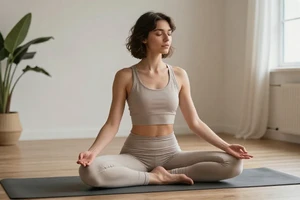
How to practice: Sit comfortably with a straight spine. Inhale slowly through your nose for a count of four. Feel the breath fill your lungs. Then, exhale smoothly through your nose for the same count of four. Continue this pattern for two to five minutes. If four feels too long, start with a count of three. The key is the equality.
Think of this as hitting the reset button on your respiratory rhythm. It’s the first step in reclaiming control.
Extended Exhale (4-7-8 Breathing)
Popularized by Dr. Andrew Weil, this technique leverages the power of a longer exhale to powerfully activate the relaxation response. Extending the out-breath is a direct signal to your nervous system to downshift.
How to practice: Place the tip of your tongue against the ridge of tissue behind your upper front teeth and keep it there throughout. Exhale completely through your mouth, making a soft whoosh sound. Close your mouth and inhale quietly through your nose for a count of four. Hold your breath for a count of seven. Then, exhale completely through your mouth (with the whoosh sound) for a count of eight. This is one breath cycle. Repeat for three more cycles.
Alternate Nostril Breathing (Nadi Shodhana)
This classic pranayama is renowned for creating mental clarity and balancing the left and right hemispheres of the brain. It can feel particularly helpful when your thoughts are scattered or agitated.
How to practice: Sit comfortably. Place your right thumb over your right nostril and inhale deeply through your left nostril. At the top of the inhale, close your left nostril with your ring finger, release your thumb, and exhale through your right nostril. Now, inhale through the right nostril, close it with your thumb, release the ring finger, and exhale through the left. This completes one round. Continue for five to ten rounds, focusing on the sensation of the breath moving in and out.
Coherent Breathing
Also known as resonance breathing, this method aims for a specific, optimal rate of about five breaths per minute (an inhale and exhale totaling about 12 seconds). This pace has been shown in research to maximize heart rate variability, a key marker of resilience and nervous system balance.
How to practice: Inhale through your nose for a count of five. Exhale through your nose for a count of five. Maintain this steady, gentle rhythm. Use a quiet timer or a dedicated breathing app if it helps you find the pace without watching a clock. Practice for five to ten minutes.
Integrating Breath into Your Stress Moments
The techniques are simple, but using them in the heat of the moment is the real skill. It’s about creating a new habit.
Start by choosing one method, perhaps Equal Breathing, and practice it for two minutes each morning when you first sit up in bed. This builds familiarity. Then, create “breath anchors” in your day. Link the practice to a routine event: after you hang up a phone call, before you start your car, or while you’re waiting for your computer to boot. When acute stress strikes, you’ll have a trained response ready to go.
If you’re in a public place or a meeting, you can practice discreetly. Simply focus on making your exhales longer and smoother than your inhales, all through your nose. No one needs to know you’re actively managing your stress response.
What to Remember When Starting Out
Breathwork is powerful. Go gently. It’s not a performance. If you feel lightheaded, dizzy, or overly anxious, stop and return to your normal breathing. The goal is regulation, not strain. Always breathe through your nose if possible, as it filters, warms, and humidifies the air, and naturally slows the breath.
These strategies are tools for managing the physiological symptoms of acute stress. They are not a substitute for professional help for chronic anxiety, trauma, or depression. If your stress feels unmanageable, speaking with a therapist or healthcare provider is a vital step.
Your breath is the most constant rhythm of your life. Learning to guide it with intention is perhaps the most accessible form of self-care there is. It turns a reflexive reaction into a chosen response, giving you back a sense of agency when the pressure mounts.