Understanding your core strength goes far beyond the number of sit-ups you can crank out. A stable, functional core is the foundation for almost every movement—from lifting a grocery bag to holding a solid yoga pose. But how do you know if your core is actually strong, or just looks the part? You don't need a gym or a fancy trainer to find out. With a few simple, evidence-based tests, you can assess your deep stabilizing muscles right in your living room.
The goal here is not to compete with anyone else. It is to establish a baseline for yourself so you can track progress and identify weak links that might be holding back your practice or predisposing you to lower back discomfort. These assessments focus on endurance and stability rather than brute force, which is a more telling measure of core health.
The 60-Second Plank: Your Stability Baseline
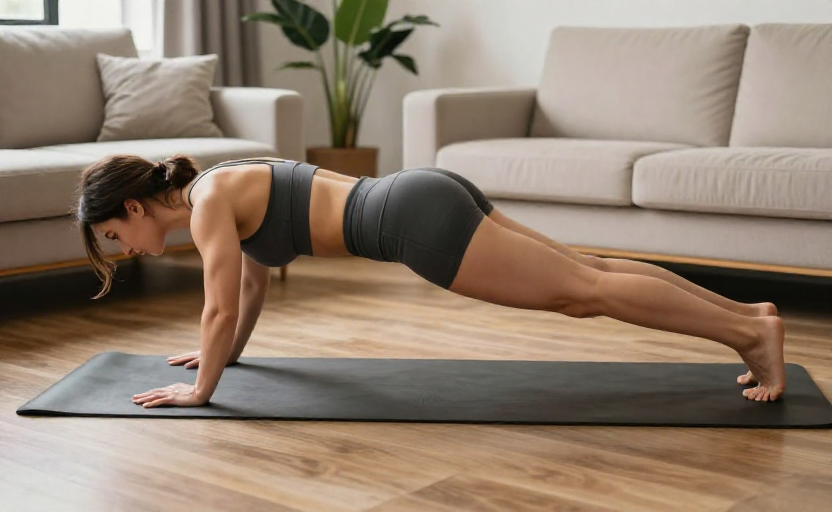
The standard front plank is a reliable indicator of core endurance. It targets the rectus abdominis, transverse abdominis, and the spinal erectors. Here is how to perform a proper test:
- Setup: Lie face down on a mat. Prop yourself up onto your forearms and toes. Your elbows should be directly under your shoulders, and your forearms parallel to each other.
- Form: Squeeze your glutes and quads to engage your legs. Pull your belly button toward your spine. Your body should form a perfectly straight line from your head to your heels—no sagging hips or raised rear end.
- The Test: Start a stopwatch. Hold the position for as long as you can while maintaining perfect form. Stop the timer the moment your hips drop, your lower back sags, or you feel forced to hold your breath.
A solid benchmark: Holding a strict plank for 60 seconds is considered a minimum standard for general fitness. If you can hit 90 to 120 seconds, you have good core endurance. Under 30 seconds signals a clear need for foundational strengthening.
The Side Plank: Checking Lateral Stability
Your obliques and quadratus lumborum are critical for side-to-side stability and preventing rotation during movement. A weak lateral chain often shows up as wobbling in side-angle poses or struggle during single-leg balances.
How to test: Lie on your side with your legs stacked. Prop yourself up onto your bottom forearm, elbow under shoulder. Lift your hips until your body forms a straight diagonal line from head to heels. Stack your top foot on your bottom foot for stability.
Measure it: Hold as long as you can without letting your hips drop. Compare the time on your right side versus your left side. A difference of more than 10 seconds indicates a muscular imbalance that you should address. The general goal is 30 to 45 seconds per side for a healthy core.
The Dead Bug: Deep Stabilizer Control
The dead bug test removes momentum and ego, exposing how well your brain can actually recruit your deep core muscles. It is more about control than raw endurance.
Execution: Lie on your back with your arms extended straight up toward the ceiling and your legs lifted with knees bent at a 90-degree angle (tabletop position). Press your lower back flat into the mat—do not let it arch.
The movement: Slowly extend your right arm overhead and your left leg straight out toward the floor, keeping both hovering just above the mat. Simultaneously, return them to center. Alternate sides. A passing grade means you can complete 8 to 10 slow, controlled repetitions per side without your lower back losing contact with the floor. If your back arches or you wobble, your core is disengaging.
The Single-Leg Lowering Test: Dynamic Control
This test evaluates your lower abdominal strength and your ability to control pelvic tilt under load. It is a favorite among physical therapists for a reason.
Setup: Lie flat on your back, legs straight, arms by your sides. Press your lumbar spine firmly into the floor.
The movement: Keeping your leg straight, slowly lower one foot toward the floor. The moment you feel your lower back start to lift off the mat, stop. Note the approximate angle that your leg has traveled (e.g., 45 degrees from vertical). The lower you can go without losing back contact, the stronger your lower core. If you cannot lower your leg past 45 degrees without arching, your lower core needs attention.
What to Do with Your Results
These tests are diagnostic, not a workout. Use them once every 4 to 6 weeks to gauge improvement. If your scores are low, avoid the temptation to rush into hundreds of crunches. Instead, prioritize exercises that build tension and control: dead bugs, bird dogs, pallof presses, and slow, tempo-based planks. If you notice significant asymmetry between sides or sharp pain during any of these tests, it is wise to consult a physical therapist or a qualified yoga instructor who understands biomechanics.
Core strength is not a destination. It is a moving target that changes with your activity level, recovery, and even your stress. Testing yourself periodically is simply a way to check in with your body's foundation without guesswork.