After years of sitting, your body has learned some very specific—and often problematic—movement habits. Your hamstrings whisper in protest when you stand, your shoulders have migrated toward your ears, and your hip flexors feel like they've taken up permanent residence in a shortened position. Yoga offers a path to undo some of that damage, but there is a paradox: the same stiffness that draws desk workers to the mat also makes them uniquely vulnerable to injury.
I have worked with enough desk-bound practitioners to notice a pattern. You push into a forward fold because you remember being more flexible in college. You crank your neck to look at the instructor because turning your whole torso feels cumbersome. You hold a pose too long because you are trying to "fix" yourself. By the time you feel a sharp twinge, the tissue has already been protesting for weeks. The goal here is to help you read those quieter signals before they become loud problems.
Why desk workers get hurt differently
Sitting for six, eight, or ten hours per day creates predictable patterns: tight chest and front shoulders, weak upper back, overworked hip flexors, and glutes that have essentially forgotten how to fire. When you enter a yoga class with these imbalances, your body compensates. It recruits muscles that are already tight to do the work that weaker muscles should be doing. This compensation feels like "stretching" in the moment, but it is actually straining tissue that is already loaded.
The early signs of trouble rarely feel like an acute injury. They feel like a slight pinch in one hip during standing poses. A vague ache in the low back the morning after class. A sensation of the hamstring being "too tight" no matter how much you stretch it. These are not normal discomforts you should push through. They are your body's way of saying that a particular movement pattern is exceeding the capacity of the tissue.
The desk worker's rule of thumb: If the sensation is new, specific to one side, or lingers longer than two days after practice, it deserves attention—not more stretching.
Where desk workers most often hurt themselves
While yoga injuries can happen anywhere, certain areas are disproportionately affected in people who spend their days at a keyboard. Knowing these hotspots helps you check for early warning signs at home.
Wrists and hands
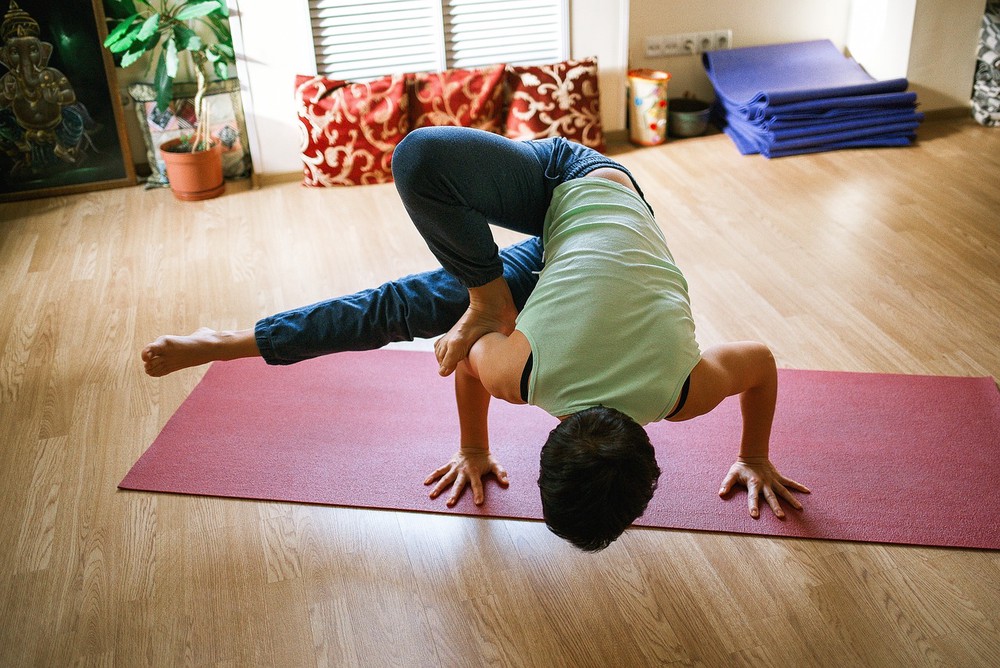
Your wrists have already endured hours of typing with less-than-ideal alignment. When you then bear weight on them in Downward Dog, Plank, or arm balances, the repetitive extension strain can aggravate the median nerve. Early signs include a sense of the wrist feeling "tight" in the first few seconds of bearing weight, a mild ache that disappears after warming up, or vague tingling in the thumb and first two fingers. Many desk workers dismiss this as normal, but it is often a precursor to carpal tunnel irritation.
Lower back
Seated postures shorten the psoas and tighten the lumbar fascia. In yoga, forward folds and deep backbends can push a tight lower back past its safe range. The early signal here is not pain—it is a feeling of the lower back "taking over" during movements that should involve the hips. If you feel your lumbar spine rounding excessively in a forward fold, or if you feel compression in the low back during a backbend rather than opening through the front body, you are likely stressing the vertebral discs and facet joints.
Hamstrings
Sitting causes the hamstrings to adaptively shorten. Desk workers often approach hamstring stretching with aggressive determination, pulling into forward folds and holding for minutes. The early warning sign is a pulling sensation that feels like it is located in the tendon close to the sit bone, rather than a broad stretch in the belly of the muscle. This specific, localized pull near the attachment point is a sign that you are stressing the proximal hamstring tendon. Continuing this pattern can lead to a stubborn tendinopathy that takes months to resolve.
Hips and SI joint
The sacroiliac joint compensates for tight hips and weak glutes. Desk workers often feel this as a vague ache in one side of the low back, just beside the sacrum, especially in standing poses or when transitioning through lunges. A common early sign is a sensation of one hip feeling "higher" or "stuck" in poses like pigeon or supine figure-four. This asymmetry is not a stretch imbalance to be corrected—it may indicate that the SI joint is moving beyond its normal range because the surrounding muscles are not providing stability.
How to self-check for injury signs at home
You do not need a yoga teacher or a physical therapist to perform a basic safety check. Before or after your practice, run through these simple assessments. If any of them produce unfamiliar sensations, consider modifying or skipping the associated poses for a few weeks.
Wrist check. Come to hands and knees. Press the palms flat and gently rock forward so that your wrists go into extension. If you feel any discomfort that is not a symmetrical, familiar stretch, that is a warning. Make a fist and try the test again with your knuckles on the mat—if the discomfort disappears, your wrists are asking for a break from weight-bearing.
Spine check. Lie on your back with knees bent. Slowly lift your hips into a small bridge, then lower. Pay attention to what your low back does. If you feel a pinch or if the low back arches excessively before the hips lift, your lumbar spine may be dominating the movement. This suggests that your glutes are not engaging properly, and you should reduce the range of motion in backbends until you can activate your glutes independently.
Hamstring check. Sit on the floor with one leg straight. Keeping a flat back, hinge forward from the hips just until you feel a sensation. Stop. If the feeling is a sharp, localized pull at the crease of the hip or behind the knee, back off. The stretch should be a broad, diffuse sensation in the belly of the hamstring.
Hip check. Stand on one leg. Lift the opposite knee toward your chest and hold for a few seconds. Then, without lowering the foot, rotate the lifted leg outward and place the ankle on the standing knee (the tree position). If the hip of the standing leg feels unstable or if the low back compensates by swaying, your stabilizers are not ready for deep hip-opening poses. Focus on strengthening the glute medius before attempting deeper external rotation.
When to modify or rest
The line between productive discomfort and harmful pain is not always obvious, but desk workers can use two simple metrics. First, the sensation should never be sharper when you repeat the movement the next day. If yesterday's pose hurts more today, you irritated something. Second, if the sensation is present during daily activities like walking or sitting, you are beyond the early warning stage and need to rest the affected area completely for a few days.
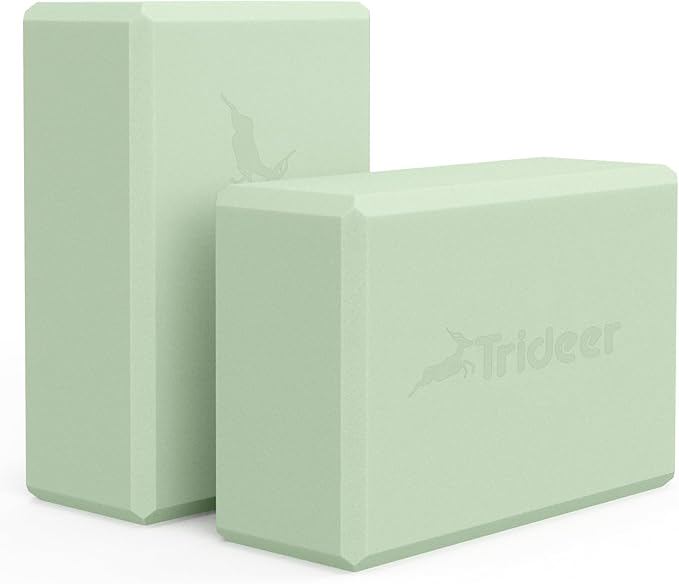
Modifications are not a sign of failure. Using blocks to raise the floor in forward folds, bending your knees in hamstring stretches, practicing dolphin pose instead of Downward Dog on high-wrist days—these adaptations keep you moving while respecting tissue load. Yoga is not about achieving a shape; it is about learning to listen more closely than you have before.
One last thought for the desk crowd: the time between realizing something feels "off" and deciding to do something about it is almost always too long. You notice the twinge, tell yourself it will go away, and then reinforce the same pattern in three more classes. If you read this article because a part of your body has been whispering for a few weeks, trust it. Give that area a week of gentle, modified practice and see what happens. Your mat is a feedback loop, not a test of will.


![Tumaz Yoga Strap/Stretch Bands [15+ Colors, 6/8/10 Feet Options] with Extra Safe Adjustable D-Ring Buckle, Durable and Comfy Delicate Texture - Best for Daily Stretching, Physical Therapy, Fitness](https://www.glowtheorylab.com/uploads/ad202604/d62cf3b7330d7d4a.webp)