You’ve just rolled up your mat, your muscles feel warm and pliable, and your mind is quiet. That post-yoga clarity is a beautiful thing — but for the millions of us who spend the other 23 hours of the day hunched over a keyboard, the real challenge begins when you sit back down at your desk. Without intentional recovery, those hard-won gains in mobility and posture can evaporate within an hour of returning to your chair.
The problem isn’t the yoga. It’s the abrupt transition from an elongated, open spine to a flexed, forward-head position. These six expert-backed habits bridge that gap, helping you preserve the benefits of your practice while protecting your body from the cumulative damage of sedentary work.
1. Hydrate with electrolytes, not just water
Yoga makes you sweat — even gentle styles in a cool room. When you rehydrate with plain water alone, you dilute your remaining electrolyte balance, which can worsen muscle cramps and fatigue. Desk workers are already prone to dehydration from air-conditioned offices and too much coffee, so this is a double risk.
Try adding a pinch of sea salt and a squeeze of lemon to your first glass of water post-practice. The sodium helps retain fluid, and the citrate in lemon may reduce the perception of muscle soreness. If you practice hot yoga or vinyasa flow, consider an electrolyte tablet with no added sugar. Aim for 16 to 20 ounces of fluid within thirty minutes of finishing your practice.
2. Do a 90-second “spinal reset” before you sit down
This is the single most effective habit I recommend to clients who sit for a living. Before you lower yourself into your desk chair, stand at the edge of your seat and perform a gentle counter-stretch. Interlace your hands behind your back, straighten your arms, and lift them away from your body as you draw your shoulder blades together. Hold for three slow breaths.
This reversed position lengthens the pectorals and opens the front of the shoulders — exactly the tissues that tighten when you reach for a keyboard. It takes less than two minutes and creates a sensory memory that says, this is how your upper body should feel. Whenever you catch yourself slumping during the workday, come back to this exact position for a breath or two.
3. Eat a recovery snack within the “golden hour”
The thirty to sixty minutes after exercise is when your muscles are most receptive to nutrients. For desk workers, skipping this window often means reaching for a sad vending-machine snack at 4 p.m. when energy crashes hit. A smart post-yoga snack supports both muscle repair and steady blood sugar for sustained focus.
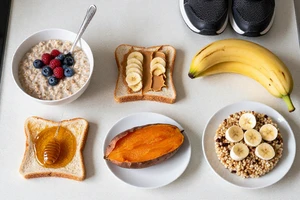
Pair protein with a carbohydrate that has some fiber: a small apple with a tablespoon of almond butter, a hard-boiled egg with a banana, or a quarter-cup of edamame. Avoid sugary protein bars that spike and drop your glucose. Your brain and muscles will thank you around hour three of an afternoon spreadsheet session.
4. Change into a different seat height for ten minutes
Your yoga mat gave you freedom to explore multiple hip and knee angles. Your desk chair locks you into a single position: hips at ninety degrees, knees at ninety degrees, spine flexed. This static loading is hard on your lumbar discs and hip capsules.
Keep a second perch near your desk — a firm yoga block, a small stool, or even a folded blanket on a chair that is six to eight inches higher than your usual seat. For the first ten minutes of your work session, sit on this elevated surface. Your hips will rest in deeper flexion (roughly a squatting angle) which decompresses the lower back and encourages an upright pelvis. After ten minutes, switch back to your regular chair. It’s a small shift that signals your spine, we are not stuck here all day.
5. Schedule one “yoga micro-break” per hour
Post-yoga recovery isn’t a one-and-done event — it’s a series of small interventions that prevent the desk from undoing your practice. Set a quiet timer on your phone or computer to go off every fifty-five minutes. When it rings, stand up and perform one single yoga pose that targets your biggest desk problems: neck, wrists, and low back.
Rotate through a short list: a standing forward fold with knees bent to release the lower back, a wrist stretch (extend one arm, pull the fingers back with the opposite hand), and a gentle neck side-bend. Each micro-break takes less than sixty seconds. Over a six-hour workday, that is only six minutes of movement that can cut your post-yoga soreness by more than half, according to research on movement breaks for sedentary workers.
6. Use a “cool-down screen” for the last five minutes of your day
Yoga teaches us to transition with awareness — savasana, after all, is the most important pose. Desk work rarely offers such closure. You close one browser tab, open another, and suddenly you have been working for three hours without noticing. This habit borrows the yogic principle of intentional transition.
Set a hard stop alarm five minutes before you plan to log off. During those final minutes, do not check email or scroll social media. Instead, sit upright with both feet flat on the floor, close your eyes, and place one hand on your belly and one on your heart. Breathe slowly for ten cycles. Then, as you open your eyes, consciously release your shoulders from your ears. This mini-savasana signals your nervous system that work-mode is over, which improves sleep quality and reduces the likelihood of carrying desk tension into your next yoga session.
Recovery is not passive. It is an active practice that extends what you gained on the mat into the rest of your life. For desk workers, the gap between yoga and sitting is small but consequential. These six habits close that gap with minimal time and no equipment — just intentional presence, which is, after all, what yoga has been teaching you all along.