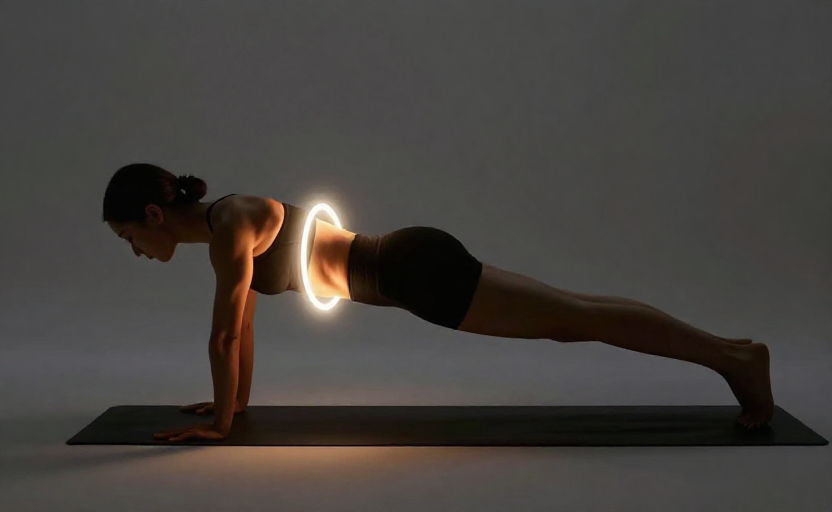
You show up on the mat, move through your sun salutations, and feel a gentle burn. But is that burn actually coming from your deep core? Many practitioners discover, often after months of practice, that their center is merely along for the ride—not doing the work.
A disengaged core in yoga isn't about a lack of effort; it's about a lack of specific, mindful activation. When your powerhouse is sleeping through class, your lower back, hips, and even your breath pattern start to compensate. Here are five concrete signs that you are relying on surface muscles and momentum instead of your true center.
1. Your Lower Back Hates Forward Folds
In a seated forward fold (Paschimottanasana) or standing forward bend (Uttanasana), you should be hinging at your hips. A clear sign of a dormant core is a rounded, painful lower spine as you descend. Instead of tucking the tailbone and engaging the lower abdominals to protect the lumbar spine, your back is taking the full load.
The fix isn't to reach further. The fix is to engage before you fold. On your next exhale, draw your navel toward your spine and imagine wrapping the muscles of your lower belly upward before you hinge forward. If your lower back feels relieved, your core was likely asleep.
Healthy forward folds come from a stable pelvis, not a flexible spine.
2. You Wobble in Standing Balance Poses
Trembling is normal. Wobbling from the ribcage is a red flag. When you stand in Tree Pose (Vrksasana) or Warrior III (Virabhadrasana III), the core's job is to keep your ribcage stacked over your pelvis. If you feel yourself tilting sideways or back, or if your lower ribs flare outward, your deep transverse abdominis is not firing.
A flared rib cage means your diaphragm is locked and your core is disengaged. To test this, place your hands on your lower ribs in Mountain Pose. Without moving your spine, gently knit the ribs toward each other. That subtle compression—not a hard crunch—is the beginning of core engagement.
3. You Glide Through Plank (and Feel Nothing in Your Belly)
Plank pose (Phalakasana) is a litmus test for core connection. If your shoulders and wrists ache before your abdominals do, or if you can hold a two-minute plank without feeling your center burn, you are likely sagging in the mid-section.
A common mistake is pushing the floor away with your arms while letting your belly drop toward the mat. Proper core engagement in plank requires a full-body line. Squeeze your glutes, hug your thighs toward the midline, and actively draw your navel upward toward your spine. You should feel as if someone is about to gently place a weight on your lower back—not because you are arching, but because your entire torso is braced.
4. Your Breath is Shallow and Noisy
Yoga breath (Ujjayi) relies on a stable, engaged core to support a smooth, deep inhalation and exhalation. If your breath is choppy, forced, or you hold your breath during transitions, your core muscles may be tight and unmoving, or entirely switched off.
The diaphragm sits directly on top of the core. When your lower ribs are expanded and your belly is soft and mute, you are not recruiting the deep stabilizing muscles. Try this: exhale fully through your nose until your lungs are empty. Hold that empty space for a beat, and notice how your lower abdominals naturally tighten. That is core engagement. Inhale into that held structure—not into a relaxed belly.
5. You Cannot Link Movement to an Exhale
In yoga, the exhale initiates movement. When you exhale, the core naturally contracts and the spine rounds slightly. If you find yourself initiating a transition (like Chaturanga or lifting into Boat Pose) with an inhale or while holding your breath, you are bypassing the core entirely.
The exhale is your anchor. Every time you exhale, consciously draw the navel in. If you cannot feel a distinct muscular pull from the belly during your exhale, your breath practice is disconnected from your core practice. Without that connection, you are doing calisthenics with a yoga soundtrack.
A practical reset. Next time you are on the mat, pick one pose from this list. Before moving, pause. Inhale. Exhale completely. Feel the navel draw back and up. Then move on that exhale. Repeat this for one week. The burn you find will tell you everything you need to know about your core.