Yoga often conjures images of stillness and gentle stretching, a quiet counterpoint to the pounding rhythm of a treadmill. But within the vast practice lies a dynamic, physically demanding style known as power yoga. It’s a flowing sequence of postures designed to build heat, strength, and endurance, challenging the body in a way that can rival—and in some cases, surpass—the calorie burn of steady-state cardio.
The secret lies in the combination of muscular engagement and cardiovascular demand. Unlike running, which primarily targets the lower body, these power yoga poses recruit major muscle groups from head to toe. Holding a demanding posture requires significant isometric strength, which elevates your heart rate and metabolism not just during the practice, but for hours afterward. It’s this full-body, metabolic effect that makes the calorie comparison so compelling.
What makes these poses so effective?
Think of your body as an engine. The more muscle mass you engage simultaneously, the more fuel that engine requires. The five poses highlighted here are compound movements. They don’t isolate one muscle; they integrate your core, legs, arms, and back into a single, stabilizing effort. This creates a high energy demand. Furthermore, the balance and control required fire up your nervous system, adding another layer of metabolic activity.
Power yoga transforms strength work into a cardiovascular challenge, making it uniquely efficient for energy expenditure.
It’s crucial to approach these poses with mindfulness, especially if you’re new to the practice. Proper form is paramount to reap the benefits and prevent strain. Listen to your body, use modifications as needed, and consider learning the foundations with a qualified instructor.
The five power poses
These asanas form a powerful core sequence. Move through them with intention, linking your breath to each movement. A single round can be challenging; repeating the sequence 3-5 times creates a formidable, calorie-torching workout.
Chaturanga Dandasana (Four-Limbed Staff Pose)
Often called the yoga push-up, Chaturanga is a full-body furnace. It builds incredible core and upper-body strength while demanding stability from your legs.
- Begin in a high plank position, wrists under shoulders, body in a straight line from head to heels.
- As you exhale, engage your core powerfully and bend your elbows, hugging them close to your ribs.
- Lower your entire body as one unit until your shoulders are level with your elbows. Avoid letting your hips sag or pike upward.
- Hold for a breath, feeling the intense engagement in your abdomen, chest, and triceps, before pushing back up or flowing into your next pose.
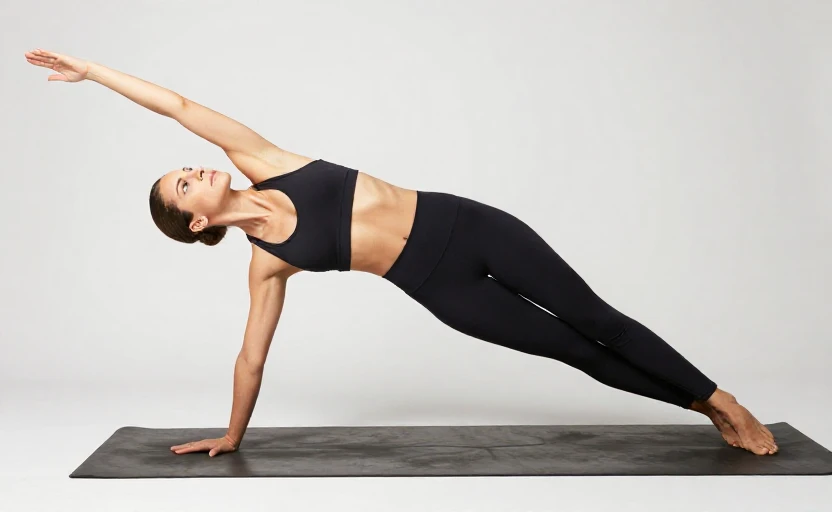
Vasisthasana (Side Plank Pose)
This pose shifts the challenge laterally, targeting the often-neglected obliques and shoulder stabilizers. It improves balance and creates a deep line of engagement along the entire side of your body.
- From a high plank, roll onto the outer edge of your right foot, stacking your left foot on top.
- Lift your left arm toward the ceiling, opening your chest. Your body should form a straight, diagonal line.
- Press firmly through your supporting hand and the stacked feet. Feel your right oblique contract to keep your hips lifted.
- Hold for several breaths, then repeat on the other side.
Ardha Pincha Mayurasana (Dolphin Pose)
A precursor to a forearm stand, Dolphin Pose is a powerhouse for the shoulders, upper back, and core. It builds the strength needed for inversions while providing a deep stretch for the posterior chain.
- Start on your hands and knees. Lower onto your forearms, keeping them parallel.
- Tuck your toes and lift your hips up and back, coming into an inverted ‘V’ shape.
- Press your chest gently toward your thighs while actively pushing the floor away with your forearms.
- Keep your neck relaxed and your gaze between your forearms. Hold for 5-10 deep breaths.
Sirsasana (Headstand)
The king of asanas inverts your entire body, demanding extraordinary core strength, shoulder stability, and focus. The effort to stabilize upside-down engages your deepest abdominal muscles and elevates your heart rate significantly.
Safety First: Never attempt a headstand without proper preparation and, ideally, initial guidance from a teacher. Use a wall for support until you develop the necessary strength and balance.
- Interlace your fingers and place your forearms on the mat, elbows shoulder-width apart. Place the crown of your head in your hands.
- Walk your feet in, lifting your hips until your spine is vertical.
- With control, engage your core and lift your legs, coming into the full inversion. Keep your gaze neutral and your breath steady.
- To come down, reverse the movement with control, finishing in Child’s Pose for a few breaths.
Virabhadrasana II (Warrior II Pose)
This foundational standing pose is deceptively strenuous. Holding a deep lunge while extending the arms creates immense muscular endurance in the legs and shoulders, building functional strength that supports all movement.
- Step your feet wide apart. Turn your right foot out 90 degrees and your left foot in slightly.
- Bend your right knee deeply, aiming to bring your thigh parallel to the floor. Keep your knee aligned over your ankle.
- Extend your arms out to the sides at shoulder height, gaze over your right fingertips.
- Ground through your back foot and feel the strength in your legs and the openness across your chest. Hold for 30 seconds to a minute, then switch sides.
Integrating these five poses into a flowing sequence creates a workout that challenges strength, balance, and stamina in equal measure. The metabolic afterburn—where your body continues to consume oxygen and calories at an elevated rate post-exercise—can be significant with this type of high-intensity muscular work. While the exact calorie comparison to running depends on individual intensity and duration, the full-body transformation and functional strength you build with power yoga offer benefits that extend far beyond any single metric.