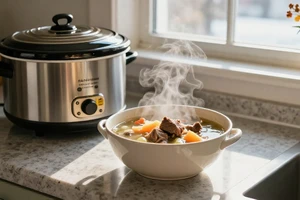

Slow cookers are a lifesaver for busy weeknights. You toss in ingredients in the morning, and by dinner, the house smells amazing and a hot meal is ready. But there's a quiet trade-off happening inside that pot. Heat, water, and time — the very things that make a slow cooker convenient — can also degrade certain vitamins in your meal. The good news is that you don't have to choose between convenience and nutrition. Here are three clear signs that your slow cooker meal may be losing vitamins, along with practical ways to keep more nutrients on your plate.
1. The Liquid Is Cloudy or Discolored
If the broth or sauce in your slow cooker looks murky or has changed color noticeably during cooking, that's a visual clue that water-soluble vitamins have leached out of the vegetables and into the liquid. Vitamins like vitamin C and many B vitamins (folate, thiamin, riboflavin) dissolve easily in water. When you cook ingredients submerged in liquid for hours, those vitamins migrate from the food into the cooking water. This is not necessarily a bad thing if you consume the broth — stews and soups keep those nutrients in the meal. However, if you drain and discard the liquid, you're pouring those vitamins down the sink.
How to stop it: Plan meals where the cooking liquid becomes part of the finished dish. Soups, stews, and braises are ideal. If your recipe calls for draining, consider reserving the liquid to use as a base for rice, gravy, or a quick sauce later.
2. Vegetables Turn Mushy and Dull in Color
Bright orange carrots, green beans, or red bell peppers that come out of the slow cooker looking pale, grayish, or falling apart are telling you that heat-sensitive vitamins have been compromised. Vitamin C and some B vitamins begin to break down at temperatures above 158°F (70°C), and slow cookers typically simmer between 190°F and 210°F (88°C–99°C) — well above that threshold. The longer the cook time, the greater the loss. A six- to eight-hour cook on low can destroy a significant portion of these delicate nutrients, especially if the vegetables were diced small and added at the very start.
How to stop it: Add quick-cooking vegetables later in the process. Root vegetables and hardy options like onions and carrots can go in at the beginning. Tender vegetables like peas, spinach, zucchini, and bell peppers should be stirred in during the last 30 to 60 minutes of cooking. This cuts their exposure to prolonged heat while still allowing them to soften and absorb flavor.
3. The Food Looks Waterlogged or Boiled
A properly slow-cooked meal should be moist but not swimming in thin liquid. If your finished dish looks more like a watery soup than a cohesive stew, and the ingredients have a blown-out, mushy texture, you've likely used too much liquid. Excess water accelerates the leaching of minerals and water-soluble vitamins from meat and vegetables. Unlike oven braising or stovetop simmering, a slow cooker lid traps nearly all steam, so very little moisture evaporates. Most recipes need far less liquid than you'd think.
How to stop it: Cut the liquid by about one-third compared to a traditional recipe. For most slow cooker dishes, you want the liquid to come about halfway up the ingredients, not fully submerge them. If you're adapting a stovetop soup recipe, reserve part of the broth to add at the end — this protects both texture and nutrient content. And resist the urge to lift the lid during cooking; each time you do, steam escapes and the temperature drops, prompting a longer cook cycle that can further degrade heat-sensitive vitamins.
A quick reminder: Fat-soluble vitamins (A, D, E, K) and minerals like potassium and magnesium are more heat-stable and generally survive slow cooking well. The biggest concerns are vitamin C and the B vitamins — especially folate and thiamin.
Your slow cooker is still a fantastic tool for healthy eating. By watching for these three signs and adjusting how — and when — you add ingredients, you can retain far more of the natural vitamins in your meal. The result is a dinner that's both convenient and genuinely nourishing.