
You crushed your leg day, and now your quads are screaming. But a few days later, the same knee starts twinging when you go downstairs. You assume it's just soreness from pushing hard, but something feels off. That nagging ache in your right hip or the fact your left arm always gives out first might not be post-workout fatigue. It could be a strength imbalance—unequal force between opposing muscle groups or between your left and right sides.
For beginners, mistaking imbalance-related discomfort for normal soreness is common. The problem is that when one muscle works harder to cover for a weaker neighbor, it leads to compensation patterns that can eventually cause injury. Knowing the difference helps you train smarter, not just harder. Here are three telltale signs that your muscle soreness is actually a sign of a strength imbalance.
1. Pain sticks around long after typical muscle soreness fades
Normal soreness from a new or intense workout—called delayed onset muscle soreness (DOMS)—usually peaks 24 to 72 hours after exercise and then fades. If you're still wincing a week later or if the ache doesn't improve with movement, that's not just soreness. It's likely a structural imbalance causing chronic tension or overuse in a specific area.
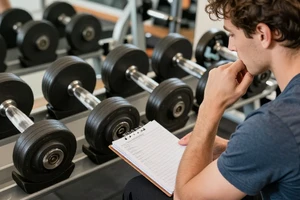
Common spots for stubborn soreness linked to imbalance are the lower back (from weak glutes or tight hip flexors) and the front of the shoulder (from weak upper-back muscles). If one side of your body hurts differently than the other, write it down. Note where the pain is, how long it lasts, and whether it changes with different movements. This kind of awareness is the first step to correcting the problem.
2. Movement quality is uneven between sides
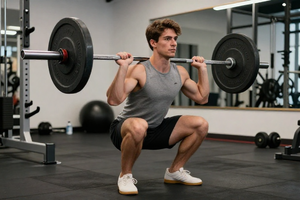
Watch yourself in a mirror—or better yet, have someone film you—performing a simple squat or push-up. Does your right hip dip down? Does one knee cave inward? Do you consistently favor one leg when stepping onto a box? These are visual clues that one side is weaker or tighter, forcing your body to shift load.
This type of imbalance often shows up as a subtle tilt, rotation, or wobble. For example, during a single-leg squat, you might notice your opposite hip hikes up to help stabilize. That's your body recruiting muscles that shouldn't be doing the heavy lifting. The soreness you feel afterward is not from the intended target muscles but from the unhappy compensators. If your left glute feels fatigued while your right one acts as a passenger, you likely have a strength discrepancy between sides.
If one arm tires noticeably before the other on the same exercise (like dumbbell rows or bench press), your body is subtly transferring load to the stronger side. That's not tenacity—it's an imbalance.
3. Joint pain is present, not just muscle ache
True muscle soreness lives in the belly of the muscle, not in the joints. If you feel sharp, deep, or grinding discomfort in your knee, hip, or shoulder during or after exercise, that's not DOMS. Joint pain often points to one muscle group pulling harder than its opposite, putting uneven pressure on the joint.
A classic example: knee pain during squats or lunges is frequently linked to tight quads and weak glutes or an overactive lateral quad pulling the kneecap off track. Another is shoulder impingement, which can arise when the front chest muscles are tight and the rear shoulder stabilizers are weak. Joint pain tells you the mechanics are off. This is a stronger signal than simple muscle ache, and it demands attention—usually a reduction in load and a focus on balance-specific exercises.
How to test yourself for a strength imbalance
You don't need fancy equipment. A single-leg squat or a one-arm push-up can reveal asymmetry, but there are simpler home tests. Stand on one leg with your eyes closed. The side you topple from first may have weaker stabilizers. Another simple test is to perform a wall slide (sitting against a wall with a foam roller behind your spine and sliding arms overhead). If one arm moves down before the other or you feel a pinch in the front of one shoulder, that's an imbalance in scapular stability.
Once you identify a suspected weakness, work both sides evenly. That doesn't mean ignoring the weak side—it means starting your set on the weaker side, matching the reps and load from the stronger side, and never sacrificing form for numbers. Unilateral exercises (single-leg deadlifts, single-arm presses, lunges) are excellent for exposing discrepancies because they prevent the stronger side from compensating.
When to ease off and when to push through
Some discomfort during exercise is part of the adaptation process. But pain that changes your form, makes you limp, or forces you to lift with a wildly uneven stance is a red flag. Lower the weight or modify the movement until you can execute it with symmetry. If the imbalance is significant, consider adding dedicated corrective work: core stability, hip mobility, and scapular control drills. A few targeted minutes before or after your main workout can make a big difference over several weeks.
Remember that imbalances are incredibly common—most people have a dominant side. The goal is not perfect symmetry, but enough balance to move safely and efficiently. By learning to distinguish normal soreness from imbalance-driven strain, you build a foundation for long-term strength without chronic pain.