You step onto your mat hoping for calm, but sometimes your mind is already racing before the first pose. Panic can feel like a knot—tightening your chest, shortening your breath. Traditional yoga instruction often tells you to breathe, but when anxiety has its grip, that simple cue can feel impossible. The solution isn't to force a breath; it's to change the pattern.
Below are three breathing techniques supported by sports medicine and clinical research, modified specifically to calm an anxious nervous system during a yoga practice. They work by changing the ratio of your inhale to your exhale, which directly signals your vagus nerve to shift from fight-or-flight to rest-and-digest.
1. Two-for-One Exhale (extended exhale breathing)
When anxiety spikes, your inhale tends to be too quick and shallow, and your exhale gets clipped short. This technique reverses that habit. The goal is simple: make your exhale about twice as long as your inhale. In yoga, this is often practiced as pulse rate breathing or a gentle kumbhaka (breath retention), but without holding the breath.
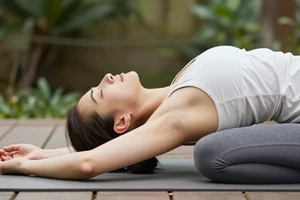
How to do it in a pose: Try this in a forward fold or child's pose where you can relax your abdomen. Inhale naturally through your nose for a count of three. Without pausing, exhale through your nose for a count of six. If six feels strained, drop to a four-count exhale. The number doesn't matter as long as the exhale is longer. The science is clear: a prolonged exhale activates the parasympathetic system and lowers heart rate within a few repetitions.
Think of each exhale as slowly pouring sand out of a jar—steady and complete, not a forceful push.
2. Coherent Breathing (resonant frequency)
Sometimes called resonant breathing, this method uses a rhythm of about five to six breaths per minute. It is the most well-studied breathing technique for anxiety reduction in clinical settings. The exact frequency is less important than the consistency—you want a smooth, unforced wave: inhale for five seconds, exhale for five seconds. This brings your heart rate variability into a coherent state, meaning the time between your heartbeats becomes more adaptive and less chaotic.
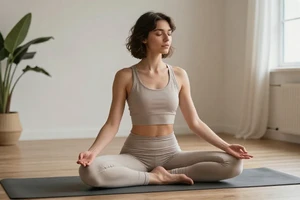
How to do it during flow: This pattern works best during steady-state movements like a slow vinyasa or a seated meditation. Match the length of your inhale to the duration of your movement. For example, inhale as you lift your chest halfway in a forward fold, exhale as you fold deeper. Do not obsess over the stopwatch; just find a rhythm that is comfortable and steady. After three minutes, you should feel a noticeable drop in muscle tension.
Why this works for yoga specifically
Unlike quick-paced breathing, coherent breathing does not increase carbon dioxide tolerance—it balances oxygen and carbon dioxide levels. This prevents the dizziness that anxious people often fear when they try deep breathing. In a yoga context, it allows you to stay present without triggering the fight-or-flight response that a faster breath might cause.
3. Box breathing with a slight exhale pause (sheetali variation)
Box breathing is well-known (four counts each: inhale, hold, exhale, hold), but for anxiety, the hold after the exhale is a critical element because it lowers the heart rate further. For yoga, you can combine this with a cooling breath called sheetali (rolling your tongue into a tube) or sheetkari (sipping air through your teeth). The cool air creates a physical sensation that anchors your attention away from anxious thoughts.
How to do it before an inversion or balance: Practice this seated or in mountain pose before attempting a headstand or tree pose. Inhale for four counts through your mouth (tongue curled or teeth together). Hold your breath lightly for four counts, but without closing your throat. Exhale slowly through your nose for four counts. Hold your breath out for four counts—this is the key part. The pause at the bottom of the exhale dampens the sympathetic nervous system more than any other point in the cycle. Repeat three to five rounds, then return to normal breathing.
When NOT to use these techniques
All three techniques rely on nasal or oral breathing with specific ratios. If you have moderate to severe asthma, COPD, or a known heart condition, consult a doctor before altering your breathing patterns. If a technique makes you feel more anxious, dizzy, or panicked, stop immediately. Some people feel claustrophobic when they hold their breath or extend the exhale—that is a sign to use a shorter ratio or switch to simple awareness of natural breathing. Anxiety breathing is not about performance; it is about what your nervous system accepts in that moment.
How to integrate them into your practice
You do not need to memorize all three at once. Pick one and practice it during the first three minutes of your next session. Over time, your body will learn to use these patterns automatically when stress elevates. The most effective technique is the one you actually use, not the one with the most elaborate name.
Breathing is your most portable tool. You cannot overdose on it. You cannot run out of it. And unlike a meditation app, it costs nothing and works exactly the same every time you decide to use it.