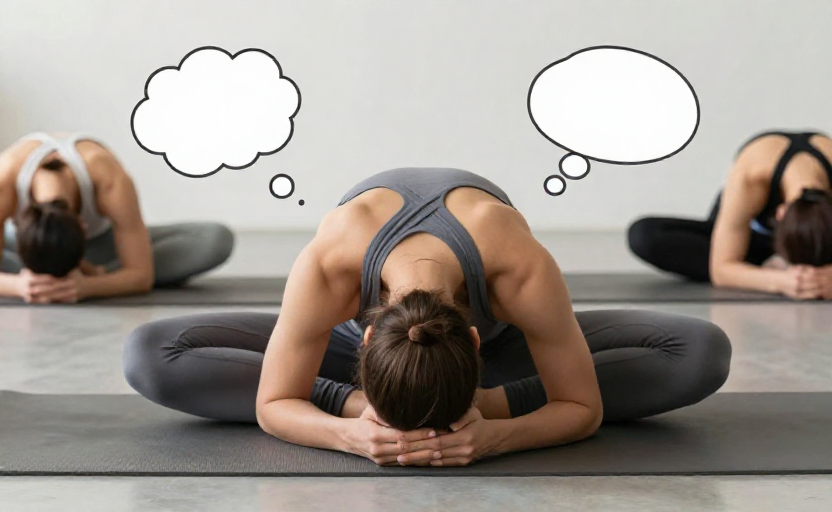
You show up to your mat, roll it out, and take a breath. You've heard yoga is supposed to help with stress and weight management. But after weeks of classes, the scale hasn't budged, and your body feels tighter than when you started. If this sounds familiar, beginner yoga anxiety might be the quiet saboteur blocking your fat loss.
Here's the nuance most instructors don't mention: mild anxiety during your first months of practice does not always feel like panic. It can feel like trying too hard, holding your breath, or rushing through poses. These two subtle signs are common, fixable, and directly tied to how your body burns fat.
Sign 1: You Hold Your Breath (or Breathe Shallowly) in Every Pose
The first sign is nearly invisible to an observer but unmistakable once you notice it. In downward dog, you catch yourself holding your stomach tight. In warrior two, your shoulders creep up toward your ears. Your breath becomes short, choppy, or stalled during holds.
Why this matters for fat loss: Shallow breathing activates your sympathetic nervous system — the fight-or-flight branch. When your body perceives mild threat (even from a new pose), it releases cortisol. Cortisol tells your cells to store energy as fat, especially around the abdomen, and to hold onto fat rather than burn it for fuel. Holding your breath during yoga keeps you in a low-grade stress state, which is the exact opposite of the calm, fat-burning mode you want.
Look for this pattern: you hold your breath during the hardest part of a pose, or you sigh heavily when you come out of it. Both indicate your nervous system did not feel safe enough to rest in the stretch. Over time, this erodes the metabolic benefit that yoga can offer — namely, improved insulin sensitivity and lower resting cortisol.
Sign 2: You Compare Your Body or Progress to Everyone Else
Second sign: your inner monologue during class is a running commentary on who is more flexible, who looks stronger, or whose body is deeper into a pose. You glance sideways mid-pose, you feel embarrassed when you wobble, and you push yourself to look like others even when your body sends signals to ease off.
This comparison loop is a form of social evaluative threat — one of the most powerful triggers of the stress response. Research in behavioral endocrinology shows that when we feel judged or perceive ourselves as inferior in a group, cortisol rises. Elevated cortisol suppresses thyroid function, encourages fat storage, and breaks down muscle tissue. Since muscle is your main calorie-burning engine, losing muscle makes fat loss harder even if you move more.
Ironically, beginners who push too hard to look advanced often strain muscles and create micro-injuries that raise inflammation. Inflammation further blocks fat metabolism and leaves you feeling sore and demoralized.
How These Two Signs Interfere With Fat Loss Specifically
When you hold your breath and compare yourself, you are essentially doing the opposite of what makes yoga metabolically effective. Yoga supports fat loss best when it lowers cortisol, improves vagal tone (parasympathetic activity), and builds lean muscle through sustained, comfortable holds. If your practice feels like a low-grade competition with yourself or others, you are training your nervous system to stay alert — not to rest, digest, and burn fat.
This is not about giving up on yoga. It is about catching these two signals early so you can shift your approach before you get discouraged and quit.
Quick Adjustments to Try This Week
- Re-label the wobble. Instead of seeing a shaky leg as failure, see it as your muscles working to find stability. Shaking often means you are building strength, not losing control.
- Anchor exhales. In any pose that feels hard, double the length of your exhale relative to your inhale. Long exhales activate the vagus nerve and signal safety to your body. Practice this in child's pose for three rounds before you start moving.
- Keep your eyes on your mat. If you catch yourself scanning the room, gently bring your gaze to a fixed spot on your mat or the wall in front of you. This reduces comparison cues and keeps your nervous system in your own body.
- Drop intensity by 20 percent. The poses that feel hardest are often the ones where you are gripping. Back off slightly — bend your knees in forward fold, lower your heel in downward dog — and check if your breath deepens. If yes, you just found your fat-burning zone.
If you finish a class feeling wired rather than settled, you are probably practicing with anxiety, not with ease.
That wired feeling is a clue. Your body is telling you it stayed in sympathetic mode for the whole session. Over weeks, that pattern keeps cortisol slightly elevated, which can slow down fat loss even if you eat well and move regularly.
When to Look Beyond Your Mat
These two signs are common in the first six months of practice. If they persist beyond that, consider whether your general life stress level is high. Sleep deprivation, chronic dieting, or a very demanding job can amplify how your nervous system reacts to the novelty of yoga. In that case, your main blocker may not be yoga anxiety alone — it may be that your baseline stress is already high, and yoga is simply the activity that reveals it.
No one needs to master yoga to lose fat. You just need to recognize when your beginner anxiety is sending the wrong signal to your metabolism. Once you catch the breath-holding and the comparison talk, you can make a choice: hold your exhale, drop the comparison, and let your body do what it came here to do.