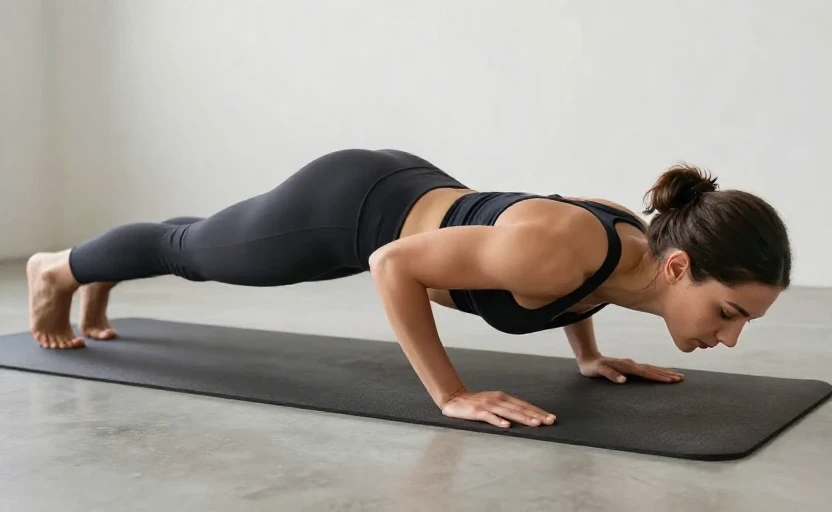
You’ve likely felt it: that familiar burn in your midsection during a plank, or the satisfying fatigue after a set of leg raises. Yet, weeks or months later, the results you’re after—a stronger, more resilient, and better-functioning core—can feel elusive. The effort is there, but the progress plateaus. The missing link often isn't a lack of effort, but a subtle misdirection of it.
Building a truly effective core routine is less about adding more exercises and more about refining how you approach the ones you already do. It’s a shift in mindset, from simply completing movements to deeply understanding and engaging the system you’re trying to strengthen. By focusing on two fundamental habit shifts, you can transform your core workout from a superficial burn to a foundation for lasting strength.
Shift 1: Prioritize Connection Over Motion
This is the cornerstone of an effective core routine. Most of us default to performing core exercises by focusing on the motion itself—cranking out crunches, holding a plank for time, swinging our legs up. The core, however, is primarily a stabilizer. Its main job is to resist motion, to create a solid pillar from which your limbs can move powerfully and safely.
When you prioritize motion, you often recruit momentum and larger muscle groups like your hip flexors. You might “complete” the exercise, but your deep core muscles—the transverse abdominis, the multifidus, the pelvic floor—remain disengaged. They’re the body’s natural weight belt, and if you’re not consciously connecting with them, you’re missing the point of the workout.
How do you make this shift?
- Start with breath. Before your first rep, take a moment to lie on your back with knees bent. Inhale gently, letting your ribs expand. As you exhale, draw your lower abdomen in and up, as if you were zipping up a tight pair of pants or gently pulling your belly button away from your waistband. This isn’t a hard suck-in; it’s a gentle, sustained engagement. That feeling is your deep core turning on.
- Maintain that connection as you move. Whether you’re moving into a dead bug, holding a plank, or performing a Pallof press, your first cue should be to re-establish that exhale and connection. If you lose it during the movement—if your lower back arches, your ribs flare, or you feel a strain in your neck—simplify the exercise. Reduce the range of motion, or even pause and reset.
The goal is not to see how much movement you can create, but to see how much stability you can maintain while moving.
This approach turns even the simplest exercise into a potent core challenge. A plank with a conscious connection to your deep core is infinitely more valuable than a two-minute plank where you’re simply hanging on your joints.
Shift 2: Train Your Core in Three Dimensions
The second habit shift requires us to think beyond the “mirror muscles.” The rectus abdominis—the “six-pack” muscle—is just one player in a complex team. Your core is a cylinder, with muscles wrapping around your sides (obliques), deep layers cinching your waist (transverse abdominis), and muscles supporting your spine from the back and the floor of your pelvis.
A routine dominated by sagittal plane movements (forward and back, like crunches and leg raises) only addresses one dimension of this system. To build a core that serves you in real life—whether lifting a heavy box, playing with kids, or swinging a golf club—you need to train it to resist and produce force in all three planes of motion.
Front-to-Back Stability (Sagittal Plane)
This is what most traditional exercises target: resisting extension and flexion of the spine. Think planks, dead bugs, and bird-dogs. These are essential, but they’re just the starting point.
Side-to-Side Stability (Frontal Plane)
This involves resisting lateral bending. Your obliques and quadratus lumborum are key here. Neglecting this plane is a common reason people feel their oblices aren’t “working.” Exercises like side planks (with proper hip stacking), suitcase carries, or Pallof presses challenge your core to prevent your torso from collapsing sideways.
Rotational Stability (Transverse Plane)
This is arguably the most sport- and life-relevant, yet most under-trained. It’s about controlling rotation. Not just creating it powerfully, but more importantly, resisting unwanted rotation. A medicine ball throw is rotational power; a Pallof press or a tall kneeling chop is rotational stability. Your core must fire to prevent your shoulders from twisting over your hips.
An effective weekly routine intentionally includes exercises from each category. Instead of doing three different variations of a crunch, you might do one sagittal plane exercise (a dead bug), one frontal plane exercise (a side plank), and one transverse plane exercise (a bird-dog with a subtle reach, which challenges anti-rotation). This holistic approach builds a core that’s capable, not just aesthetically focused.
Putting It All Together
These two shifts are interdependent. You apply the principle of connection to movements across all three dimensions. Here’s what a mindful, effective core session might look like, integrating both habits:
- Preparation (2-3 minutes): Lie on your back, knees bent. Practice your breath connection. Inhale to expand, exhale to gently draw your deep core in. Feel your lower back gently press into the floor without force.
- Exercise Circuit (3 exercises):
- Dead Bug (Sagittal): Focus on keeping your ribcage down and your deep core engaged as you slowly alternate extending your arm and opposite leg. The moment your back arches, stop and reset.
- Side Plank (Frontal): Stack your hips and shoulders. Instead of just holding for time, think about actively pushing your bottom hip up toward the ceiling while maintaining that side-body engagement.
- Bird Dog (Transverse): From all fours, extend your right arm and left leg. The challenge is to keep your hips square to the floor, resisting any rotation in your torso. Hold for a breath at the top, then return with control.
Perform 2-3 rounds of 8-10 controlled reps per side (or 20-30 second holds). The quality of every single rep, guided by your connection, is your measure of success—not the number on the clock.
By adopting these two habit shifts, you move from working on your core to working with it. You build a foundation of stability that enhances every other physical pursuit, reduces your risk of injury, and cultivates a sense of integrated strength that lasts far longer than any fleeting muscle burn.