
When you first start strength training, it’s easy to focus on the numbers: how much you can lift, how many reps you can grind out, and how quickly you can move up in weight. One thing many beginners overlook, however, is balance between sides. You might notice your right arm feels a little stronger than your left, or that your dominant leg seems to do most of the work during a squat. That slight difference might seem like no big deal, but ignoring a minor strength imbalance can actually set you up for injury—sometimes in places you’d never expect.
What exactly is a strength imbalance?
A strength imbalance happens when one side of your body—or one muscle group—is noticeably stronger or more coordinated than its counterpart. For beginners, this often shows up as a subtle favoring of the dominant hand or leg. It’s not about being perfectly symmetrical; no one is. The concern is when the gap becomes big enough that your body starts compensating during movement.
For example, if your left quad is weaker than your right, you might unconsciously shift weight to your stronger leg during a lunge. Over time, that compensation pattern becomes a habit, placing uneven stress on your joints, tendons, and ligaments. The imbalance itself isn’t the injury—it’s the altered movement that comes with it.
How a small gap becomes a big problem
Think of your body like a car with tires that are slightly different sizes. It will still drive, but eventually the uneven wear damages the suspension. Similarly, a strength imbalance that goes unaddressed can cause the following chain reaction:
- Compensatory movement patterns: Your stronger side takes over, so the weaker side never catches up. The movement becomes inefficient.
- Joint stress: The knee, hip, or shoulder on your weaker side may rotate or track differently, irritating cartilage or labrum tissue.
- Muscle strains: The overworked side is at higher risk for a pull or tear because it’s doing more than its share.
- Delayed recovery: Once you do get hurt, an existing imbalance can slow rehabilitation, because the weaker side struggles to support normal function.
In one common scenario, a beginner notices their left shoulder feels tight after bench press. They assume it’s just stiffness, but it’s actually the right side taking over, causing the left rotator cuff to work as a stabilizer under heavier load than it can handle. That “minor” tightness can evolve into tendinitis.
Why beginners are especially vulnerable
If you’re new to strength training, your nervous system hasn’t yet learned to recruit muscle fibers efficiently across both sides of your body. You naturally rely on the patterns you use in daily life—carrying a bag on one shoulder, stepping up with your dominant leg, or opening doors with your stronger arm. Those habits carry over into the gym.
Without conscious effort, you might increase weight on an exercise while your weaker side is still lagging. The stronger side adapts, but the weaker side stays behind. This is how a 5% strength gap can widen to 15% or more over a few months. That’s when the risk of injury spikes.
A 5% strength gap can widen to 15% or more in just a few months if you don't address it. That’s when injury risk spikes.
Signs you might already have an imbalance
You don’t need fancy equipment to spot this. During your next workout, pay attention to these clues:
- You feel one arm or leg fatiguing earlier than the other.
- Your body twists slightly when you squat or press overhead.
- You can lift more weight with one side during single-arm or single-leg exercises.
- You experience nagging discomfort in one shoulder, hip, or knee that isn’t explained by a specific injury.
If any of these sound familiar, it’s worth spending a few weeks addressing the imbalance before pushing your numbers higher.
Practical steps to fix—or prevent—an imbalance
The good news is that correcting a minor strength imbalance doesn’t require a complete overhaul of your training. Here are four straightforward approaches:
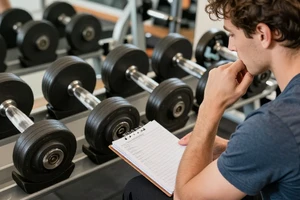
- Start with single-limb exercises. Moves like single-leg Romanian deadlifts, split squats, dumbbell rows, and single-arm overhead presses force each side to work independently. Begin with your weaker side first, match the reps and weight on your stronger side, and don’t exceed that load.
- Use unilateral weight progression. If you can do eight reps on your left side but twelve on your right, use the left side as your guide. Increase weight only when both sides can handle the same load for the same reps with good form.
- Include balance and stability work. Exercises that challenge your coordination—like lunges on a foam pad, single-leg stands, or bird-dog holds—help your nervous system learn to recruit muscles evenly.
- Check your form in a mirror or with video. Sometimes an imbalance is visible only when you see yourself from the front. Record a set of squats or a push-up. Look for asymmetries like a shoulder drop, a hip shift, or a foot that turns out more than its opposite.
Tip: If you can do eight reps on your stronger side, don't do more than eight on the weaker side—match the reps, not your ego.
Does this mean you shouldn’t use barbells?
Not at all. Barbells are effective tools. But for a beginner who hasn’t yet addressed imbalances, relying exclusively on barbell lifts can mask the problem. A barbell squat may look even on both sides, but it allows your stronger leg to drive more of the weight. Incorporating some dumbbell or cable work for a few weeks can help bring things back into alignment. Once your strength is more balanced, you can return to the barbell with better mechanics and lower injury risk.
The long-term payoff
Addressing a minor strength imbalance early isn’t just about avoiding injury—it also helps you build a more functional, resilient body. You’ll move better in everyday life, whether you’re carrying groceries, playing with your kids, or picking up a heavy box. And in the gym, balanced strength allows you to lift heavier more safely over time.
The next time you catch yourself thinking “it’s just a small difference, it’s not a big deal,” remember that small differences add up. A few minutes of focused unilateral work now can save you weeks of recovery later. Consider it an investment in staying strong without interruption.