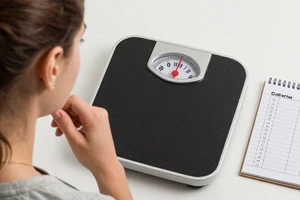
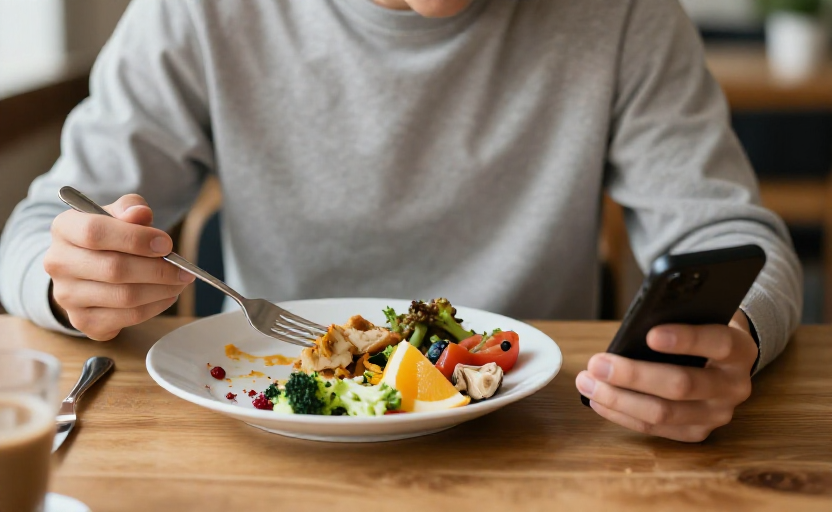
You track your meals. You measure your portions. You stick to reasonable servings of vegetables, protein, and complex carbs. And yet, the scale barely budges—or your energy dips in the afternoon. What if the problem isn't what you eat, but how fast you eat it?
Speed-eating has become a default habit for many of us: breakfast inhaled over a keyboard, lunch polished off in five minutes, dinner finished before anyone else at the table is halfway through. This common behavior actively undermines portion control, regardless of how carefully you've measured your plate.
Why eating speed matters for portion control
Your brain needs time to register fullness. When you eat quickly, you overwhelm the signals that tell you when to stop. The hormone leptin, which communicates satiety, takes roughly 20 minutes to rise after you start eating. If you finish your meal in 8 to 10 minutes, you've bypassed your body's own portion-control mechanism entirely.
Researchers have documented that slow eaters consume fewer calories per meal than fast eaters—without feeling deprived. In one controlled trial, participants who ate at a slow pace reported being just as satisfied as those who ate quickly, despite taking in significantly less food. The habit doesn't just affect how much you eat at one sitting; it can distort your perception of appropriate portion sizes over time.
The mindless plate-cleaner reflex
There's also a behavioral component. Eating rapidly disconnects you from the sensory experience of food—you stop tasting, smelling, or even noticing what's on your fork. That's when the "clean plate" reflex takes over, regardless of whether you're still hungry. The people who struggle most with portion control often report feeling "unexpectedly" full or bloated after meals, a direct result of outpacing their body's satiety cues.
The 20-minute rule: If you can stretch a meal to at least 20 minutes, you give your body a fair chance to send the "stop eating" message before you overfill.
How fast eating hijacks your hunger hormones
To understand why this habit undoes portion control, it helps to know what happens inside your body when you rush.
When you swallow food quickly, you tend to take larger bites and chew less thoroughly. This reduces the mechanical breakdown of food in your mouth, which means your stomach has to work harder. More critically, rapid eating blunts the release of several key appetite-regulating hormones:
- Ghrelin (the hunger hormone) stays elevated longer when you eat fast, meaning you don't feel as full as you should.
- CCK (cholecystokinin), a hormone that promotes satiety, rises more slowly if your meal is consumed in under 15 minutes.
- GLP-1 and PYY, both involved in signaling fullness to the brain, appear at lower levels after quick meals.
This hormonal lag creates a window where you can eat several hundred extra calories before your brain catches up. Over weeks and months, that gap adds up.
Practical strategies to slow down (without making meals a chore)
Slowing your eating pace doesn't require meditative dining. Small structural changes to your routine can make a meaningful difference:
- Put utensils down between bites. This simple pause adds seconds to each mouthful and naturally lengthens the meal.
- Chew with intention. Aim for 15 to 20 chews per bite, especially for dense or fibrous foods. This gives your brain more time to register texture and flavor, which enhances satisfaction.
- Use smaller utensils or chopsticks. You'll take smaller bites without thinking about it.
- Set a timer. If you know you usually finish lunch in 8 minutes, commit to staying at the table for 20. You don't have to eat the whole time—just pause, sip water, or breathe.
- Build a buffer before seconds. Wait 10 minutes after finishing your first serving before deciding whether you want more. Often, the urge fades once your satiety signals catch up.
Tip: Try serving your meal on a smaller plate. It creates the visual illusion of a full portion while encouraging slower, more deliberate eating.
Common scenarios where speed-eating sneaks in
Most people don't realize how often they rush through meals. Watch for these situations:
- Lunch at your desk: The classic multitasking meal. Eating while answering emails means you're focused on the screen, not your plate. Studies show that distracted eaters consume more at the next meal, too.
- Family dinners with young children: You may rush to finish before the toddler needs attention. But you can still slow your own pace while supervising—try eating with your non-dominant hand to force a slower rhythm.
- Post-workout refueling: It's natural to be hungry after exercise, but eating quickly can cancel out some of the metabolic benefits you just earned. Take at least 15 minutes to consume your recovery meal.
The one habit worth breaking
Portion control isn't just about measuring cups and serving sizes. The most consistent tool you have is your own biology—if you give it time to work. The habit of rushing through meals quietly undoes every other effort you make, from counting calories to choosing whole foods over processed ones.
You don't need to obsessively time every bite. Just aim to eat your next meal in 20 minutes or longer. Let your fork rest between mouthfuls. Notice the taste, texture, and smell. That small shift may be the missing piece in your portion control strategy.