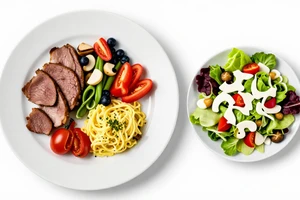

You finish a meal, push your plate away, and feel that pleasant, comfortable fullness. An hour later, you’re standing at the pantry, hand in a bag of chips, wondering why you’re eating again. This disconnect between a body that’s had enough and a mind that wants more is a common experience, and it often stems from missing the subtle cues our bodies send us. Satiety—the feeling of satisfaction and fullness that tells us to stop eating—is a complex biological signal, not just a simple on/off switch. Learning to listen to it can transform your relationship with food from one of constant negotiation to one of natural harmony.
Many of us have been taught to override these signals from a young age. We clean our plates out of obligation, eat on a strict schedule regardless of hunger, or use food to cope with stress or boredom. Over time, the gentle internal whisper of "I'm satisfied" gets drowned out by external rules and habits. The good news is that this connection can be rekindled. It starts by recognizing and correcting the common, well-intentioned mistakes that silence our body's innate wisdom.
What Does Satiety Actually Feel Like?
Before we can tune in, we need to know what we’re listening for. Satiety is not the same as being stuffed or uncomfortably full. That sensation is often a sign you’ve already missed the signal. True satiety is a quieter, more neutral state. You feel content. The compelling urgency to eat has faded. The food in front of you loses its magnetic appeal, and the thought of taking another bite feels more like a chore than a desire. Physically, you might feel a gentle warmth or a settled feeling in your stomach, but there’s no pressure, bloating, or lethargy.
Think of satiety as the point where you could comfortably stop eating, not the point where you physically cannot take another bite.
This signal is orchestrated by a cascade of hormones, like leptin and peptide YY, that communicate from your gut to your brain. It’s a biological process designed for survival, but our modern eating environment—with its distractions, oversized portions, and hyper-palatable foods—makes it easy to ignore.
Mistake #1: Eating While Distracted
This is perhaps the most pervasive saboteur of satiety. When you eat while working, scrolling, watching TV, or driving, you split your attention. Your brain is primarily engaged with the screen or the task, leaving little processing power to register the sensory experience of eating or the developing feelings of fullness.
You miss the critical early cues. The first few bites of a meal trigger the release of satiety hormones, but it takes about 20 minutes for those signals to travel and for your brain to register them. If you’re distracted, you can consume a large amount of food in that window without your brain ever logging the pleasure, texture, or volume. The meal is over before your body has had a chance to report in, leaving you feeling unsatisfied and likely to seek more food soon after.
To counter this, practice bringing even a modest amount of attention to your meal. It doesn’t have to be a silent, ceremonial half-hour. Start with one meal a day where you simply pause before eating, look at your food, and commit to eating without other screens or inputs. Put your fork down between bites. These small acts create the space for internal signals to be heard.
Mistake #2: Confusing Thirst for Hunger
The body’s signals for thirst and hunger can feel remarkably similar—a low energy, a slight headache, a sense of emptiness or gnawing. This is because the same part of your brain, the hypothalamus, regulates both. When you’re mildly dehydrated, it can easily send out a generic "need something" signal that we interpret as a need for food.
Reaching for a snack when your body actually wants water is a surefire way to miss satiety. You’re giving it the wrong tool for the job, so the underlying need isn’t met, and the "hunger" pangs persist. You might keep eating, searching for satisfaction that food alone can’t provide.
When a hunger pang strikes, especially between meals, try drinking a full glass of water and waiting 10–15 minutes. You may find the sensation disappears completely.
Building a habit of consistent hydration throughout the day smooths out this confusion. It keeps the thirst signal from ever getting strong enough to masquerade as hunger, allowing your true appetite to speak more clearly.
Mistake #3: Eating Too Quickly
Speed is the enemy of satiety. The 20-minute hormonal delay is non-negotiable. If you finish a large plate in 10 minutes, you’ve consumed all that food on an empty-stomach feedback loop. Your brain is still operating under the "start eating" protocol because it hasn’t received the "approaching full" memos yet. By the time the satiety signals finally arrive, you’ve overshot the mark and landed in the uncomfortable territory of being overfull.
Fast eating is often a deeply ingrained habit, tied to busy schedules or a childhood environment where eating quickly was necessary. Slowing down is a mechanical fix with profound effects. It gives biology a chance to catch up. Strategies like using chopsticks if you normally use a fork, eating with your non-dominant hand, or simply committing to chew each bite thoroughly can automatically insert the necessary pauses.
The goal isn’t to eat painfully slowly, but to find a pace that allows you to converse, to breathe, and to notice the changing experience of the meal from first bite to last.
Rebuilding the Connection
Correcting these mistakes is less about adding restrictive rules and more about subtracting interference. It’s a practice of mindful eating, which simply means eating with awareness and intention. Start with a simple check-in, often called the Hunger-Fullness Scale. Before you eat, ask yourself: On a scale of 1 (ravenous) to 10 (painfully stuffed), where am I? Aim to start eating around a 3 or 4 (gently hungry). During your meal, pause halfway through. Put your fork down, take a breath, and check in again. Are you still eating because you’re hungry, or because the food is there? Aim to stop at a 6 or 7 (comfortably satisfied, no longer hungry).
This practice rebuilds the neural pathways between your gut and your brain. Over time, the signals become clearer and easier to trust. You begin to eat in response to physical need, not just clock time, emotional cue, or environmental temptation. Food becomes a source of nourishment and pleasure again, not a source of constant negotiation or guilt. Your body has been trying to tell you this all along. It just needs you to listen.