
The floor of your living room is surprisingly versatile real estate. You don’t need a barbell, a gym membership, or even a pair of shoes to start building strength. A home bodyweight workout is one of the most accessible ways to train, but it’s also easy to fall into a routine of random push-ups and squats that feels productive but lacks direction.
Structure is what separates a real workout from just moving around. Without it, you might work the same muscle groups twice, skip the ones that need attention, or quit after five minutes because you aren’t sure what comes next. Here’s how to assemble a safe, effective, and surprisingly challenging bodyweight session with nothing but your own weight and a bit of space.
Why a warm-up isn't optional
The first five minutes of your session are the most important. Cold muscles don't move well, especially when you're asking them to support your full body weight in unfamiliar positions. A warm-up should raise your heart rate slightly and move your joints through their full range of motion.
Stick to dynamic movements rather than static stretching. Think arm circles, leg swings, torso twists, and a slow set of bodyweight squats that don't go to full depth. You want blood flowing into the shoulders, hips, and spine before you ask them to work. Five minutes is enough. Your body will let you know when it’s ready—movement feels easier, and your breathing picks up just a bit.
Choose your movement categories
A well-structured bodyweight workout covers four fundamental movement patterns. You don’t need to hit all four in every session, but rotating through them across the week ensures balanced development and reduces the risk of overuse injuries.
- Push — exercises like push-ups, pike push-ups, or dips on a sturdy chair that target the chest, shoulders, and triceps.
- Pull — inverted rows using a table, doorframe rows, or static holds like a plank with scapular retraction to target the back and biceps.
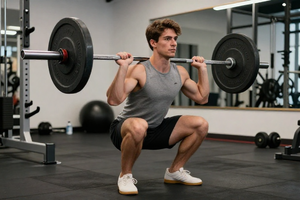
- Squat — bodyweight squats, split squats, lunges, and Bulgarian split squats using a low bench or step.
- Hinge — glute bridges, single-leg glute bridges, and hip thrusts that target the posterior chain (glutes, hamstrings, lower back).
If you have limited equipment at home, the pull category is often the weakest link. Get creative with a table that doesn’t slide, use doorframe anchors for a suspension trainer, or simply emphasize isometric holds like the active hang and scapular push-ups to build lat and rhomboid engagement.
Set your rep and rest structure
For a beginner, focusing on time under tension rather than a target number of reps is more forgiving and reduces the temptation to cheat for the sake of counting. Try a simple format: 40 seconds of work, 20 seconds of rest. This gives you enough time to complete quality reps without rushing, and the short rest keeps your heart rate elevated for a conditioning benefit.
If you prefer counting, aim for 8–12 controlled reps per set. When you can comfortably complete 15 reps of a given exercise with perfect form, it’s time to progress to a harder variation. For push-ups, this might mean lowering your hands to a decline surface or adding a pause at the bottom. For squats, try a single-leg variation or a deeper range of motion.
Rest between sets should be 45–90 seconds. Keep it consistent. If you find yourself checking your phone and losing track, set a timer. The goal is to work hard enough that you’re looking forward to that rest, not wishing it lasted longer.
Circuit training vs. straight sets
Two common structures work well for home bodyweight training. Circuits keep you moving continuously from one exercise to the next with little to no rest between different movements, and then you rest after you’ve completed all exercises in the circuit. Straight sets involve doing all your sets of one exercise before moving on to the next.
Circuits are excellent for saving time and building cardiovascular endurance. A sample circuit might be: squat (40 seconds), rest (20 seconds), push-up (40 seconds), rest (20 seconds), glute bridge (40 seconds), rest (20 seconds), and a 30-second plank for the core. Repeat this circuit 3–4 times with a 60-second break between rounds. The entire session takes about 20–25 minutes.
Straight sets are better if your goal is pure strength or if you’re working on a particular movement pattern that requires more focus. For example, you might do four sets of glute bridges with 60 seconds of rest between sets, then move on to four sets of split squats. This approach tends to take a little longer but allows for heavier effort on each exercise.
Progression without weight plates
The biggest challenge with bodyweight training is making the exercises harder as you get stronger. You can't simply add more weight, but you can manipulate leverage, tempo, and volume. Tempo training — slowing down the lowering (eccentric) phase of a movement to three or four seconds — dramatically increases time under tension without changing the exercise itself. You can also add a pause at the bottom of a squat or push-up for 2–3 seconds before pressing back up.
Single-leg variations are another way to increase difficulty. A single-leg glute bridge requires far more stability and strength from the working leg than its two-legged counterpart. Similarly, elevating your feet for push-ups shifts more of your body weight into your upper body, making the exercise significantly harder.
Slow down for two seconds on the lowering phase of every rep, and you’ll double the difficulty of nearly any bodyweight exercise.
Finally, you can increase total volume across the week. If you could only do three sets of squats two weeks ago and now you’re completing three sets comfortably, add a fourth set. Once you’re doing five sets with good form, it’s time to switch to a harder variation.
Sample beginner session
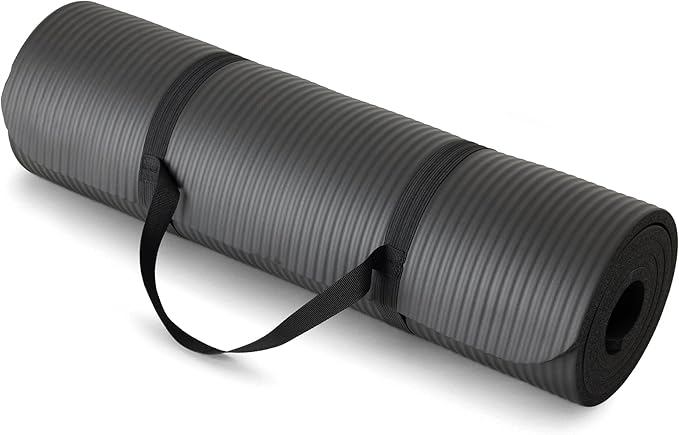
This session takes about 25 minutes and can be done in a space the size of a yoga mat. Warm up for 5 minutes with dynamic stretches, then perform the following circuit. Complete all five exercises consecutively with 20 seconds of rest between each, then rest 60 seconds after the circuit. Repeat for a total of three rounds.
- Bodyweight squat — 40 seconds
- Knee push-up or incline push-up — 40 seconds
- Glute bridge — 40 seconds
- Plank — 30 seconds
- Bird dog (alternating arm and leg) — 40 seconds
If you finish the third round feeling like you could go again, you left too much in the tank during earlier rounds. Push each interval to a 7 or 8 out of 10 in terms of perceived effort. The last 10 seconds of each work period should feel noticeably harder than the first 10.
Listen to your body, but be honest
There’s a fine line between normal muscle fatigue and pain that signals something is wrong. A burning sensation in the quads during the last few reps of a squat is expected. A sharp, stabbing pain in the knee is not. If you feel joint pain, stop and adjust your form or choose a different exercise that doesn’t aggravate the area. It’s also normal to be sore one or two days after a new workout. That’s called delayed onset muscle soreness, and it typically peaks around 48 hours post-exercise. Light movement, hydration, and sleep are the best supports for recovery.
If you feel pain during the movement itself — not after, not the next day — that’s your signal to modify or stop. Bodyweight training is forgiving on the joints, but poor form with repetitive volume can still cause strain, especially in the wrists, shoulders, and lower back.
Building your weekly rhythm
Beginners often benefit from three full-body bodyweight sessions per week, with at least one rest day between each session. This schedule looks like Monday, Wednesday, Friday. Each workout can follow the same circuit format or rotate between a push-focused day and a squat-and-hinge-focused day. The key is consistency. Twenty minutes three times a week will produce more noticeable progress than an hour once a week.
After about three to four weeks, you can increase the number of rounds, add a fourth day, or begin experimenting with more advanced variations. By that point, your body will have adapted to the stress of the movements, and your joints will be ready for a slightly heavier training load — even if that load is still just your own body.