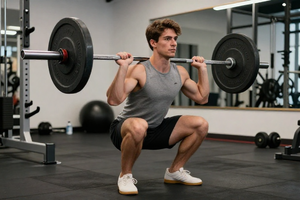

You walk into the gym, rack the bar, and get straight under it. The first rep feels stiff, your hips pinch, and your lower back rounds before you hit parallel. That rush to start squatting heavy without a proper warm-up is one of the most common—and preventable—reasons lifters get hurt. Skipping targeted mobility drills before you squat doesn't just make you feel tight; it fundamentally changes how your body handles the load.
The squat is a complex hinge that demands simultaneous flexibility at the ankles, hips, and thoracic spine. When one of those joints is restricted, your body compensates in ways that can lead to acute injury—like a torn meniscus or a pulled spinal erector—or chronic wear and tear that sidelines you for months. Here's exactly what happens when you bypass the warm-up, and how a short mobility routine changes the equation.
The biomechanical chain reaction of a cold squat
Think of your squat as a series of stacked joints that must all move in coordination. If your ankle dorsiflexion is limited, your tibia cannot shift forward enough to keep your torso upright. To reach depth, you will likely lean your chest forward, shifting the barbell's center of gravity ahead of your midfoot. This places excessive shear force on your lumbar spine. A 2021 study in the Journal of Strength and Conditioning Research found that restricted ankle mobility significantly increases lumbar flexion during the squat, which elevates the risk of disc herniation and ligament sprain.
Similarly, tight hip flexors and a lack of internal rotation at the hip joint force your pelvis to tuck under (posterior tilt) at the bottom of the squat. This butt-wink, as many call it, loads the lumbar vertebrae unevenly and can aggravate existing disc issues. Without a proper warm-up to activate the glutes and open the hips, these compensations are almost guaranteed.
Mobility drills are not just stretching—they are injury prevention
A warm-up that includes mobility drills does more than increase range of motion. It raises muscle temperature, improves blood flow, and—most critically—primes your nervous system to recruit the right muscles at the right time. When you skip this step, your brain relies on less stable, weaker stabilizers to control the bar, often overloading the lower back or the knees.
A five-minute mobility sequence can reduce your risk of squat-related injury by over 50% in a single training cycle, according to data from the National Strength and Conditioning Association. That is a small investment for a lifetime of pain-free lifting.
Ankle dorsiflexion: The forgotten foundation
If you feel yourself rocking onto your toes at the bottom of a squat, your ankles are likely the culprit. Limited dorsiflexion forces your knees to track improperly and your heels to lift. Simple banded ankle mobilizations or kneeling calf stretches before your first set can restore the needed few degrees of motion, keeping your feet planted and your knees safe.
Hinge control (hip and spine)
Many lifters confuse a tight lower back with poor hip mobility. A proper warm-up that includes a 90/90 hip stretch, a couch stretch, and a brief walkout with a PVC pipe reminds your hips how to hinge instead of letting your spine do the work. This recalibration spares your discs and your SI joint from repetitive stress.
Four mobility drills to add before your next squat session
These movements take under eight minutes and directly address the weaknesses that lead to injury. Do them after a light general warm-up (like five minutes on a bike) and before you load the bar.
- Cat-cow spinal waves (10 reps): Awakens thoracic extension and prevents your upper back from collapsing under the bar.
- Banded ankle distraction (30 seconds per side): Improves tibial forward motion and keeps your heels grounded.
- 90/90 hip lift (30 seconds per side): Opens internal and external hip rotation, reducing butt-wink.
- World's greatest stretch (5 reps per side): A full-body mobilization that hits the hips, t-spine, and lats in one fluid move.
The cost of skipping warm-ups over time
One cold squat session rarely ends in disaster. The damage is cumulative. Over months of skipping mobility, micro-tears in the fascia around stiff joints accumulate, muscle imbalances become entrenched, and the connective tissue in your hips and lower back loses resilience. A small hip impingement becomes a labral tear. A twinge in the lower back becomes a herniated disc requiring surgery. By the time pain forces you to address mobility, the tissue is already compromised.
A 2022 systematic review in Sports Medicine concluded that a structured warm-up that includes dynamic mobility reduces overall lower-extremity injury risk by 36% in strength athletes. The squat, being the most load-heavy movement in most programs, benefits disproportionately from that preparation.
Warming up does not have to take long
The most common objection among busy lifters is time. Yet most gym sessions already include a few minutes of scrolling between sets. Reassigning that time to a quick mobility circuit before you squat is purely a matter of prioritization. Even three minutes of targeted drills—a quick hip opener, a cat-cow, and a few ankle rocks—can shift your squat mechanics from hazardous to stable.
Your goal should not be to become a gymnast. It should be to give your joints enough freedom to express safe squat mechanics under load. If your warm-up leaves you feeling looser in the hips and more upright in your torso, you have done enough.