You’ve successfully navigated the breakout, but now a new landscape has emerged on your skin. Is that lingering red spot an active pimple, or has it already transitioned into a scar? The confusion is common, and understanding the difference is the first, crucial step toward choosing the right path for your skin’s recovery. Post-acne marks come in distinct forms, each with its own timeline and treatment approach. Let’s learn to read your skin’s signals.
Think of your skin’s response to a pimple as a journey. An active blemish is an event—a clogged pore, inflammation, sometimes bacteria. What it leaves behind is the aftermath. Some marks are temporary passengers, fading with time. Others represent more permanent changes to the skin’s structure. Identifying which is which saves you from treating a scar like a pimple, or vice versa, and helps you set realistic expectations for your skin’s healing.
The Active Pimple: The Event Itself
Before we decipher the marks, let’s be clear on the source. An active pimple is a current, inflamed lesion. It may be tender, raised, and can have a whitehead or blackhead. It’s a sign that the pore is still compromised. The core rule is simple: if it’s swollen, painful, or has a visible center of pus, it’s still in the active phase. Your focus here should be on gentle, anti-inflammatory care, not on treating scarring. Picking or aggressively treating an active pimple is often what creates a more severe mark or scar in the first place.
Post-Inflammatory Erythema (PIE): The Red or Pink Mark
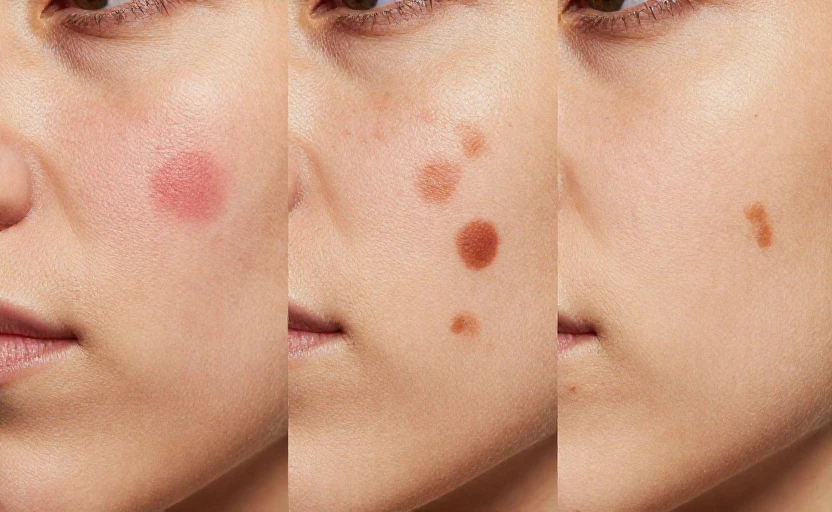
Once the active inflammation subsides, a flat red, pink, or sometimes purplish mark often remains. This is most likely Post-Inflammatory Erythema, or PIE. It’s not a scar in the traditional sense of texture change.
PIE is essentially dilated blood vessels and residual inflammation left behind after the injury of the pimple heals. Imagine the skin around the pore got so inflamed that the tiny capillaries widened. Now that the swelling is gone, those widened vessels are still visible through the skin, creating a red mark.
Key Identifiers for PIE: Flat, red/pink/purple, fades temporarily when you press on it (blanches), common in lighter skin tones but can occur in all.
These marks can last for months, but they are temporary. They will fade on their own as the body slowly repairs the capillaries. Your goal is to support this process with calming, barrier-supporting ingredients and sun protection, as UV exposure can darken and prolong the mark.
Post-Inflammatory Hyperpigmentation (PIH): The Brown or Dark Mark
If the leftover mark is flat but brown, tan, grayish, or black, you’re likely looking at Post-Inflammatory Hyperpigmentation, or PIH. This is also not a true scar, but a change in pigment.
PIH occurs when the inflammation of the pimple triggers the skin’s melanocytes (pigment-producing cells) to go into overdrive. They deposit excess melanin into the area as it heals. It’s your skin’s natural, albeit sometimes overzealous, response to injury.
Key Identifiers for PIH: Flat, brown/tan/gray/black, does not blanch when pressed, more common in medium to deeper skin tones.
Like PIE, PIH is temporary but can be stubborn, sometimes lasting 6 to 12 months or more. Sun exposure is its best friend—UV rays will stimulate more pigment, making the mark darker and more persistent. Consistent, broad-spectrum sunscreen is non-negotiable here.
True Acne Scars: A Change in Texture
True acne scars involve a permanent change in the skin’s texture due to damage to the collagen and elastin fibers during the healing process. They don’t fade on their own with time. There are two main types, and you can even have both in the same area.
Atrophic Scars: Depressions in the Skin
These are the most common type of acne scar. They occur when the skin doesn’t produce enough collagen as it heals, leading to a loss of tissue and a depressed area. They come in a few shapes:
- Icepick Scars: Deep, narrow, and V-shaped, like a small puncture wound. They extend deep into the dermis.
- Boxcar Scars: Wider depressions with sharp, defined edges, similar to chickenpox scars. They can be shallow or deep.
- Rolling Scars: Broad, shallow depressions with sloping edges that give the skin a wavy, uneven appearance.
You can identify these by looking at your skin in angled light (like from a window). The shadows will reveal the depressions.
Hypertrophic and Keloid Scars: Raised Tissue
Less common from acne, these scars result from an overproduction of collagen during healing, creating a raised mass of tissue.
- Hypertrophic Scars: Raised, but stay within the boundary of the original wound.
- Keloid Scars: Grow beyond the original wound’s borders, can be itchy or painful, and are more common on chest, back, and jawline.
How to Care for Your Skin Based on the Mark
Your approach should match what you’re seeing. Treating PIH with methods meant for deep scars is ineffective, and vice versa.
For PIE (Red Marks): Focus on calming inflammation and supporting blood vessel health. Ingredients like centella asiatica, niacinamide, azelaic acid, and licorice root extract can be helpful. Gentle care and patience are key.
For PIH (Brown Marks): The strategy involves inhibiting melanin production and encouraging cell turnover. Look for products with vitamin C, niacinamide, alpha arbutin, tranexamic acid, kojic acid, or retinoids (like adapalene). Sun protection is your most important product.
For True Scars (Texture Changes): Topical products have limited ability to reshape skin. Effective approaches typically involve professional treatments like chemical peels, microneedling, laser resurfacing, or fillers, which aim to stimulate new collagen or fill depressions. A dermatologist can guide you to the best option for your scar type and skin.
Your First and Best Step
If you’re unsure about what you’re seeing, or if your marks are severe and causing distress, consulting a board-certified dermatologist is the wisest move. They can provide a definitive diagnosis and create a tailored treatment plan. Remember, your skin tells a story of healing. Learning to read its chapters—the red flare of PIE, the shadow of PIH, or the texture of a scar—empowers you to support its journey with knowledge and care.