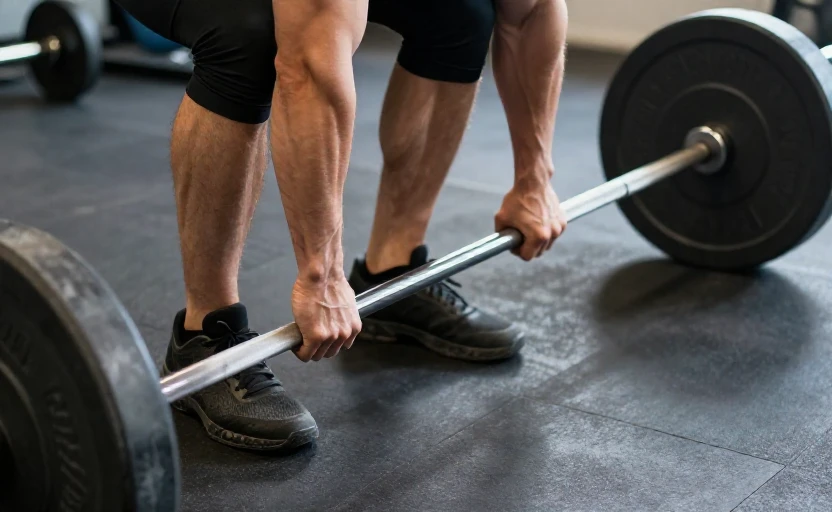
Your deadlift is only as strong as your grip. It’s the single point of contact between you and the bar, the final link in the chain of force you generate from the floor up. Yet, for many lifters, grip is an afterthought—something that fails long before their back or legs give out. The frustration of a bar slipping from your fingers isn't just about lost pounds on the lift; it can stall progress, compromise form, and even lead to injury.
Focusing on your grip isn't about having superhero forearms. It's about creating a secure, efficient connection that allows the rest of your body to do its job. Let's look at three common, often overlooked, grip mistakes that might be holding your deadlift back.
Mistake 1: Relying Solely on a Mixed Grip Too Soon
The mixed grip—one hand overhand, one hand underhand—is a powerful tool. By positioning your hands opposite each other, you prevent the bar from rolling out of your fingers, allowing you to handle heavier weights. The problem isn't the mixed grip itself; it's turning to it as a first resort, before developing foundational grip strength.
When you default to a mixed grip for every working set, you miss the opportunity to strengthen your forearms and crush grip in a balanced way. Furthermore, the underhand position in a mixed grip places a different stress on the biceps and shoulder of that arm, which some lifters find uncomfortable or even risky if not set correctly.
Use your double overhand grip for as many warm-up sets and reps as possible. It’s your grip’s primary training tool.
Think of your double overhand grip as your baseline. Use it for all your warm-up sets and early work sets. Only when the weight becomes truly challenging for your grip should you switch to a mixed grip for your heaviest sets. This practice ensures you're consistently building raw grip strength while still having a secure option for maximal loads.
Mistake 2: Letting the Bar Drift into Your Fingertips
This is a subtle but critical error. Instead of gripping the bar deep in the palm, many lifters allow it to settle high in the fingers, especially as fatigue sets in. A fingertip grip drastically reduces your mechanical advantage. It forces your finger flexors to work much harder to hold the same weight, leading to premature failure. It also often causes the bar to swing away from your body mid-lift, pulling you out of position and straining your lower back.
The correct position is to set the bar directly over the junction of your palm and fingers, right in the crease. Before you even initiate the pull, actively “load” your grip by squeezing the bar as hard as you can, trying to almost bend it across your thighs. This engages the larger muscles of your forearm and creates a more stable, rigid connection.
Mistake 3: Neglecting Your Grip as an Integrated Part of the Setup
Your grip setup isn't separate from the rest of your deadlift form. How you approach the bar, take your grip, and set your lats and back directly influences your grip security. A rushed, disjointed setup often leads to a weak grip.
Here’s how to integrate your grip into a solid setup sequence:
- Position your feet, then hinge down to the bar without rounding your back.
- Grip the bar firmly in the crease of your palm, at shoulder width.
- Without moving the bar, pull the slack out by engaging your lats (imagine squeezing oranges in your armpits) and applying upward tension. This tension should travel through your arms and into your locked grip.
- With everything tight—grip, lats, core, hamstrings—initiate the lift.
When your grip is engaged as part of this full-body tension, it becomes an anchor point, not a weak link. The bar feels like an extension of your body, not a separate object you're trying to clutch.
Building a Stronger Grip, Beyond the Deadlift
If you consistently struggle with grip, some targeted supplementary work can help. The goal isn't to burn out your forearms before deadlift day, but to build resilience over time.
Simple, effective exercises include farmer’s walks (carrying heavy weights in each hand for distance), timed dead hangs from a pull-up bar, and even holding the top position of a dumbbell row for a few extra seconds. These movements train your grip to endure under load, translating directly to a more confident hold on the barbell.
Remember, addressing your grip is about enabling performance and safety. It allows the strength you’ve built in your posterior chain to express itself fully. Pay attention to these three common mistakes—gradually wean off an early mixed grip, anchor the bar deep in your hand, and integrate your grip into your setup—and you might find that the weight you’ve been fighting suddenly feels lighter in your hands.