
You’re working on your squat. You’ve watched the form videos, you’ve practiced bracing, and you’re trying to hit that sweet spot where your hips go below parallel. But something stops you. Maybe it’s a pinch in the front of the hip, or a feeling like the joint is glued. Before you assume it’s a strength issue, consider this: sometimes the problem isn’t weakness — it’s mobility. Specifically, tightness in the hips.
Your hip joints are complex ball-and-socket structures that need enough range of motion in several directions to squat deeply. If the muscles and connective tissues around them are tight, they can literally stop you from descending safely. Here are five specific signs that your hips might be the limiting factor — and what to do about it, without forcing a stretch or risking injury.
1. You Feel a Pinching or Impingement in the Front of the Hip
When you lower into a squat, your femur (thigh bone) needs to slide backward into the hip socket as your hips flex. If the muscles at the front of your hip — particularly the hip flexors (iliopsoas) and the rectus femoris — are short or tight, they can compress the front of the joint. That pinch you feel deep in the groin or front of the hip is often the femoral head pressing against the socket before it’s supposed to.
Safely address it: Avoid squatting into sharp pain. Instead, work on static hip flexor stretching after your workout, and incorporate controlled leg-lowering drills on your back (like a supine march) to gently improve hip extension range.
2. Your Heels Pop Off the Floor, or You Round Your Lower Back
If you find yourself rocking onto your toes or feeling your lower back curl under (posterior pelvic tilt) at the bottom of the squat, tight hips could be the culprit. Specifically, short hip adductors (inner thighs) and a tight posterior capsule can pull your pelvis into a tucked position, which shifts your weight forward and lifts your heels. This isn’t just a form flaw; it’s a safety signal that your hips don’t have the necessary internal rotation or flexion.
Safely address it: practice deep, tempo goblet squats with a light load, focusing on keeping your chest up and letting your knees track over your toes (within your natural line). Use a 2-second descent and pause at the bottom without bouncing. This loads the tissues gently and teaches your brain to trust the range you do have.
3. Your Knees Cave In Excessively on the Way Down
While some knee valgus (inward collapse) can be due to weakness in the glute medius, it can also happen when tight lateral hip rotators (like the piriformis) or a tight iliotibial band restricts the femur’s ability to rotate internally. When your hip can’t internally rotate, your knee often compensates by moving inward — putting stress on the ACL and meniscus.
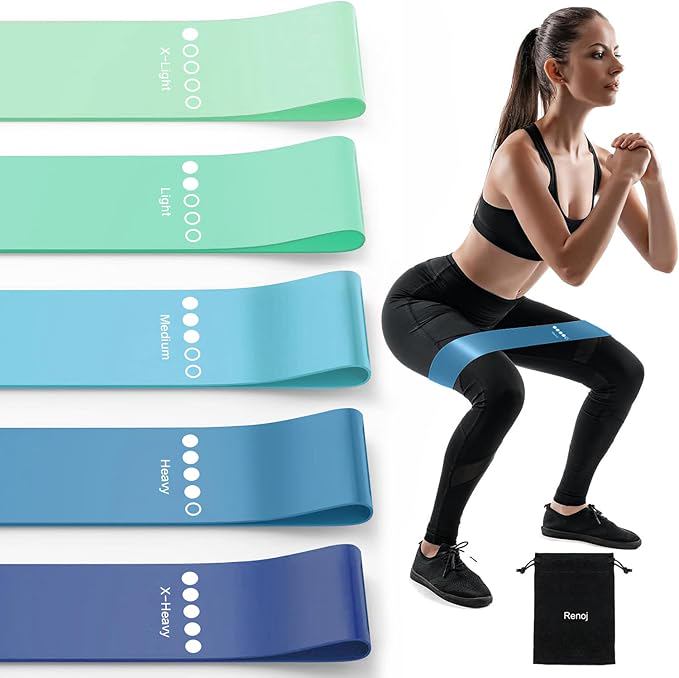
Safely address it: Strengthen your glute medius with banded clamshells or lateral band walks. For the tightness, gentle pigeon pose or a figure-four stretch (held for 30 seconds, no bouncing) can help release the external rotators without overstretching the joint.
4. You’re Unable to Get Your Thighs Parallel to the Floor — or Even Close
This one is straightforward: if your squat stops well above parallel, and it feels like a block in the hip joint rather than a loss of balance or strength, it’s almost certainly a mobility limitation. The limitation can come from tight hip flexors (which limit hip flexion itself) or from tight hamstrings pulling on the pelvis and preventing it from tilting forward enough to let the hips descend.
Safely address it: Instead of forcing a deeper squat, work on hip hinge drills (like a Romanian deadlift) to improve hamstring flexibility, and use a low box or bench to squat to for a few weeks. Lower the box height gradually as your pain-free range improves.
5. Your Squat Feels “Stuck” in the Mid-Range, and You Sway Forward
Some people can get into a decent squat position at the top, but as they cross the halfway mark their chest drops, their torso leans forward, and they have to fight to stay upright. This is often a sign that the hip capsule itself or the deep external rotators (like the obturator internus and gemelli) are limiting the joint’s ability to flex fully. Your body leans forward to create more space in the hip, shifting the load onto your lower back and knees.
Safely address it: Use a wall squat or a dowel rod held overhead to keep your torso upright. This teaches you to keep the weight in your midfoot while giving your hips extra feedback. Follow this with supine hip CARs (controlled articular rotations) — slow, pain-free circles of the hip joint — to butter up the range of motion without force.
If any of these signs sound familiar, it's important that you do not simply force a deeper squat. Pushing into restricted range can strain the hip joint, the labrum, or the lumbar spine. Instead, treat the signs as diagnostic clues. Dedicate a few minutes before each lower-body workout to gentle, controlled mobility work that targets the specific tightness you feel. Over weeks, those small improvements in hip mobility will let you squat deeper, safer, and with much less frustration.