
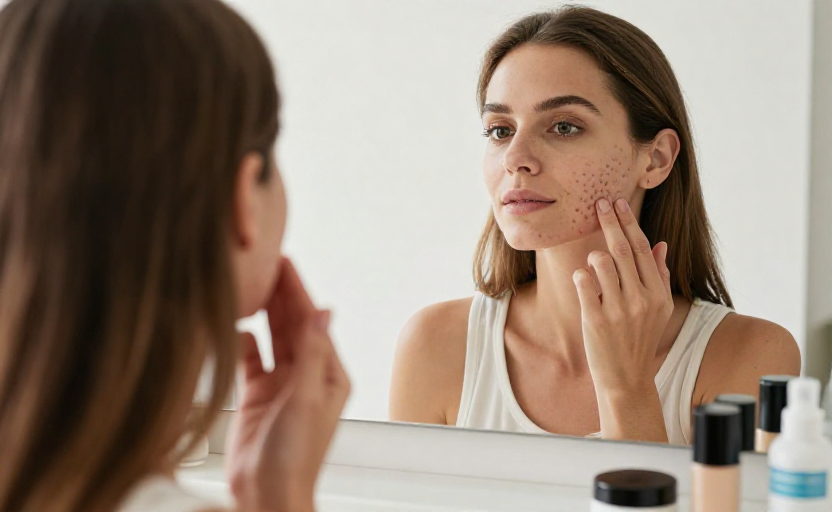
You wash your face morning and night. You change your pillowcase. You might even be using a prescription cleanser. Yet those bumps keep appearing—clustered around your chin, your cheeks, or along your jawline. If that sounds familiar, the culprit might not be your skin. It might be your makeup.
Cosmetic-induced breakouts are more common than most people realize. The challenge is that they do not always look like the pimples you had in high school. Knowing exactly which symptoms signal that your makeup is the trigger can save you weeks of frustration—and help you make smarter choices at the beauty counter.
Clusters of Small Bumps That Appear Days After You Try a New Product
One of the most telling signs of makeup-related acne is timing. You start using a new foundation, concealer, primer, or even a setting spray—and within two to five days, small bumps appear in the areas where you applied that product.
These are not always the angry, red, pus-filled pimples you might expect. More often, they show up as:
- Tiny closed comedones (whiteheads) that give the skin a slightly bumpy texture
- Small flesh-colored papules that feel rough when you run a finger over them
- Uniform bumps clustered in one zone, such as both cheeks or concentrated around the mouth and chin
If the breakouts are spread randomly across your forehead, nose, and back, they are more likely to be hormonal or bacterial. But when the distribution mirrors exactly where you apply makeup, that is a strong signal your foundation or concealer is the problem.
Why This Happens
Many makeup products contain ingredients that can block pores—a category dermatologists call comedogenic. Common offenders include certain silicones (such as dimethicone in high concentrations), cocoa butter, coconut oil, isopropyl myristate, and some waxes. When these sit on the skin for hours under a layer of powder or setting spray, they trap oil and dead skin cells, leading to those telltale small bumps.
Quick check: If the bumps appeared only after you introduced a new product and they line up with your application zones, pause that product for two weeks and see if your skin begins to clear.
Breakouts That Cluster Along the Jawline, Chin, and Cheek Perimeter
Not all makeup-caused acne looks the same, but there is a classic pattern. Hormonal acne tends to target the lower third of the face—the jawline and chin—in deep, cystic nodules. Makeup-related acne often overlaps that zone, but it also creeps into areas that are less typical for hormones alone.
Pay close attention when you see breakouts in these specific spots:
- The hollow of your cheeks (the area that gets the most coverage when you blend foundation)
- Along the jawline and under the jaw (where foundation often settles or is not fully blended)
- Around the mouth and corners of the nose (where concealer and foundation tend to pool)
- Near the hairline and temples (a common spot for breakouts triggered by tinted moisturizer, BB cream, or hair styling products that migrate onto the skin)
This pattern makes sense when you think about how you apply makeup. Most people start in the center of the face and blend outward. The edges—jawline, hairline, and sides of the face—often get the most product buildup, especially if you are layering foundation, bronzer, and blush in the same area.
Blackheads and Whiteheads That Return in the Same Spot After Every Wash
Occasional breakouts happen to everyone. But when you notice the same pore getting clogged over and over—a blackhead on your left cheek that clears and comes back, or a whitehead that forms in the exact same spot on your chin each week—makeup could be the reason.
This repetitive pattern is distinct from a random pustule or a cystic lesion that moves around. It suggests that something you are applying to that area is constantly re-clogging the follicle.
Common triggers for this stubborn type of comedonal acne include:
- Heavy concealers used daily to cover a blemish (creating a cycle: cover, clog, breakout, cover again)
- Setting powders that contain talc or starch and get ground into the pores over the course of the day
- Makeup sponges and brushes that are not cleaned frequently—old product and bacteria transfer directly onto clean skin
- Lip products that migrate beyond the lip line (ingredients in lip gloss and lipstick can clog the pores around the mouth)
Tip: If you have a stubborn blackhead that returns in the same spot within a few days of clearing, try skipping makeup on that specific area for one week. If the blackhead stays gone, your makeup is likely the driver.
What to Do If You Suspect Makeup Is Causing Your Breakouts
Before you throw away your entire collection, take a methodical approach. Stopping all cosmetics cold turkey can be frustrating, especially if you rely on makeup for work or confidence. Instead, try these steps:
- Identify the newest product. Look at what you added to your routine in the two weeks before the breakouts started. That is your top suspect.
- Read the label for comedogenic ingredients. Cocoa butter, coconut oil, isopropyl myristate, and isopropyl palmitate are high on the list. Lanolin and some waxes can also be problematic.
- Switch to a non-comedogenic version. Look for labels that say “non-comedogenic,” “oil-free,” or “won’t clog pores.” Mineral-based powders are often safer for acne-prone skin because they contain fewer pore-blocking ingredients.
- Wash your brushes weekly and replace sponges every four to six weeks. Bacteria buildup is a common overlooked cause of persistent bumps.
- Give your skin a break. If possible, go without makeup for three to seven days. This is the clearest test: if the bumps start to flatten and fade during a makeup-free period, you have your answer.
Acne is frustrating, but understanding the signals your skin is sending makes a difference. When you know that clustered small bumps, patterned breakouts along your application zones, and repetitive clogs in the same pore are all linked to makeup, you can act with confidence—not guesswork.
Your skin is not betraying you. It is telling you that something in your routine needs adjusting. Listen to it, and your complexion will thank you.