
You’ve been sticking to your plan — eating what you think is less, moving more — yet the scale refuses to budge. Before you assume your metabolism has failed or that weight loss is simply impossible for you, consider this: the stall might not be a plateau at all. It might be a calorie deficit misconception.
Many people believe that a calorie deficit is a simple, linear equation: eat fewer calories than you burn, and the pounds will drop week after week. But the reality is more nuanced. The body adapts, hunger signals change, and many of us inadvertently overestimate our deficit — or misunderstand what a deficit actually feels like. Here are three signs that your so-called plateau is actually a misunderstanding of your calorie deficit.
1. You feel excessively hungry or fatigued most of the time
It’s natural to feel some hunger when you’re in a true, moderate calorie deficit. But persistent, gnawing hunger or constant fatigue is not a badge of honour; it is usually a sign that your deficit is too large or that you are not giving your body enough of the right fuel. When the body senses a sharp drop in available energy, it responds by lowering your metabolic rate and increasing hunger signals. This can lead to a biological sabotage of your efforts — you might eat back the deficit without realizing it, or lose lean muscle mass instead of fat.
A moderate deficit that supports steady fat loss should not leave you feeling drained or ravenous all day. If it does, your approach may need recalibrating.
Instead of slashing calories further, consider whether your food choices are nutrient-dense enough. Protein, fibre, and healthy fats help sustain satiety and energy levels. A deficit that works on paper may fail in practice if it leaves you too hungry to stick with it — or causes you to unknowingly compensate later.
2. Your workouts feel harder and you’re not recovering well
When you are in a genuine but sustainable calorie deficit, your performance in the gym usually remains stable or drops only slightly. But if you notice that your usual weights feel heavier, your recovery takes longer, or your motivation to exercise has plummeted, these are red flags. The body requires adequate energy to repair muscle tissue and maintain training intensity. If your deficit is too aggressive or mis-timed, your body will prioritize survival over muscle preservation and performance.
Many people confuse the feeling of a hard workout with the feeling of being under-fueled. If you are constantly battling fatigue during exercise and not seeing body composition changes, the issue might not be that you are eating too much — but that you are not eating enough to support your activity level. A true calorie deficit should still allow you to perform your workouts and wake up feeling reasonably refreshed the next day.
3. You’re losing inches or clothes fit differently, but the scale isn’t moving
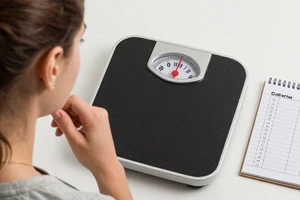
This is one of the most common calorie deficit misconceptions: weight loss is not always the same as fat loss. If you are exercising, particularly with strength training, you may be gaining muscle while losing fat. Muscle is denser than fat, so the scale might stay the same even as your waistline shrinks. This is a positive sign that your deficit — and your training — are working exactly as intended, but it can look like a “stall” if you rely only on the number on the scale.
If you notice that your clothes are looser, your body composition is changing, or your energy levels remain stable, then your deficit is likely appropriate. The problem is not the deficit itself but the metric you are using to measure success. Track measurements, progress photos, and how your clothes fit alongside the scale to get a fuller picture. A stall on the scale that coincides with visible body changes is actually a win, not a failure.
Why a deeper calorie deficit is rarely the answer
When weight loss slows, the typical reaction is to cut calories further. But this often backfires. A very low calorie intake can trigger adaptive thermogenesis — a metabolic slowdown that makes further loss harder and weight regain more likely. Instead of eating less, consider whether you are truly in a deficit. Common errors include underestimating liquid calories, portions of calorie-dense foods like nuts or oils, and mindless snacking. Using a food diary for a few days — honestly — can reveal whether your deficit is real or imagined.
Alternatively, look at your non-diet factors. Sleep quality, stress levels, and hydration all influence hormones like cortisol and insulin, which affect fat storage and appetite. A weight loss stall may be a signal to focus on recovery and lifestyle habits rather than slashing calories.
Takeaways for a true, sustainable deficit
The goal is not the largest possible deficit, but the smallest effective deficit that allows consistent fat loss without starving your body or your spirit. If you see any of these three signs, resist the urge to cut further. Instead, reassess your nutrition quality, your activity level, and your recovery. Sometimes the best way to restart progress is to eat a little more — not less.