
Building a home gym is an exciting step toward taking your strength training seriously. But when you start looking at barbells, the options can feel overwhelming. Do you need a $600 Olympic bar, or will a standard budget model do the job? The wrong choice can stall your progress or, worse, lead to an injury. To help you cut through the noise, we’ve distilled the selection process down to three fundamental, expert-backed tips for choosing your first home gym barbell.
Tip 1: Match the Barbell to Your Space and Flooring
Before you even think about grip or knurling, ask yourself one question: where will this bar actually hit the floor? A dropping barbell can destroy concrete and render your home gym unusable. If you are training in a garage, basement, or spare room on a hard surface, the bar’s weight rating and shaft diameter matter less than your floor protection plan.
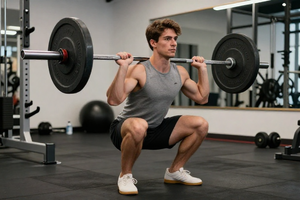
You have two realistic paths here. The first is to buy a quality 7-foot Olympic barbell (the standard 20-kilo/45-pound men’s bar or the slightly shorter 15-kilo/33-pound women’s bar) and pair it with a proper deadlift platform or heavy-duty rubber crash mats. The second, often smarter option for beginners, is a specialty bar like a trap bar (hex bar) or a 5-foot “short” Olympic bar. These allow you to stand inside the load and perform deadlifts or holds without the bar having to travel past your feet and slam down. If you plan to do Olympic lifts like clean and jerks, you absolutely need high-quality bumper plates and a platform—those lifts demand a bar that can spin freely and handle repeated drops.
A key trade-off: longer bars (standard Olympic) give you better versatility for bench press and squats, but shorter bars (trap bar) are kinder to your lower back and the floor. Choose based on your primary lifts and your willingness to invest in floor protection.
Tip 2: Check the Spin and the Knurling — Not Just the Price
Many first-time buyers grab the cheapest bar they can find, only to discover it rusts quickly, has a sticky rotation, or chews up their hands. Your barbell is the heartbeat of your strength training—you will touch it thousands of times. Spend the extra $50 to $100 to get something that feels right.
Focus on two features. First, the shaft finish. A bare steel bar offers the best grip but will rust if you don’t wipe it down after every session. A zinc, chrome, or black oxide coating is more forgiving in humid basements. Avoid painted bars; the paint flakes off and creates a slippery surface. Second, the knurling. You want a medium-depth knurl (the crosshatch pattern on the shaft). Too passive and your hands slip during heavy deadlifts. Too aggressive, and you will lose skin on your shins and palms. Some bars use a “dual knurl” with marks for both Olympic and powerlifting hand placement—very helpful for a beginner learning to set up consistently.
Spin is critical only if you plan to do Olympic lifts (snatch, clean and jerk). For general strength training—squats, bench, rows, deadlifts—too much spin in the sleeves is actually a nuisance. Look for a bar with bronze bushings rather than needle bearings for a balance of durability and moderate spin.
- Best for powerlifting (squat/bench/deadlift): 28.5mm to 29mm shaft diameter, moderate knurling, low-sleeve spin.
- Best for Olympic lifting (snatch/clean): 28mm shaft diameter, passive knurling, high-sleeve spin.
- Best for general fitness (curls, presses, circuits): 28.5mm bar with a center knurl (helps the bar stay put on your back during squats).
Tip 3: Learn the Load Limit — Know Your Real Numbers
A standard 1-inch chrome bar found at big-box stores is fine for light dumbbell curls, but it will bend or snap if you load 300 pounds onto it for deadlifts. Your first home gym barbell must be rated for the weight you will actually lift within the next 12 months, plus a safety margin.
Olympic barbells all have a 2-inch diameter sleeve that accepts standard bumper plates. They are typically rated to at least 700 pounds (for budget models) and up to 1,500 pounds for high-end competition bars. For 90% of home gym users, a bar rated to 1,000 pounds or more is overkill but gives peace of mind. The practical advice: do not buy a bar with a tensile strength of less than 150,000 PSI (or a weight rating under 800 pounds) if you ever plan to deadlift more than 250 pounds. The bar will develop a permanent bend after a few heavy sessions.
You also need to consider the whip—how much the bar flexes under load. A stiffer bar (powerlifting style) is better for the bench press because it doesn’t wobble. A whippier bar (Olympic style) is better for the clean because it absorbs force. For most beginners, a medium-stiffness bar with a tensile strength around 190,000 PSI is a sweet spot: it will last for years and handle anything you throw at it.
Choosing your first home gym barbell doesn't require a degree in metallurgy. Focus on your space, your primary lifts, and the weight you realistically expect to handle. A good 7-foot Olympic bar with a moderate knurl and a 150,000+ PSI rating will serve you well through years of strength training. If you have the budget, add a trap bar for deadlifts—it saves your floor and your lower back. Invest in a bar that fits your home, your hands, and your goals, and every rep you take will feel solid from the ground up.