Stepping into the world of strength training is an empowering decision. You’re building resilience, not just muscle. Yet, in those early sessions, the focus often shifts to the weight on the bar or the number of reps, while the silent language of your form goes unheard. Learning to listen to that language—to recognize when your body is signaling distress rather than effort—is your most powerful tool for staying safe and making progress.
While some muscle soreness is expected, pain that feels sharp, joint-focused, or persistent is a different story. The real warning signs are often subtler than acute pain; they are patterns of movement that, repeated over time, create undue stress on tissues not designed to bear the load. For beginners, two specific signs are incredibly common and highly predictive of future trouble. Catching them early can completely change your training trajectory.
Warning Sign #1: The Dominant Joint Takeover
This is perhaps the most frequent pattern we see in new lifters. Your body is a brilliant compensator. When a primary muscle group is weak, fatigued, or you’re simply unsure how to engage it, your nervous system will recruit other, often smaller, joints to do the heavy lifting. You’re not doing this on purpose—it’s an automatic, inefficient strategy to complete the movement.
You’ll see it manifest in specific ways:
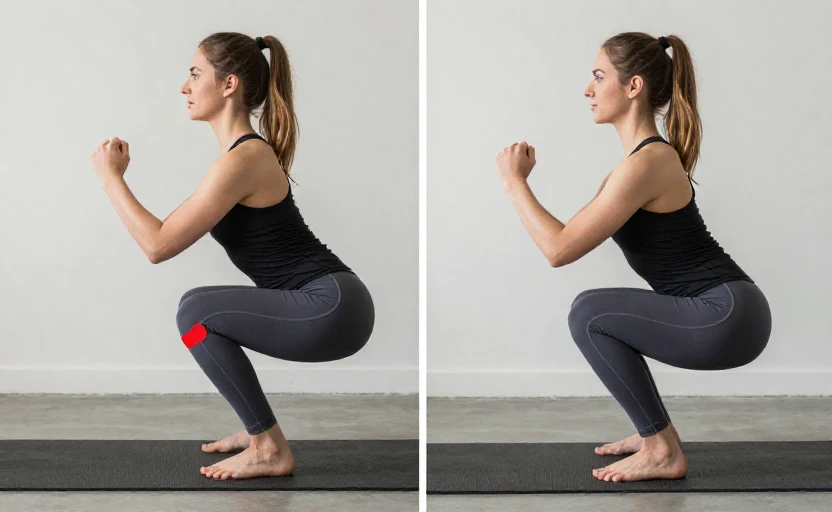
- During squats or lunges: Your knees cave inward (a movement called valgus) as you stand up. This isn’t just a knee issue; it often signals weak glutes or poor engagement of the outer hip muscles, placing dangerous rotational stress on the knee ligaments.
- During overhead presses or push-ups: Your lower back arches excessively, and your ribs flare out. This is your spine taking over for a lack of core stability and shoulder mobility, compressing the lumbar vertebrae.
- During rows or deadlifts: Your shoulders hike up toward your ears, and you feel the pull mostly in your neck. This is your upper traps and neck muscles hijacking a movement meant for the larger muscles of the mid-back and lats.
The goal of good form isn't perfection—it's directing force to the structures built to handle it.
This takeover creates a dangerous mismatch. Large forces generated by moving weight are channeled through smaller, stabilizing joints not meant to be the prime movers. The result is cumulative wear on tendons, ligaments, and cartilage, leading to overuse injuries like tendonitis, joint pain, and chronic inflammation.
Warning Sign #2: The Breath and Brace Breakdown
If the first sign is about where the movement happens, this one is about how the body is supported from within. Proper intra-abdominal pressure—created by bracing your core—is the foundational pillar of safe lifting. It stabilizes your spine like a tightly inflated cylinder, protecting the vertebrae and disks.
For beginners, the breathing pattern is often reversed or forgotten. The telltale signs are clear:
- You inhale as you lower the weight and exhale sharply as you lift, losing all tension in your midsection at the moment you need it most.
- You hold your breath entirely, turning red in the face, which can spike blood pressure dangerously (the Valsalva maneuver, when done uncontrolled).
- You simply forget to brace, leaving your spine vulnerable to flexion or extension under load, a primary cause of disc-related injuries.
Without this internal brace, your spine becomes a column of loosely stacked blocks trying to support a heavy load. The force transfers directly to the passive structures of your back. You might complete the rep, but at a significant cost to spinal integrity.
How to Rebuild Your Foundation
Correcting these signs doesn't require less weight; it requires more awareness. Start by practicing the movement pattern with no weight at all. For the Dominant Joint Takeover, focus on “kinesthetic feel.” In a squat, consciously push your knees outward throughout the movement. In a row, initiate the pull by imagining squeezing a pencil between your shoulder blades. The goal is to wake up the connection between your brain and the correct muscles.
For the Breath and Brace Breakdown, practice bracing without weight. Take a deep breath into your belly, not just your chest. Then, as if you were about to be gently punched in the gut, contract your entire core—front, sides, and back—while maintaining that breath. This is bracing. Practice exhaling with control against this tightness. This skill is non-negotiable for safe loading.
Building Habits That Last
The journey from beginner to confident lifter is paved with mindful repetitions, not heroic one-rep maxes. Prioritize quality over quantity every single session. It is far more productive to perform three sets of eight perfect, controlled reps than five sets of twelve sloppy, painful ones.
Consider filming your sets from the side. The camera doesn’t lie and can reveal shifts and compensations you don’t feel. Review the footage with a critical, kind eye, looking for those two warning signs. Better yet, invest in a session or two with a qualified trainer who can provide real-time feedback. This isn’t a sign of weakness; it’s an acceleration of your learning curve.
Finally, respect the difference between discomfort and pain. Muscle fatigue, the burn of a working set—these are normal. Sharp, pinching, or radiating pain is a command to stop. Your form is your first line of defense. By learning to spot these two warning signs, you’re not just avoiding injury; you’re building a stronger, more resilient body capable of handling the challenges you give it for years to come.